


We have been in Berlin since Sunday, what an amazing city. I have not been here since 1965 and there is no question that this city has had a transformation. When I was here most of the buildings were bombed out facades and the streets were a wreck, all broken up. It was worth your life to walk around and not sprain an ankle there were so many holes in the sidewalk.
Checkpoint Charlie is now preserved exactly where it stood. It brought back memories of going over to the East Side and being warned to stay in our group and not to say anything, just go to the museum, and do not take pictures. This is where I saw Queen Nephrite’s statue and was completely in awe of it. It is still here today.


What I saw then on the East side was a lot of Soviet style grey apartments and buildings ,also bombed out, but everything was in worse shape. Today it is hard to tell the difference or where the wall was. There are remnants and cobblestone placed along the street to remind us of this. We visited Bernauer Street where the apartments were right on the wall. People were jumping from the windows until the East German police bricked up all the windows and put barbwire on the roof. They evacuated the apartment houses and eventually put up a wall behind the apartments. Then they demolished the apartments and between the new wall and on the site of the apartments they built a higher wall, creating a no man’s land between. Having lived through this era, seeing the pictures on TV, and reading the descriptions and pictures at the wall with the guard tower, it all brought back many memories.


Looking through the wall to the East Side today
According to someone we talked to, you can still see the influence and feel the difference in the East side of Berlin from the West even today. He also said that each sector (the American, French and British) that was developed after the war has a distinct flavor.To me, Berlin looks completely modern with small reminders and government buildings that remain the same.


Apparently, Berlin has the least amount of cars as any city and I would say this is true. They have the most amazing bike lanes, which protect you from the traffic. It seems that everyone is on a bike. There are bikes with carriers in the front for small babies and groceries. There people going to work, riding in the Tiergarten but the hardest thing was staying out of the bike lane, as a pedestrian you share the sidewalk with the bikers.


We had the most moving experience at the Jewish Museum. There is one tribute near the Brandenburg Gate that you will see below. These rectangular stones form a maze that you walk in and out of, no names just a silent walk through them. Below them is a museum dedicated to the Holocaust where some of the displays hang in corresponding shape to the stones above as if they came through the roof. There are stories of families with some surviving relatives who gave photographs. Everyone walked in silence and reverence.
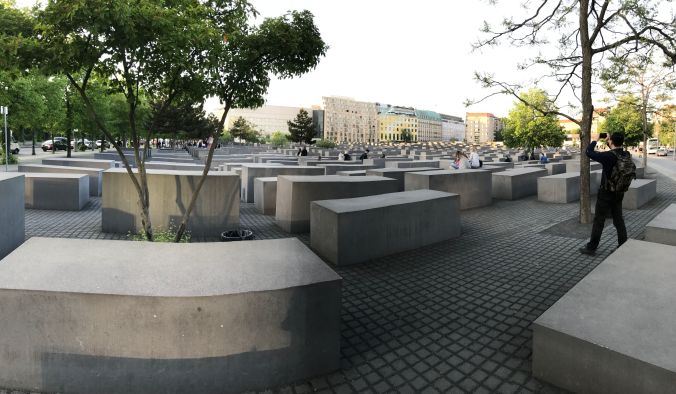
Thinking that there could not be a more moving experience, we still went to the actual Jewish Museum and we were both completely in awe of this entire experience. I want to quote the architect because I cannot describe in anyway what he puts into words:
For Libeskind, “The new design, which was created a year before the Berlin Wall came down, was based on three conceptions that formed the museum’s foundation: first, the impossibility of understanding the history of Berlin without understanding the enormous intellectual, economic and cultural contribution made by the Jewish citizens of Berlin, second, the necessity to integrate physically and spiritually the meaning of the Holocaust into the consciousness and memory of the city of Berlin. Third, that only through the acknowledgement and incorporation of this erasure and void of Jewish life in Berlin, can the history of Berlin and Europe have a human future.”[13] A line of “Voids,” empty spaces about 66 feet (20 m) tall, slices linearly through the entire building. Such voids represent “That which can never be exhibited when it comes to Jewish Berlin history: Humanity reduced to ashes.
Most of the exhibit is underground and brings you from an existing building to a steel and concrete modern building with a few windows. Most of the time you are underground until you climb stairs leading to an exhibit of the Jewish history through time.
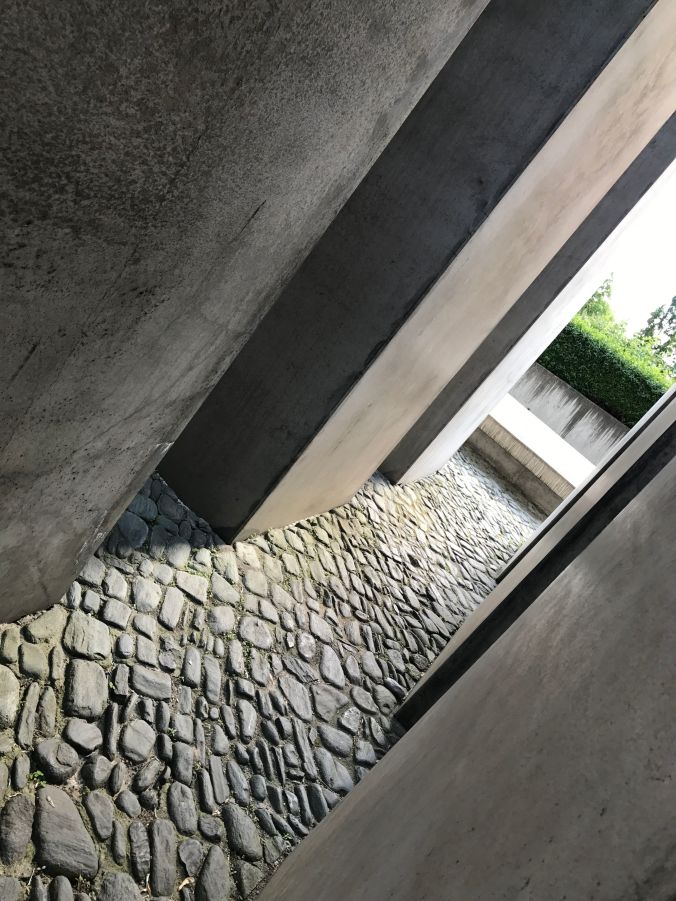
Garden of Exile
The floors are slanted giving you a sense of imbalance while you stand in the “Void,” the intersecting empty spaces. But even more disconcerting is the “Garden of Exile.”I took this picture this way so that you would have the feeling of what it is like to walk in this Garden.
To demonstrate the feeling the Jews felt when arriving in new countries, having gotten out of Germany in the 1930’s, the garden is built with an upward slant from where you enter and a tilt to the right. Again there are large concrete pillars with trees planted on top for you to walk through. Only this time you are never on sure footing, you always feel like you will topple over. So you not only experience this exile emotionally, but physically.


Garden of Exile
The “ Holocaust Tower” was even more poignant. I thought I was going into a tower to climb up, but instead entered a completely dark triangular room with a sky light built into the ceiling creating a slice of light directed downward to illuminate only a bit of the room. You could hear the traffic and sounds from outside, but you were standing in a black void with a bit of grey from the light. To me, it created a feeling of what the gas chambers must have felt like. To Shap, it was very spiritual. The walls leading to the light at the top was enlightening for him, that there was hope. So you see, how we interrupt our experiences different. Some people peeked in and left, I think feeling nothing. Shap and I stayed there for a long time. I am glad he saw hope, I saw the void of nothingness, of despair.
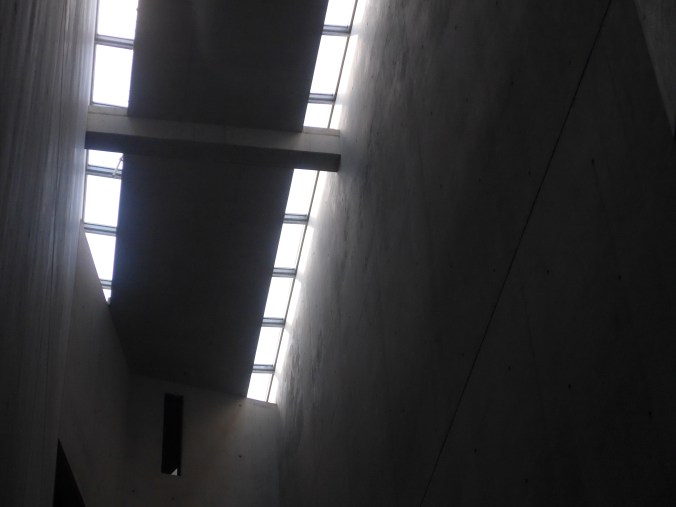
Holocaust Tower
There were three exhibits that left Shap and I with indelible memories, the two I just mentioned and the third was called “Fallen Leaves” but I think it should be called “10,000 Faces.” Here is the description:
Installation Shalekhet – Fallen leaves[
10 000 faces punched out of steel are distributed on the ground of the Memory Void, the only “voided” space of the Libeskind Building that can be entered. Israeli artist Menashe Kadishman dedicated his artwork not only to Jews killed during the Shoah, but to all victims of violence and war. Visitors are invited to walk on the faces and listen to the sounds created by the metal sheets, as they clang and rattle against one another.
You have no concept of what this does to you emotionally. You can see the picture below and then perhaps it will hit you as it did us. These metal faces are in a triangular room, again with a shaft of light, and they are all piled up on each other. It reminds you of all the pictures that you have seen of the murdered Jews laying on top of each other. One face on top of another, on top of another, scattered throughout the room, 10,000 of them. And as you walk on them the noise of the metal sounds like screams, you think to yourself, I am walking on the dead, I am hearing them screaming for us to remember them. Shap thought that the sound was of breaking glass, that it was spiritual and the contrast of walking from the light into the dark corner affected him. But this installation did not just remind one of the Holocaust, but of the thousands of people being killed by terrorists, by dictators, by ISIS. It is horrifying how genocide continues through the ages.
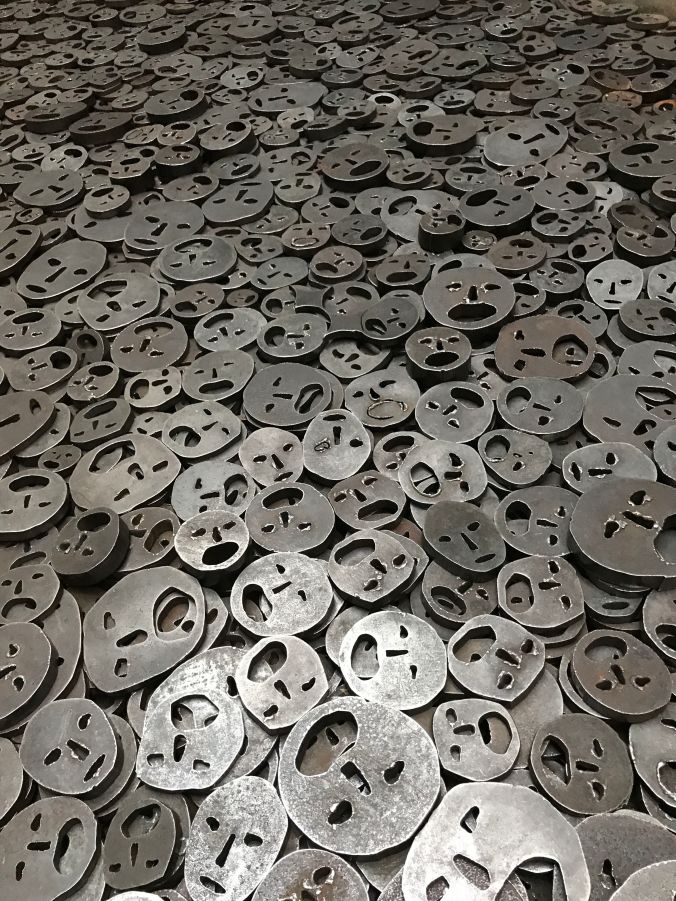
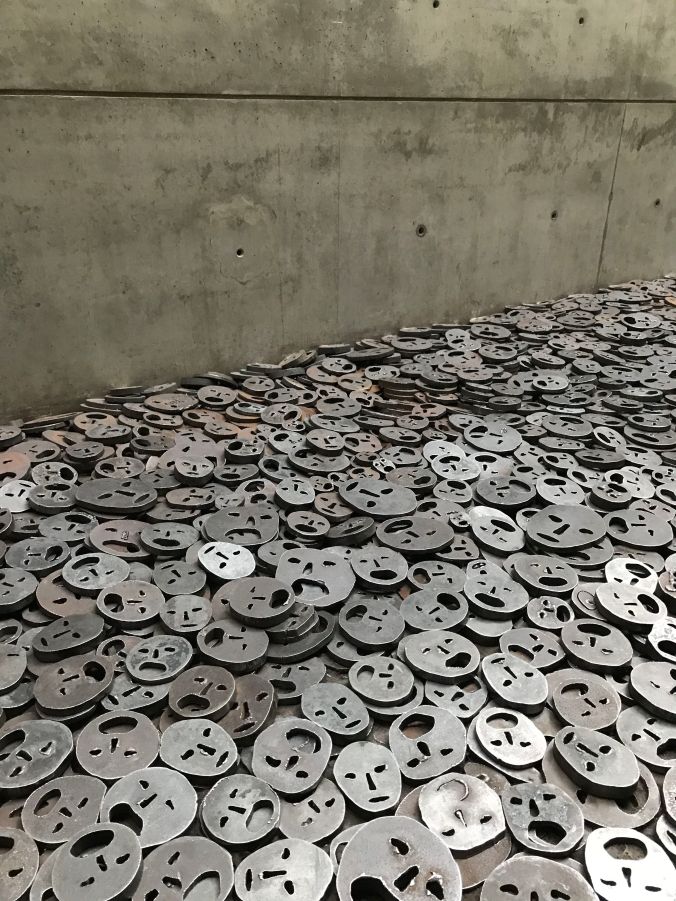
This says it all, I think.
We left the museum after three hours completely in awe of the architect and the artist that could create such an emotional experience by steel, concrete, and metal. The other exhibits are amazing but Libeskind created a masterpiece. If you never go to another museum, this one should never be missed.
 Go wild with the Smith's
quite an experience. Been to the memorial in Israel but this sounds pretty emotional too.
LikeLike