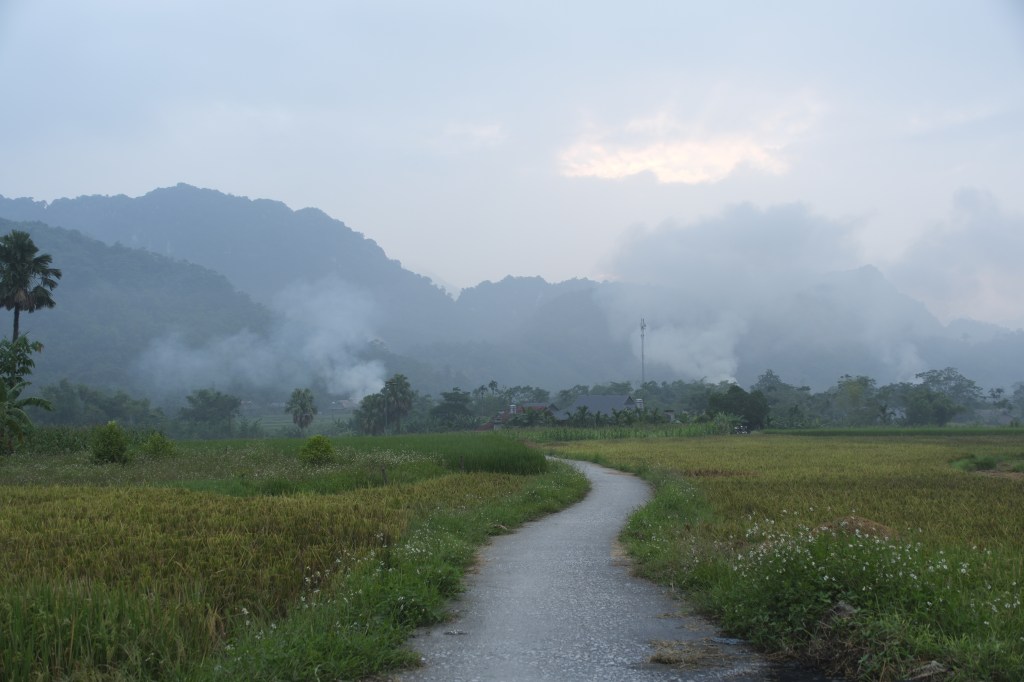
We are now on the coast about three hours from Hanoi in Minh Chau on the China Sea. This is the extension part of the trip, two people have left us. It is very hot and humid. This heat brings memories of summer days in Gettysburg with the humidity and heat shimmering off the pavement and grass. I hate this kind of heat. It takes everything you have to function in it. And getting out of the air conditioned van into the sweltering heat is not for the faint of heart.
After about 3 hours we arrived in a small village whose speciality is making incense. They are known for the black incense which they apply by hand. The black incense is used for greeting in the New Year and other ceremonies. The red incense which smells more like cinnamon is done by machine and is used more widely. It seems villages around Vietnam have their own specialities. Some make cinnamon bark from the trees, others work turning trees into plywood, today’s village made incense which is exported all over the world. Drying in the sun are rows and rows of these incense sticks, while others form a beautiful round shapes. The black incense has a red center.
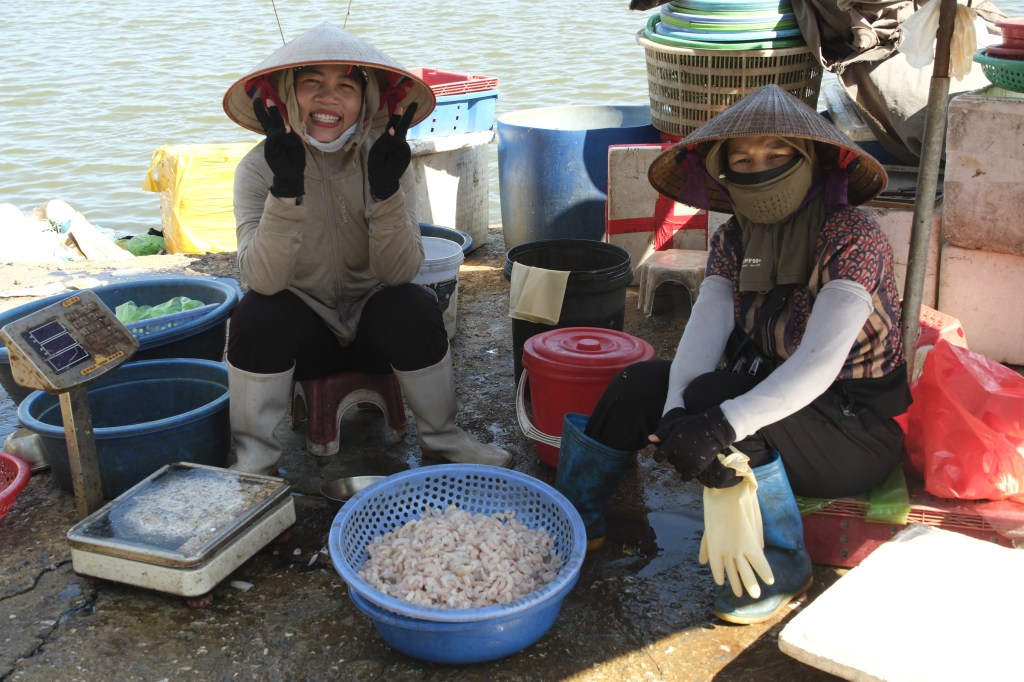
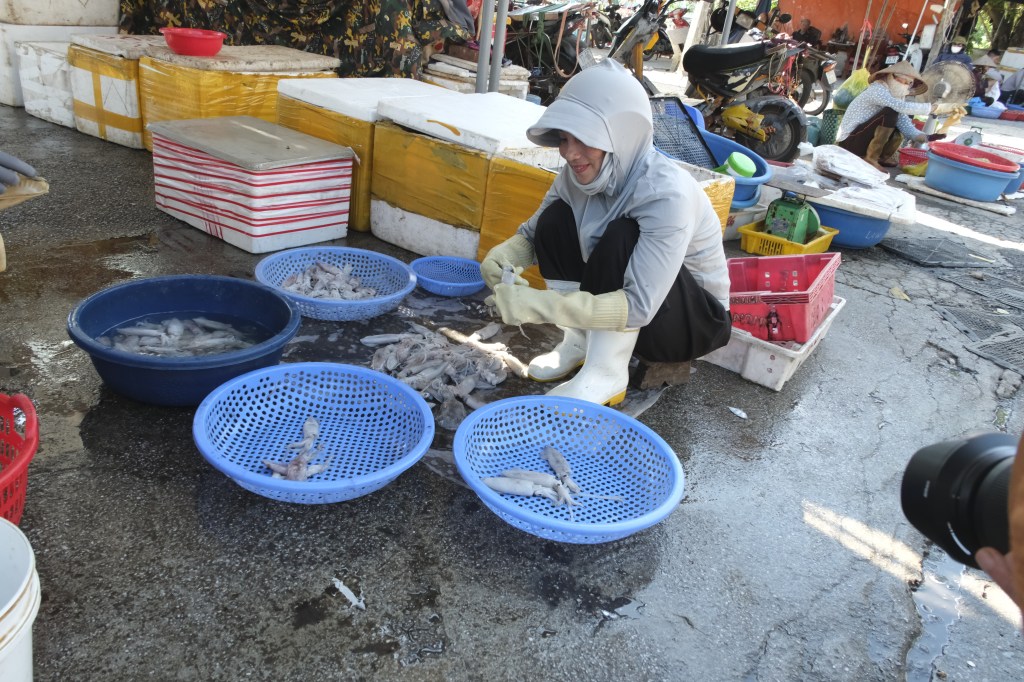
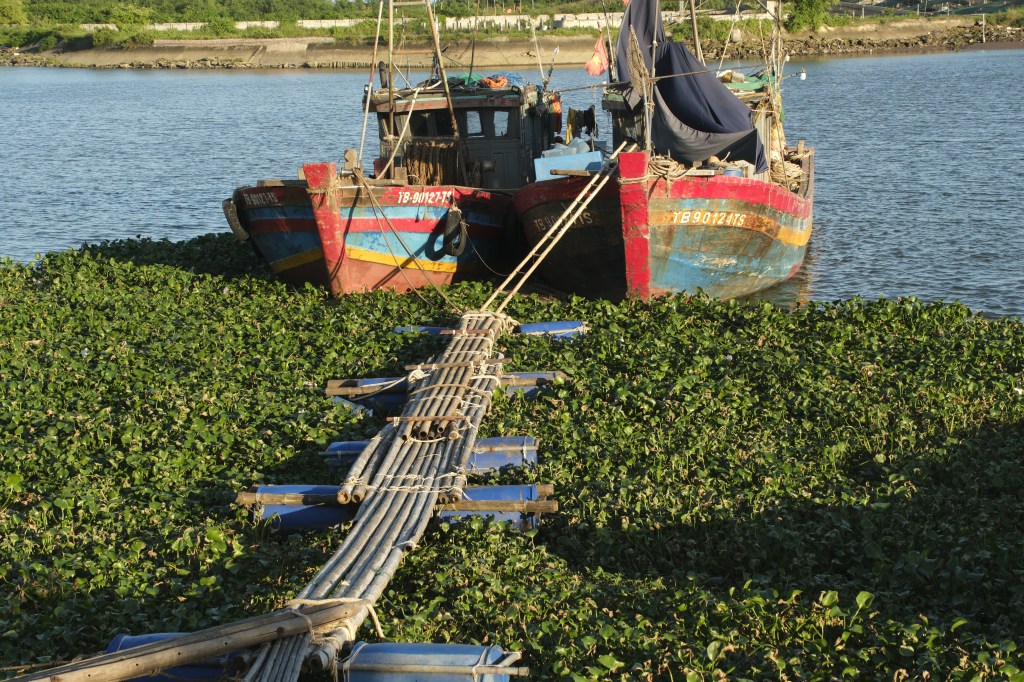
After walking around the village we piled into the van and took off for a fish market. This was along the coast with brightly painted fishing boats tied up at wharfs that were made from old boats. I brought my small sproket printer and had fun giving out photos. We spent quite a while photographing people, and looking at an assortment of fish. We returned later in the day to photograph the fishing boats that had come in, but there were few people around.
We were there for about 40 minutes and our guide caught up with us to inform us the police had insisted we stop photographing as we were near the South China sea and the border. Photographing was not allowed. We only got a warning, no jail for us.
Tomorrow we are up for the dawn patrol. a silk weed farm, and more photographing. This will be our last day. It has been an amazing trip. We have been where no tourists have gone and had many unique experiences. We have had the opportunity to engage with the local people, get our picture taken with many of them, and to enjoy a truly authentic experience. Vietnam is an amazing beautifu country. I feel better having been here and received an education on how Vietnam has pulled itself up after the war and to feel the warm friendly people acceptance of us has been an eye opener for me. I still think about what we did to these people and this country, how we poisoned them with Agent Orange and killed their families. I do not think I would be so welcoming.
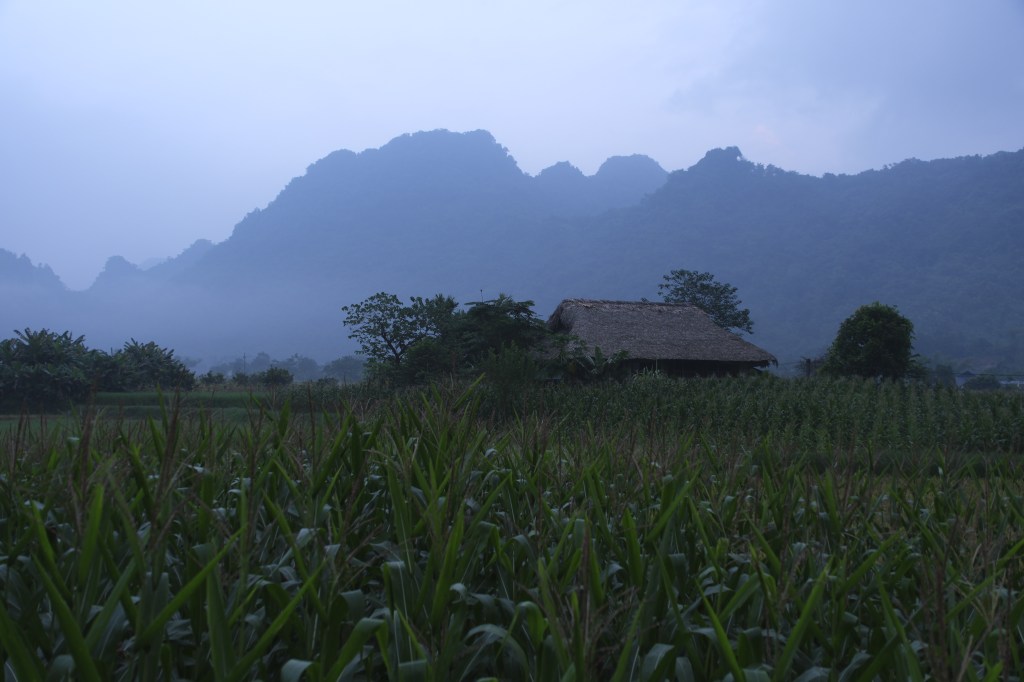
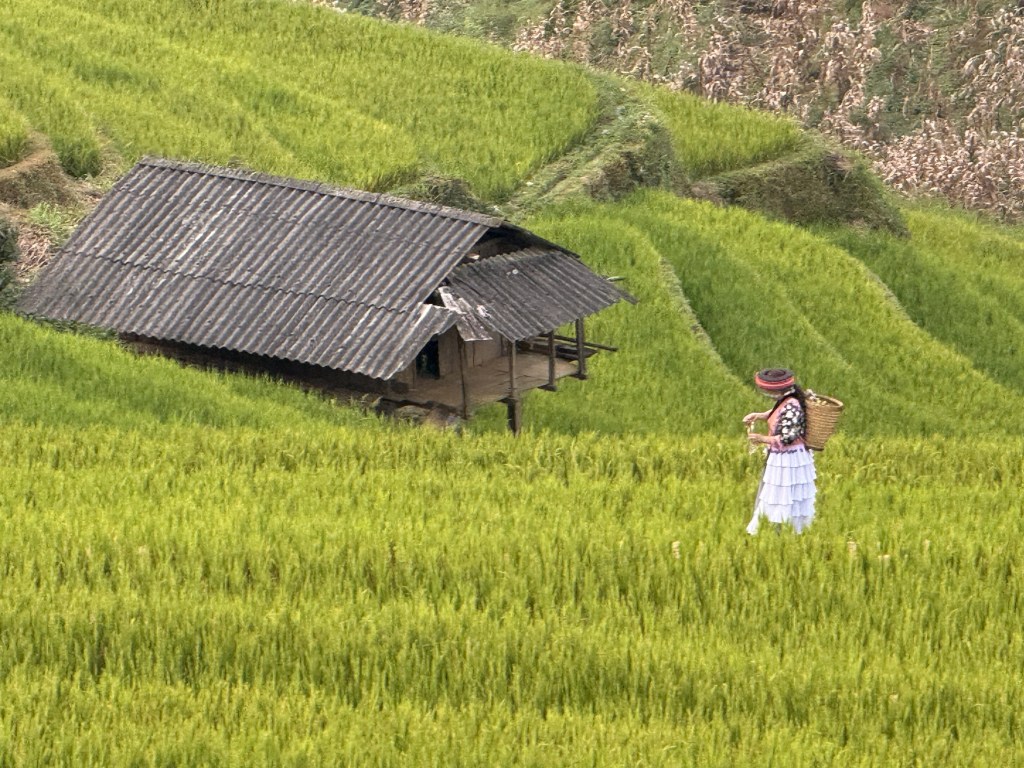
We have been up since 4:30 AM on the dawn patrol. However, dawn does not come until 5:15. We are in a completely different environment than the northern part of Vietnam. This area is populated by the Thai people, who are not from Thailand. However, the Thai influence is very strong. The houses have thatched roofs, and are built up on stilts with the living area above. Talk about an open floor plan. There is not a wall anywhere on the second floor and few support beams as the roof carries most of it. For privacy, which there is none, the parent’s bed has a curtain around it. No furniture except cushions and low tables.
Yesterday we walked to a “swimmng hole” which was fed by a natural mountain spring. I expected the water to be cold, it wasn’t as cold as the water in Vermont. It was refreshing after walking two miles in the heat and humidity to get there. The “ladies” demonstrated our Olympic synchronized team swimming abilities for the men in the group. They would not join us. No fun at all.
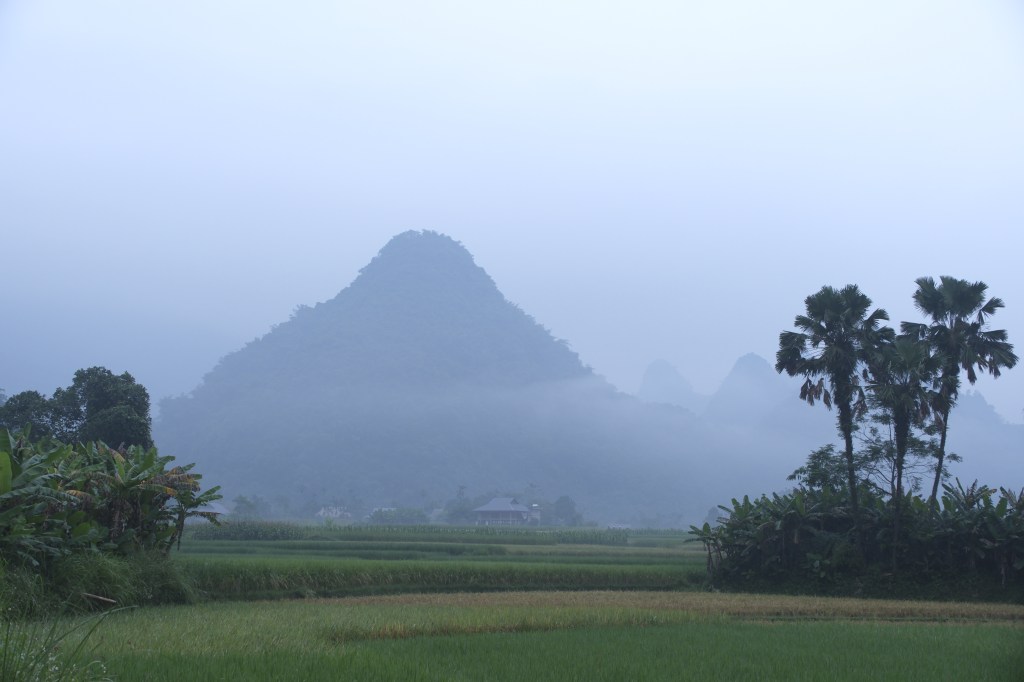
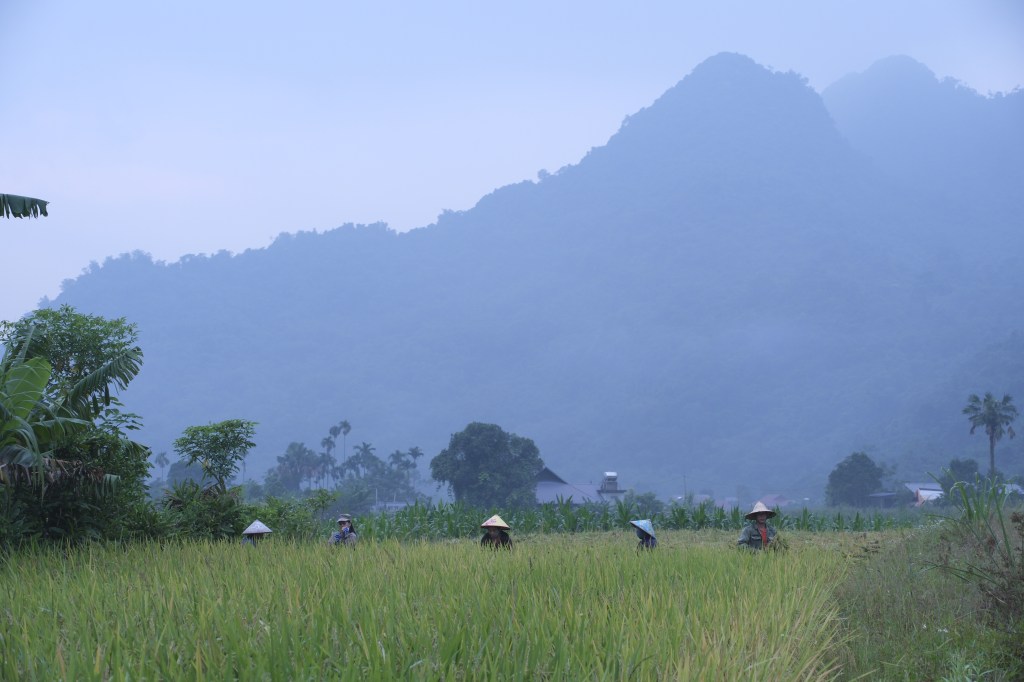
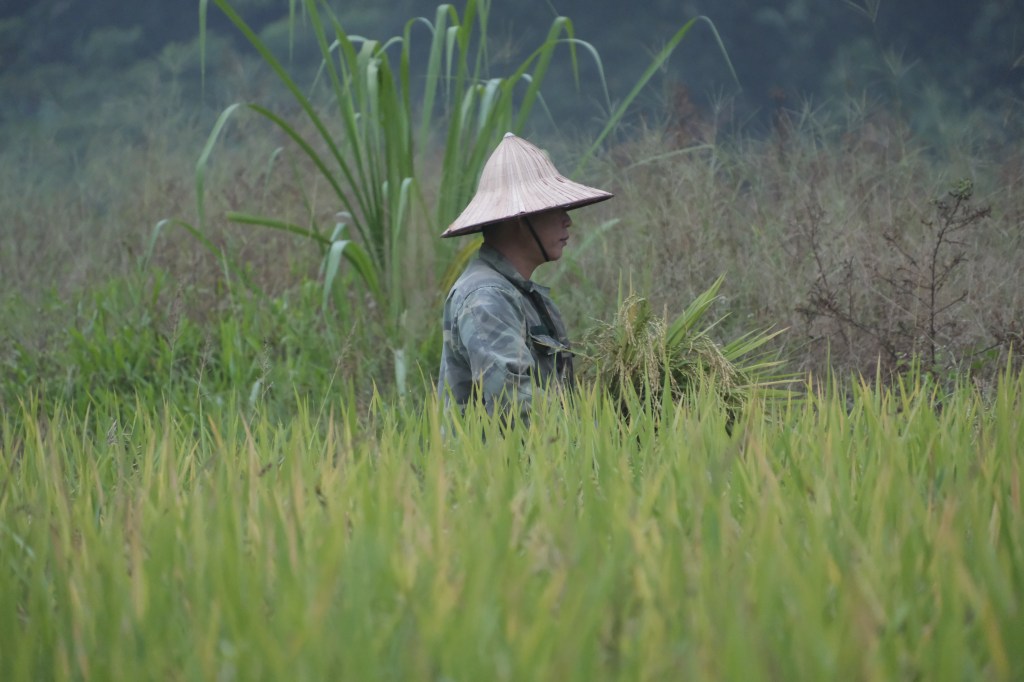
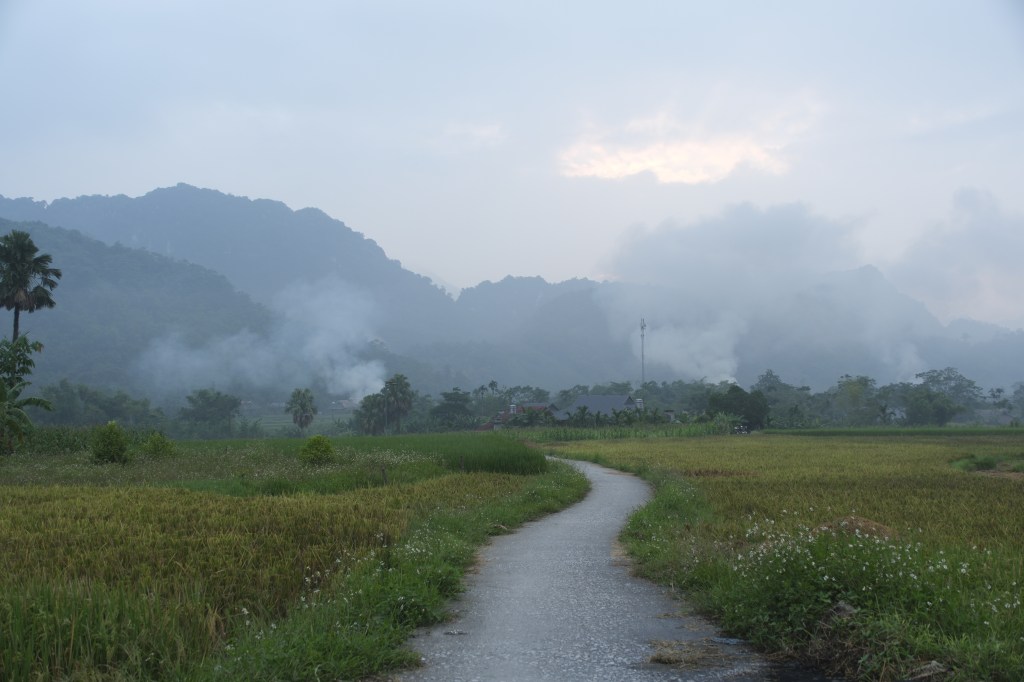
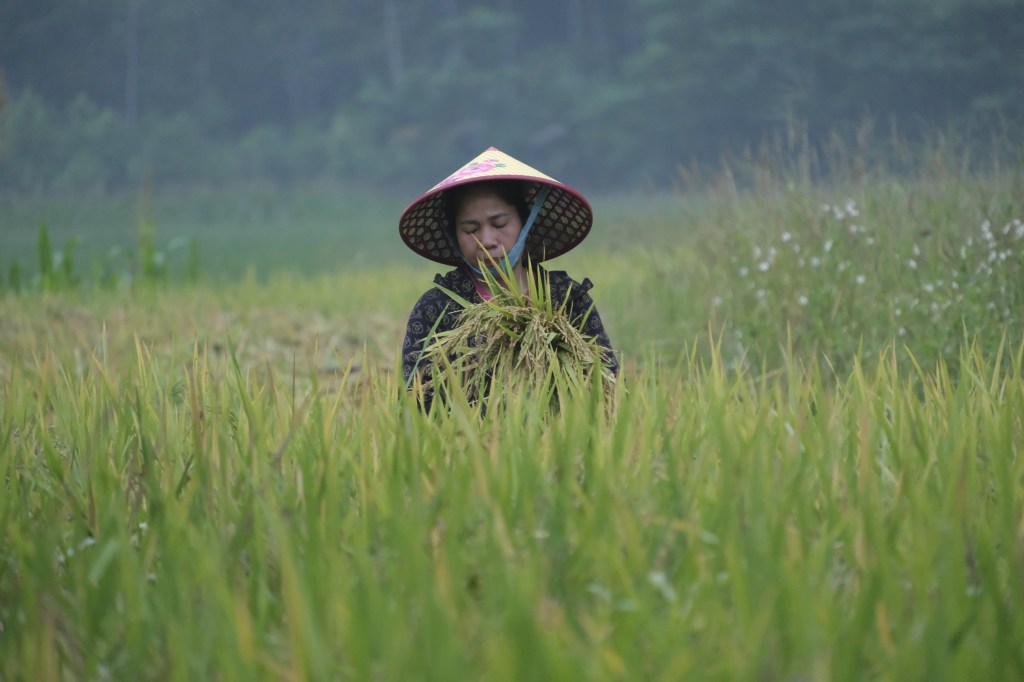
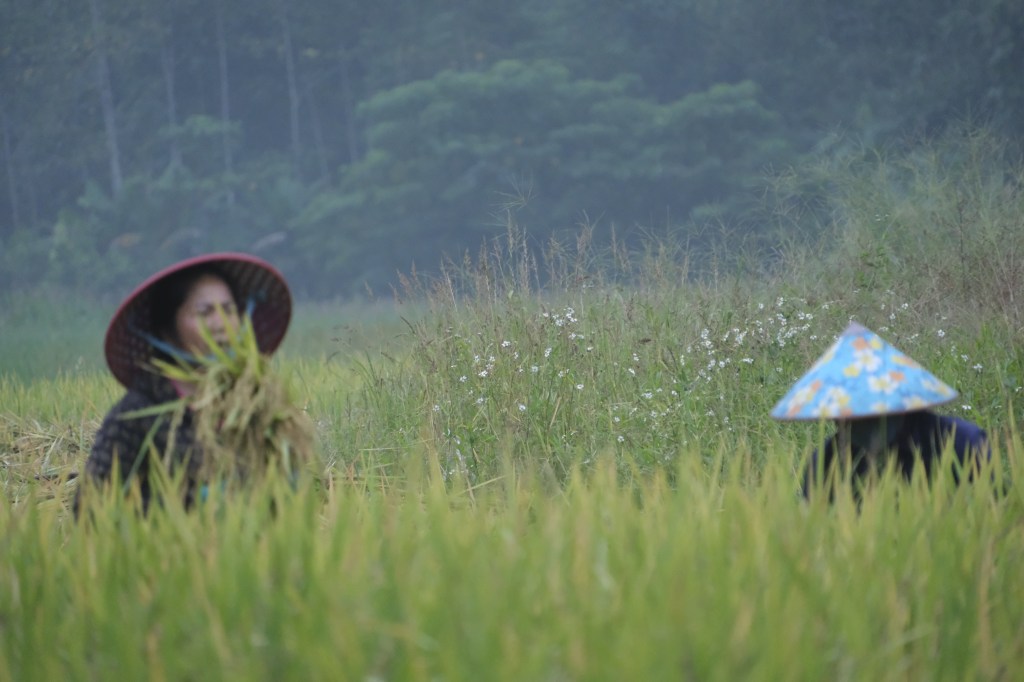
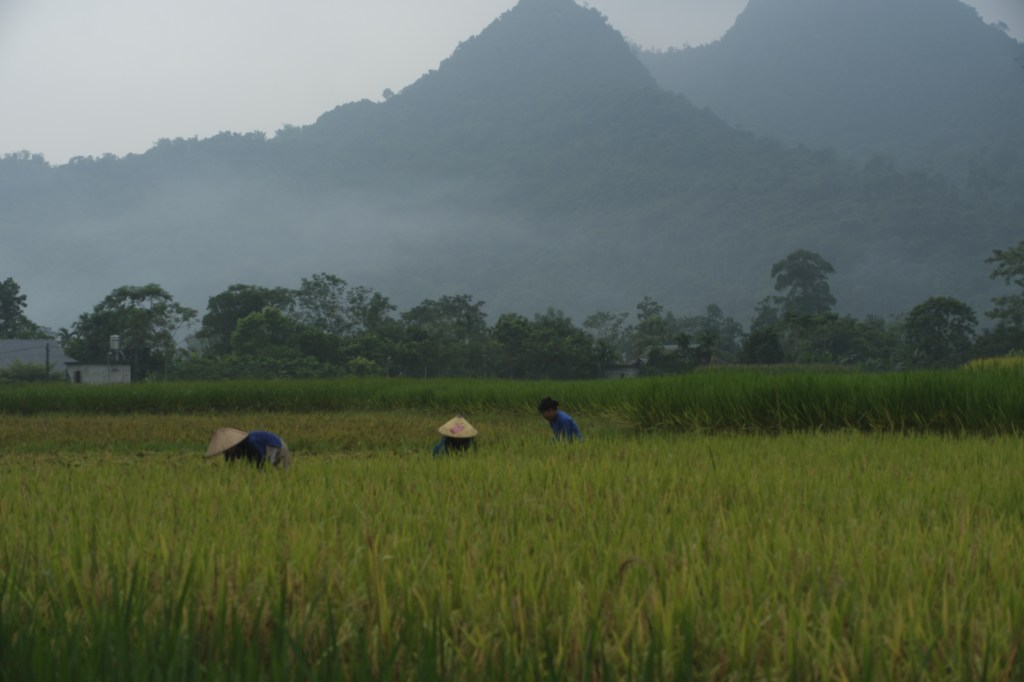
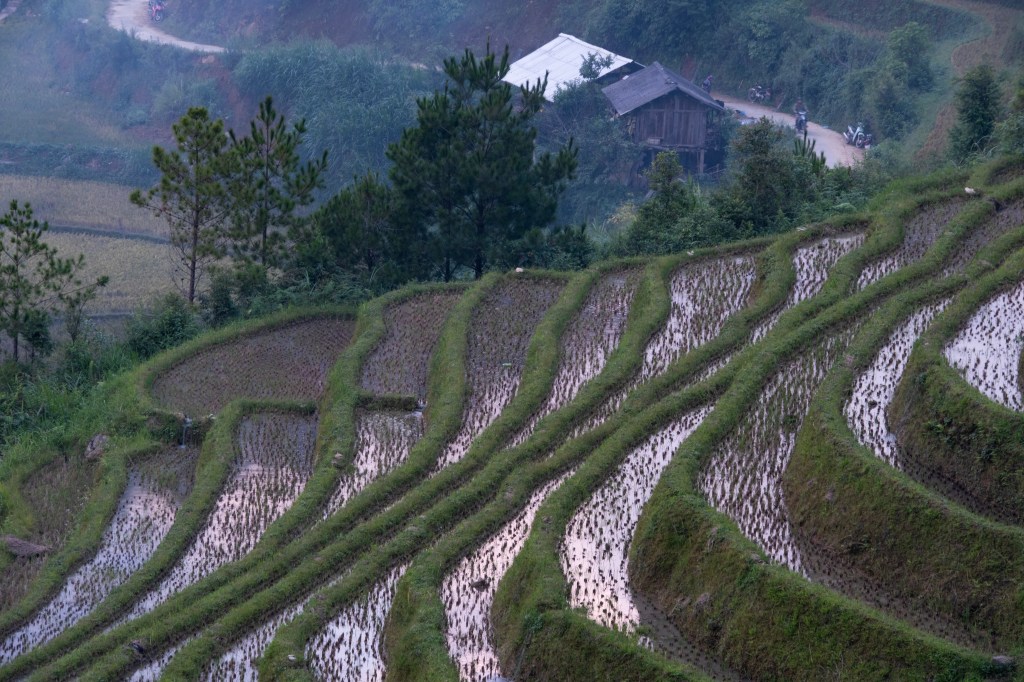
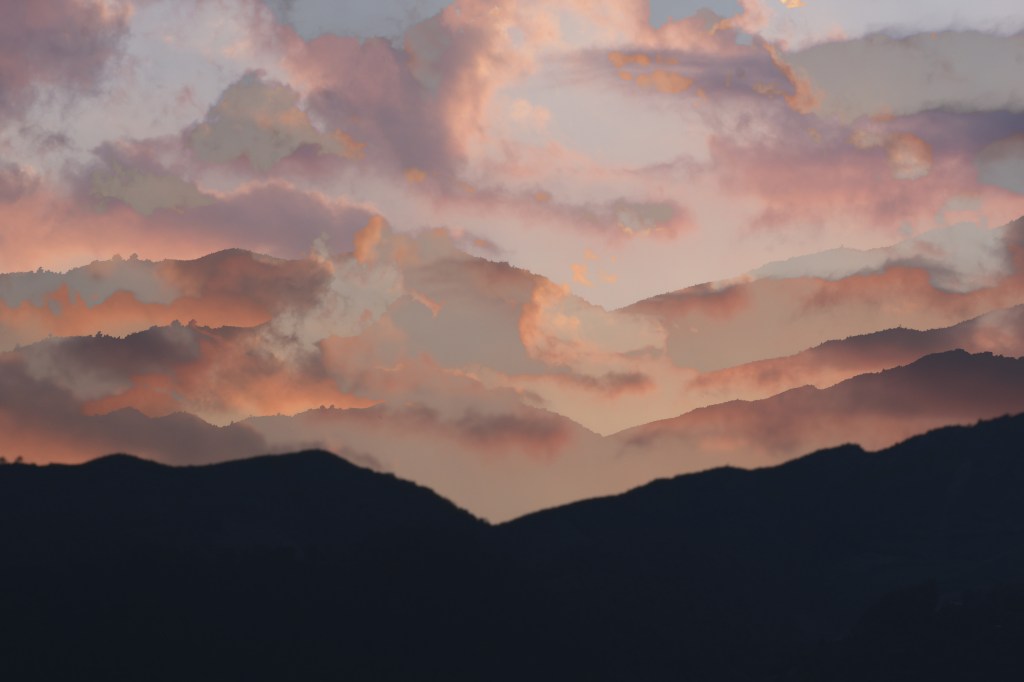
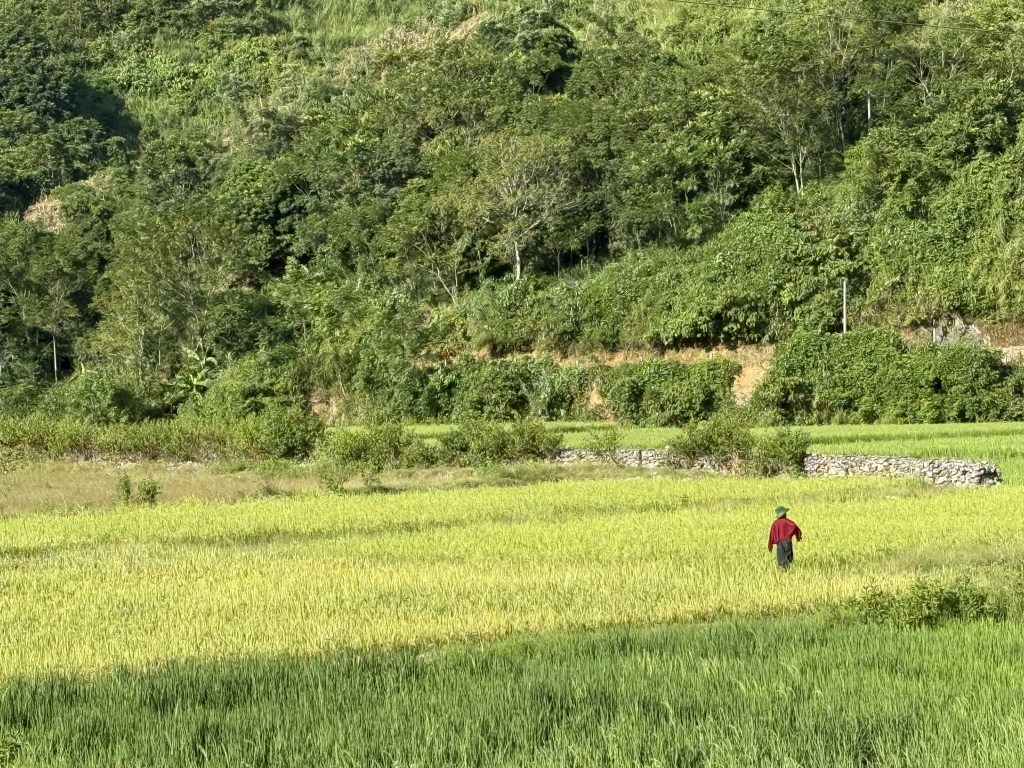
Back to the dawn patrol. Finally the morning light began to creep along the rice fields illuminating the fog hanging throughout the mountains. A few motor bikes came by, the dogs alerted the family to my presence, and the roosters made sure everyone was awake. Although there was no sunlight peaking through the mountains, there was a brush of pink to the clouds. Slowly people began to make their way to the rice fields, waving to me as I went by with my camera. I was completely alone on my walk having the expanse of fields and mountains to myself.
I felt it was a privilege to be in this moment, across the world, in a place where I thought I would never be. A place where the mention of the name, Vietnam, created anxiety in me. And now years later, it is as if this beautiful world had not been destroyed by war. As if we did not poison the people who lived here. I wonder what we were doing here in the first place, fighting a war to fight communism. Today, after all the killing, the sorrow, the grief, Vietnam is communist, it is a leading economic community in Asia. The world has not been destroyed. But once again, we have invaded another country, Iran, for what is perceived as a threat to humanity. I wonder who is the perceived threat?
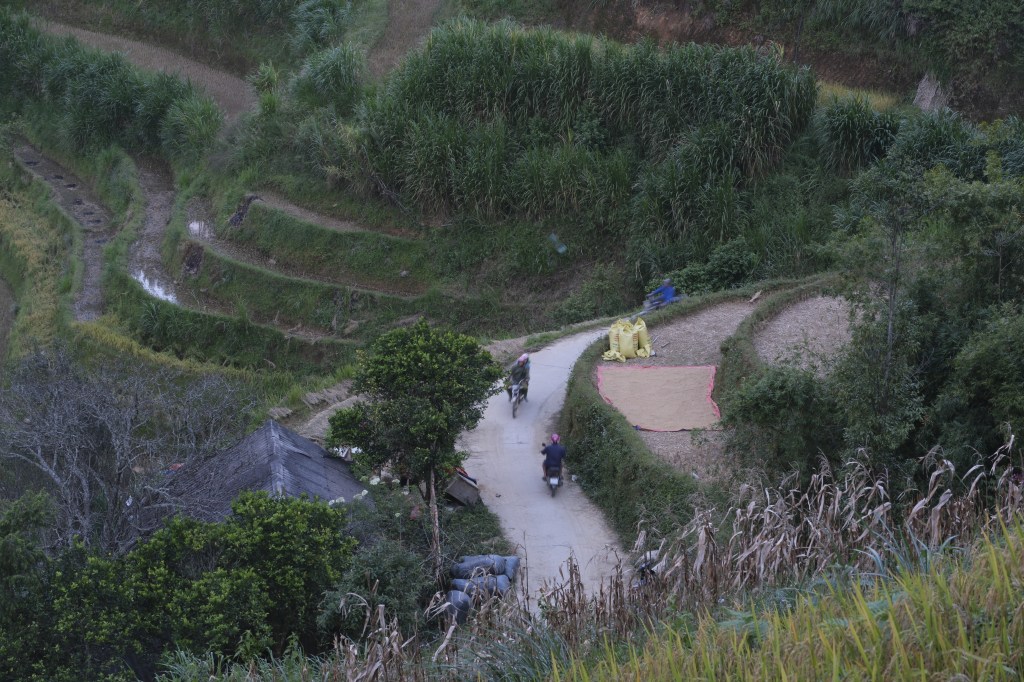
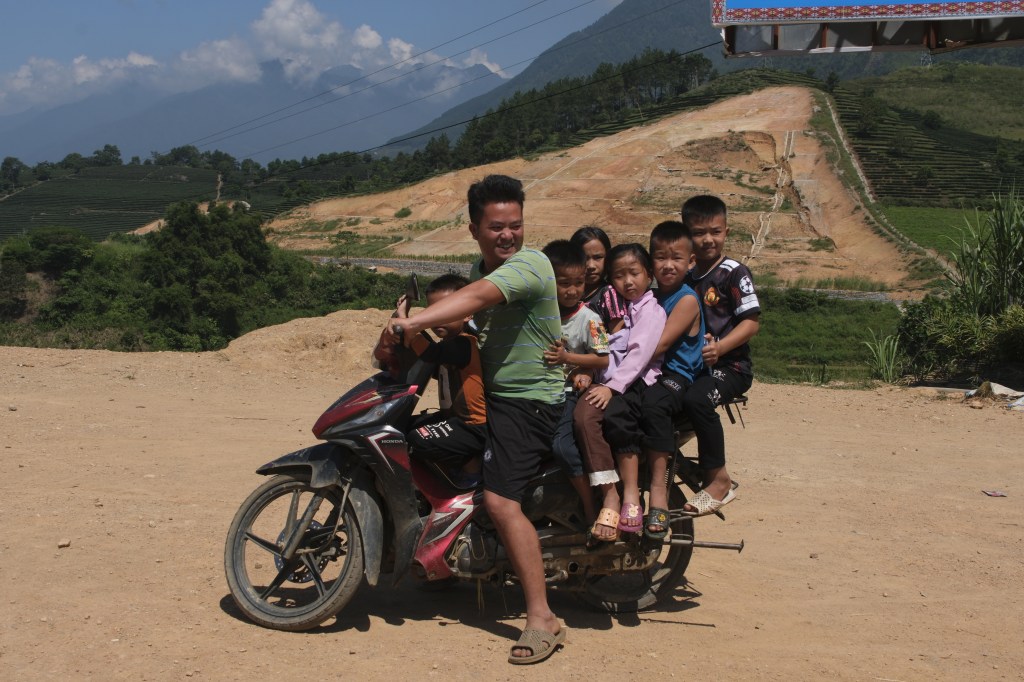
Back on the motorbikes for a climb to the bamboo forest. This was more terrifying than the ride yesterday. It started out what has become the norm, 3-5 foot paths, steep hills, switchbacks curving in on each other, dogs, chickens, cattle, and the motor bike with grass sticking out from the back of the bike, threatening to knock you over as you pass. This time, there was a toll halfway up, which slowed down the progress. As if to make up for it, my driver zooms full sped plunging down a steep bank only to start up an incline that was half washed out. My last look, before I closed my eyes, was a tire width path with stones popping up everywhere, and a drop to nowhere you would want to look. In your mind you imagine being flung somewhere along the hillside, crashing downward. It makes no difference if your helmet fits or not, as it would do little to protect you. As you are hanging on, you are bouncing from side to side, the motorbike is rocking this way and that, coming close to the edge one minute and seemingly bouncing off the bank on the other side.
At this moment, you are asking yourself why it is so important to see a bamboo forest when your life is hanging by a thread. You imagine the phone call to your kids informing them their mom died while sailing off a motorbike into an abyss. Oh and if that is not enough, you finally get to the top of the steep hill where the path turns into a 2 foot path when down comes a loaded motorbike full of hay. The path maybe widened to 3 feet for the rest of the journey as you continue to climb ending at the top of the mountain. Your fellow travelers are either behind you, or are waiting with expressions of horror as you arrive. A group hug seemed to be necessary to calm our beating hearts.
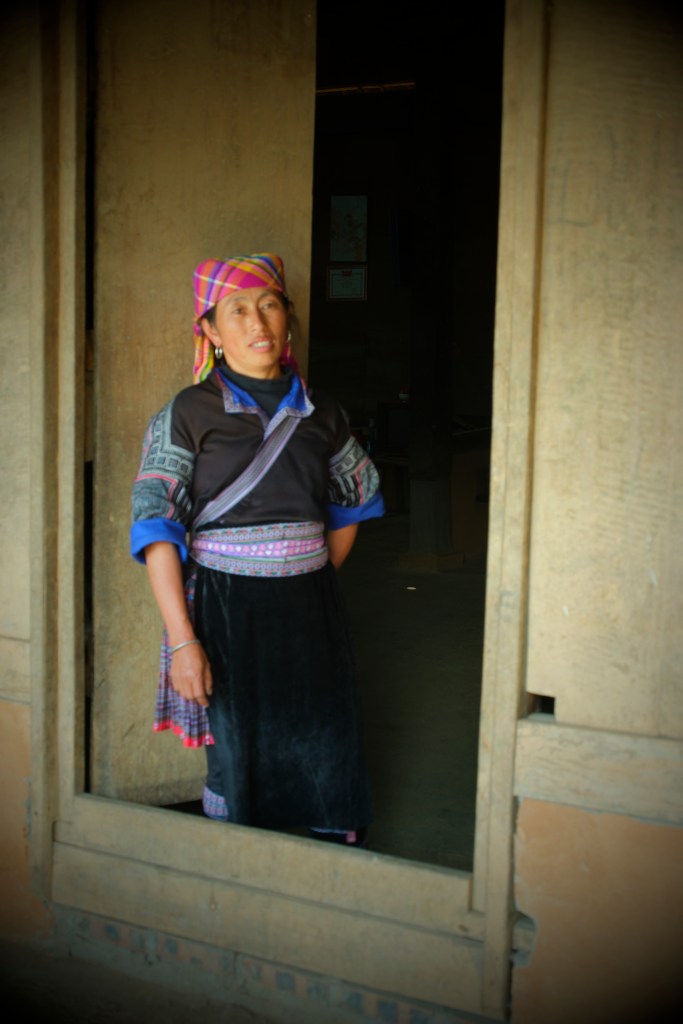
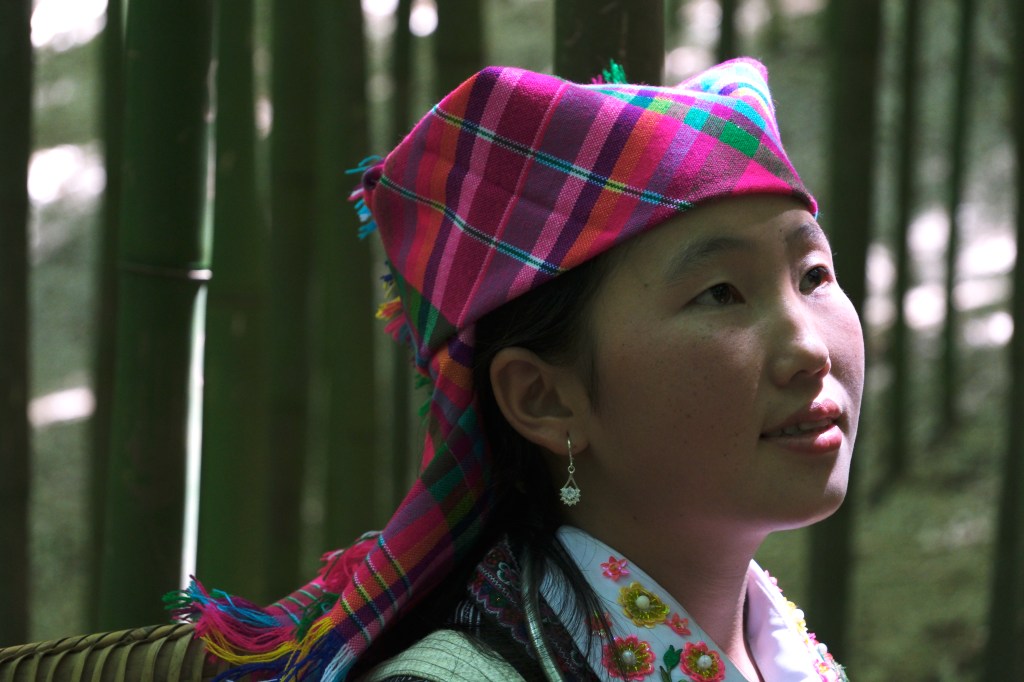
The rest of the morning was spent walking through the bamboo forest and practicing portrait photography with a model dressed in her traditional Hmong clothes. We had an opportunity to really spend time with lighting filtering through the forest, and different setting. Lunch was served at a Hmong family home who specialized in batik. Then back on the motor bikes, waiting in anticipation for the single track, rock strewn path you had traversed earlier. By this time we were seasoned travelers prepared for the terror and the faith that we would come back to the road alive.
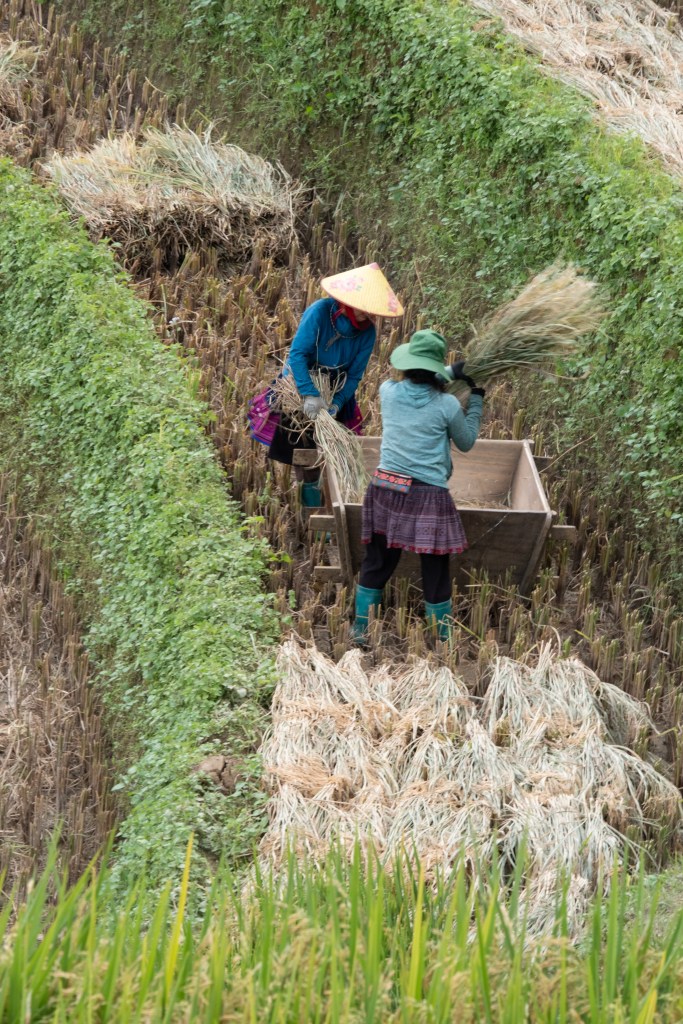
Off to another mountain, shaped like a dinosaur’s spines, but the light was too harsh. We stopped for a coffee. I mentioned to the guide that it would be nice if we could find an intimate spot to photograph rice workers without tourists in the shots. This is difficult because it is hard to stop on the narrow roads. However, we climbed to the second floor of a coffee shop only to discover rice workers right below us. I decided to go around the back of the building and there I found a path to walk down to the rice fields. An adorable puppy followed us as we descended the steep narrow path. Once down to the bottom we were able to photograph the workers at the same level.
Back in the van after an hour heading to the mountain range, with motor bikes, only to pull in as a rain storm began. Change of plans to head back to the lodge, with a walk through the forest on the way back if it stopped raining. Which it did. As we headed out on the path, views of rice fields, sunset reflections in water, and evening shadows advancing on the mountain with moon rise over the trees. Of course, we all stopped to get pictures when after 10 minutes our guide informed us that we had an hour walk ahead of us. None of us realized the “walk” was really a hike, nor did we realize our vans had left and were meeting us at the other end of the trail. Sometimes it is helpful to know the plan, but flexibility is the key word when you are on a trip like this.
We were rewarded with dinner of crispy fish, and the promise we could sleep in late (7:00pm), have a leisure morning before we left. The guides and our leader seemed very impressed that 8 older people were able to do what we accomplished, which is why I believe they decided to give us a “rest.” Or maybe they needed it more than we did.
It is actually 5 AM on the 22nd. The roosters are sounding the alarm and I can’t sleep due to the rock solid bed. Old bones need soft landings. I am watching dawn arrive from my cabin in the mountains. fog surrounds us, as darkness did last night. I have yet to experience this eco lodge’s as we arrived too late. Lighted pathways led us to our individual cabin.
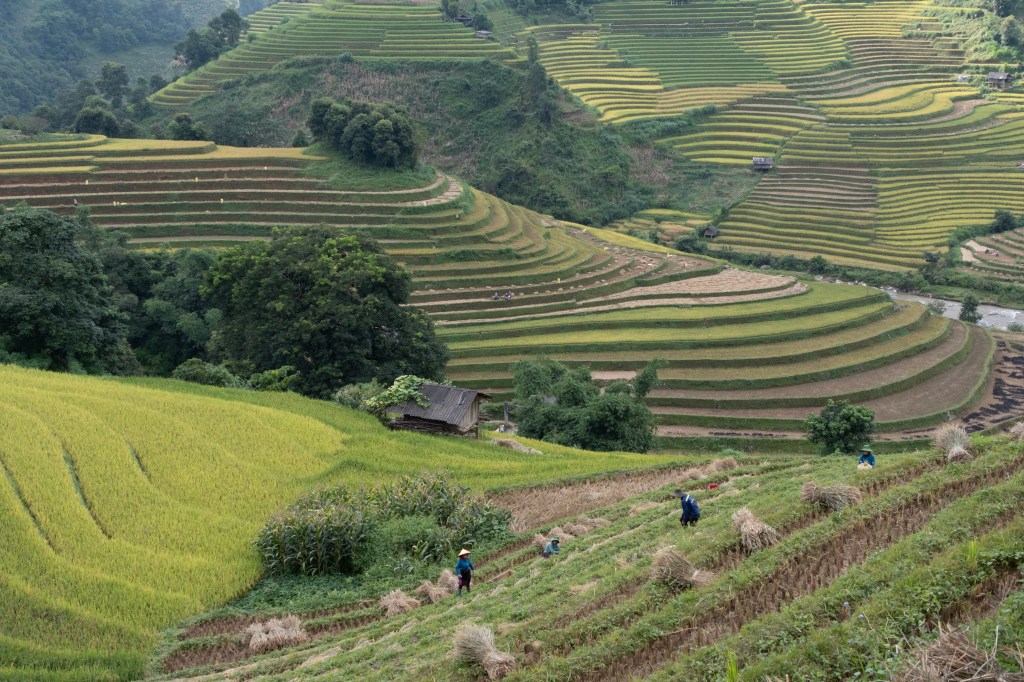
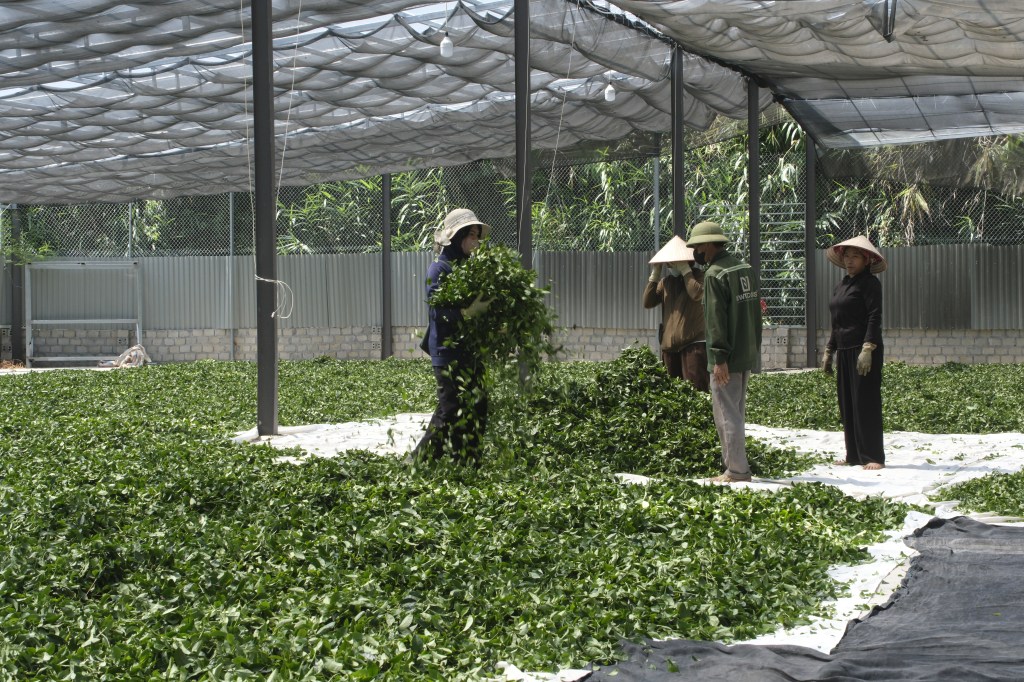
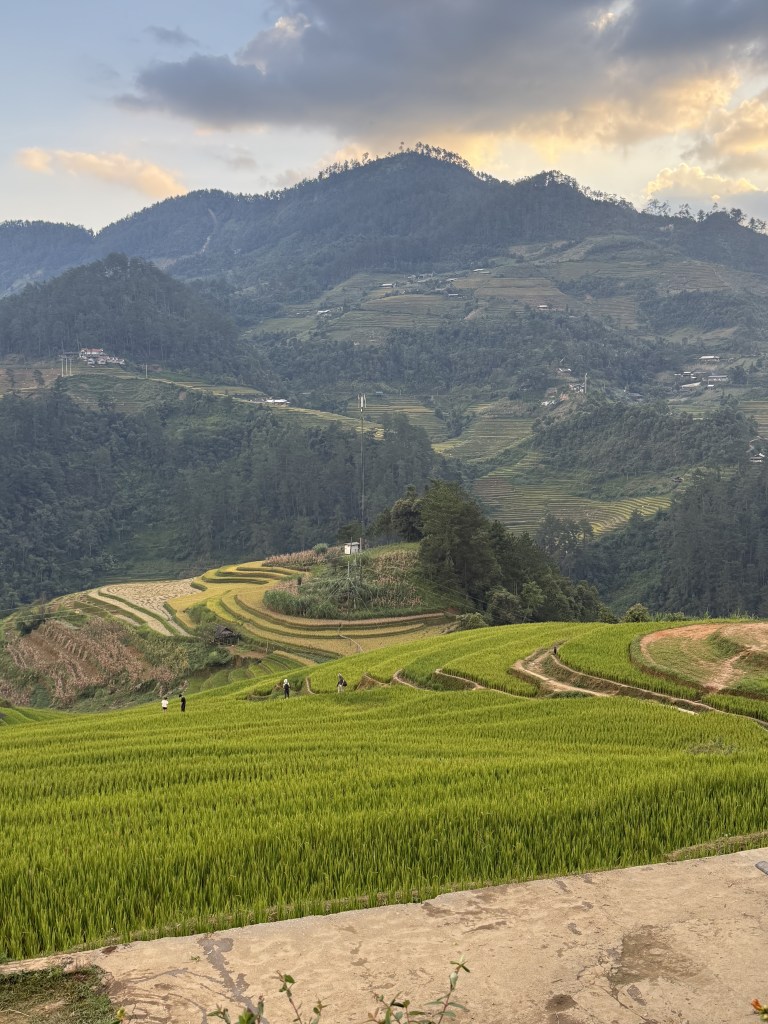
Our six hour ride yesterday was interspersed with stops to photograph people drying and grinding tea leaves for preparation to send to be packaged. Frequent stops created views of rice fields clinging to mountainsides, interspersed with tea plantations and corn. Layers upon layers of patterns, and color inspired us.
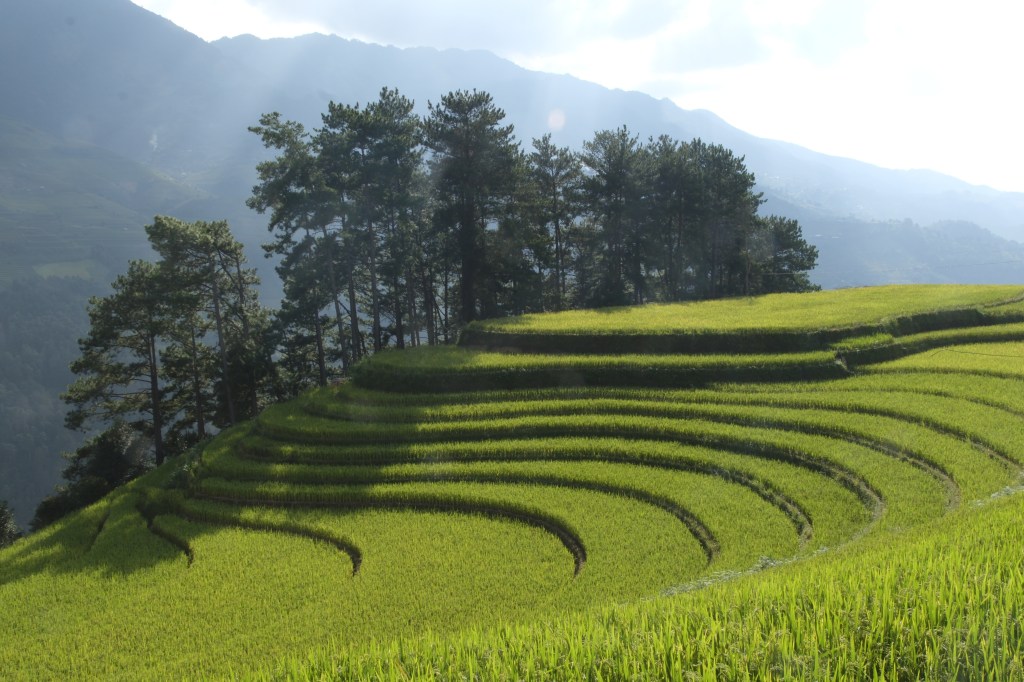
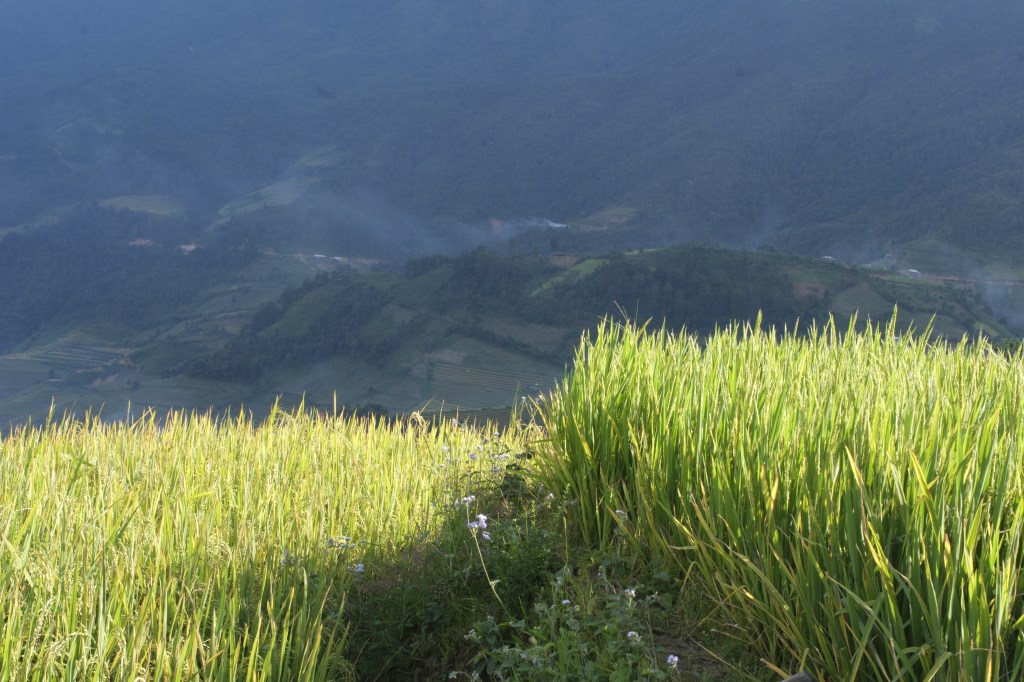
This region is known for the most beautiful rice fields in Vietnam. Being more accessible than our previous location we began to experience more tourism. Where we did not see any foreigners before, we began to see more buses and obvious tourists. Having been spoiled and privileged with no one stepping into our photographs with a cell phone or posing to take selfies, we did not take kindly to the intrusion.
Information as to our daily activities comes slowly, or as we all suspected, purposely being sprung on us at the last minute. We found out we would again be on the back of motorbikes. The particular viewpoint we were going to was up at the very top of a steep mountain. A toothy grinning teenager motioned me onto his bike. Hardly on the back, he took off as if we were being chased by bandits into traffic, cutting across oncoming traffic to a narrow concrete pathway and up a hill at about a 40 percent grade. Hanging on the back, we sped around switchback curves, narrowly missing chickens, dogs, people and oncoming motor scooters while edging to the side of ten thousand drop into the valleys.
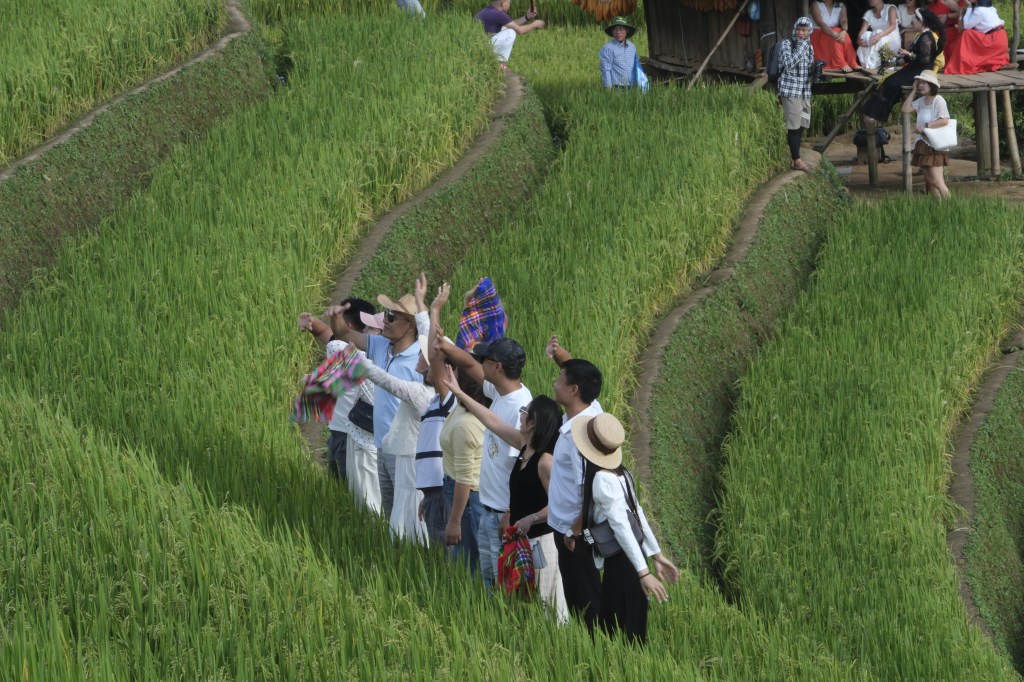
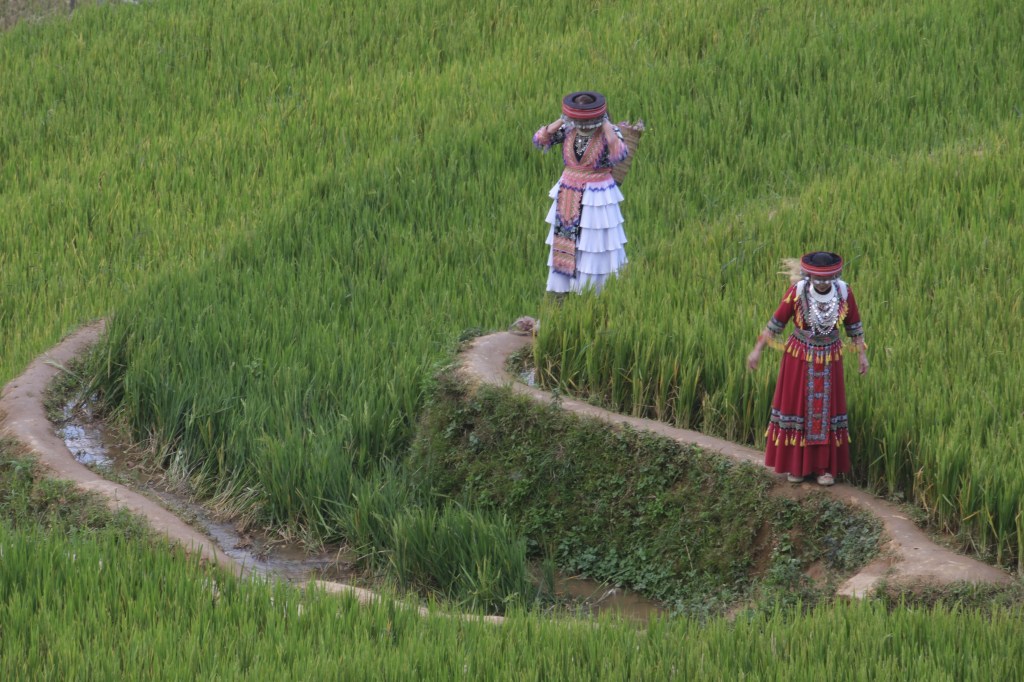
Arriving at the top, we experienced our first “tourist” experience. Shops rented various degrees of fancy Hmong dresses to wear while walking in the rice fields. People old and young hire photographers to come while they model. Groups of the younger generation gather to take selfies or Instagram style pictures, never bothering to look at the incredible view around them. It is all rather bizarre.
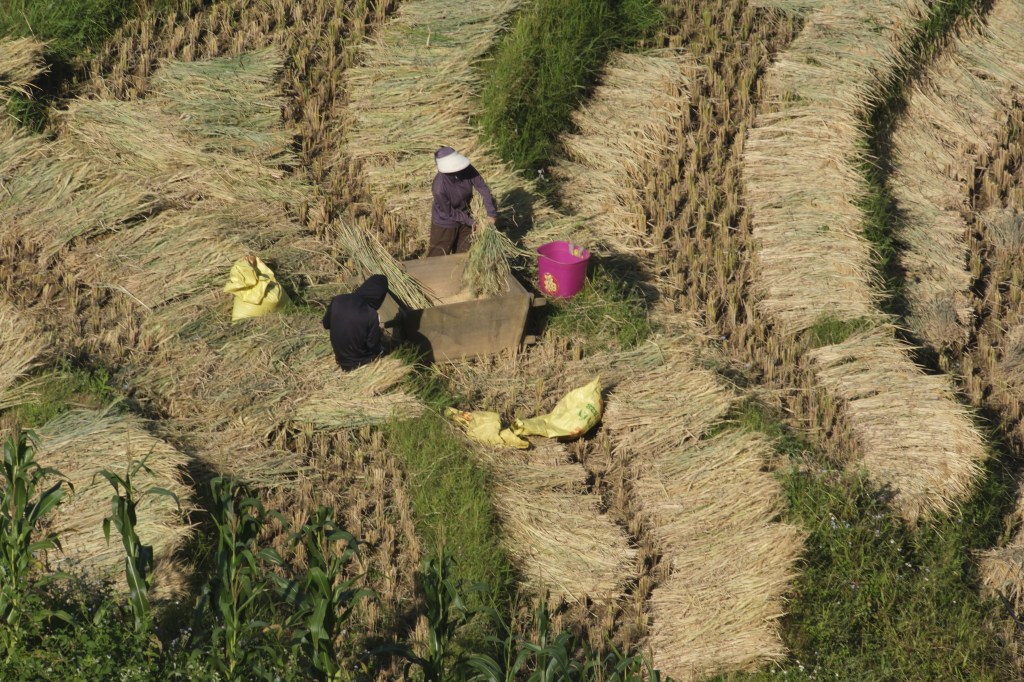
Once over the shock of this intrusion into one of the most spectacular sites I have ever experienced, we were able to walk away from the crowd and find areas with no tourists to photograph. Although I will say, the scene provided a form of “street photography.” Meanwhile, in the valley were workers cutting and thrashing the rice into a large container. The heat was oppressive and you wonder how they could stand it, dressed head to toe with protective clothes to keep them from getting sun burned.
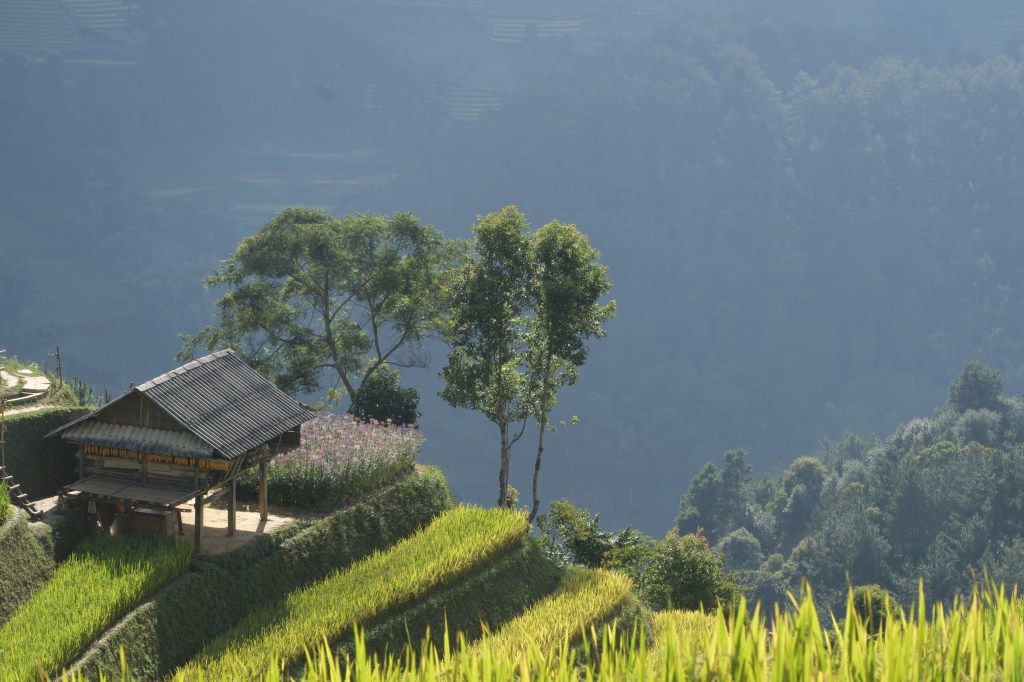
The contrast with valley workers probably making three dollars an hour to the money spent by the tourist at the top shocked us. I imagine it is not much different in the U.S., with people posing against mountain scenery. The fields were beautiful with marigolds, and purple flowers planted along the rice paddies, wooden huts dotted throughout, and the ever changing shadows on the mountains, it creates an unforgettable scene.
One more ride up to the top of another mountain, this time I chose an older woman as my driver. The road was not as steep. I am becoming used to this form of getting to the top of mountains and for my 81 year old self I am happy not to be climbing up in this altitude and steepness.
Today brings another motor scooter ride and lunch in a family home. We are still among the Hmong tribes. The colors and patterns of Vietnam is what I will take with me.
Another day of sun, what luck, as Hanoi has been flooded. Here in the mountains we have had great weather. Surprise of surprises…what did I wish for last night? Some peanut butter! Breakfast today consisted of toast, fried eggs, cheese, and peanut butter. We were all delighted. Such a treat.
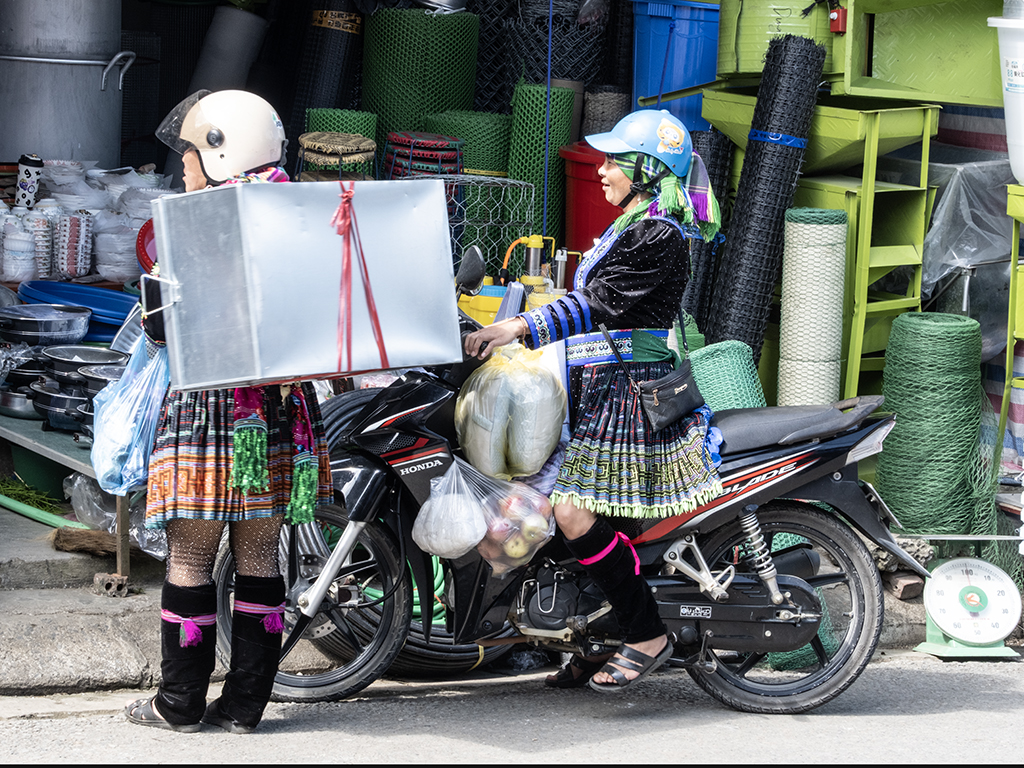
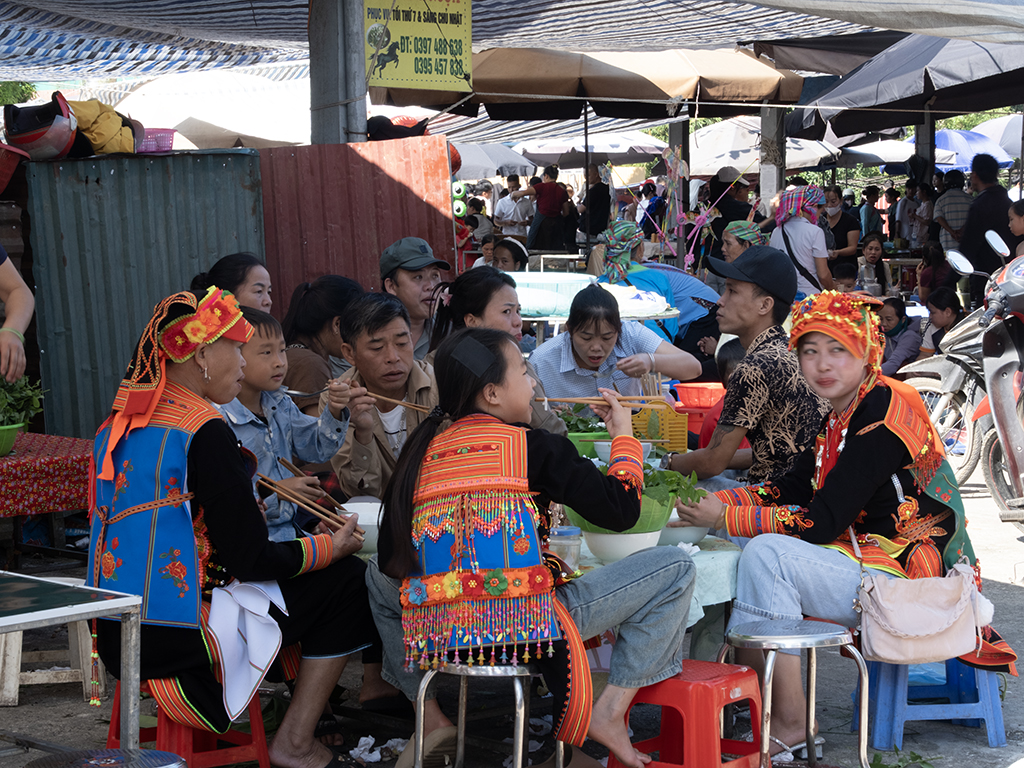
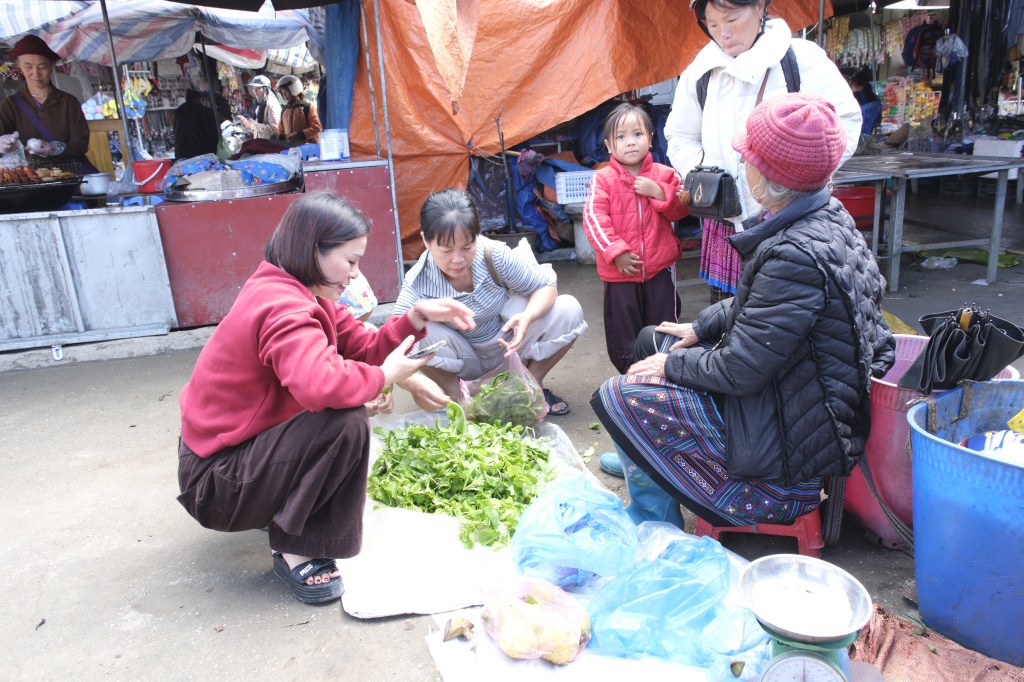
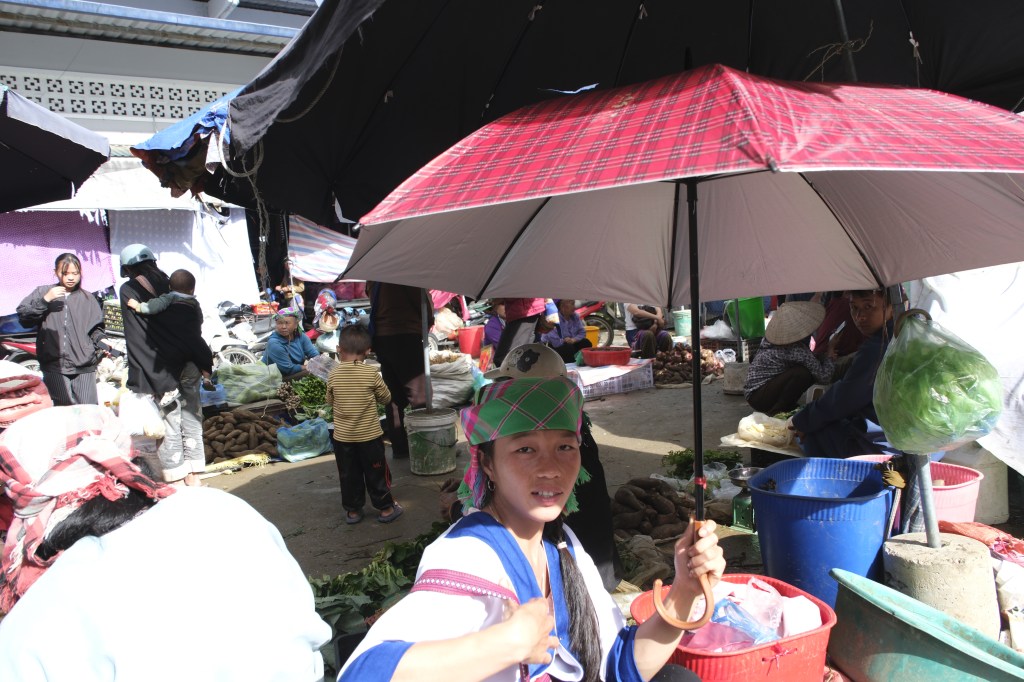
Off to the Sunday market about 10 minutes away. This one was so congested, it was impossible to get a clear shot of anyone or any activity. I finally came to the conclusion it would be good to move toward the food area and clothes as there is less activity. There I was able to get pictures of people eating, conversing, cooking and generally enjoying themselves. We spent about an hour and a half there, dogging mopeds, making friends with lots of people, some who spoke some English, but mostly it was sign language.
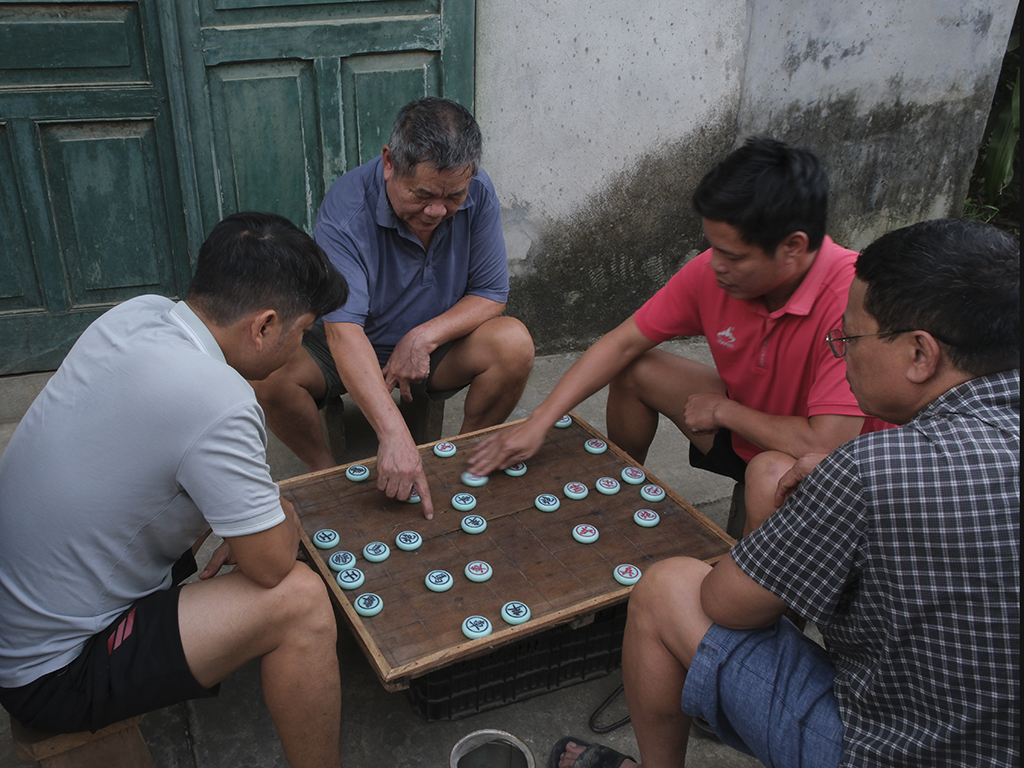
Later in the afternoon we took off for the rice fields and a town nearby. The fields were lovely, but the sun was still harsh so we went into town to photograph and waited until the sun began to set. At the very end of the market we came upon a friendly game of Chinese chess and spent a long time with them. The backdrop of a green door, kids watching their fathers, and the bantering back and forth added to the picture taking.
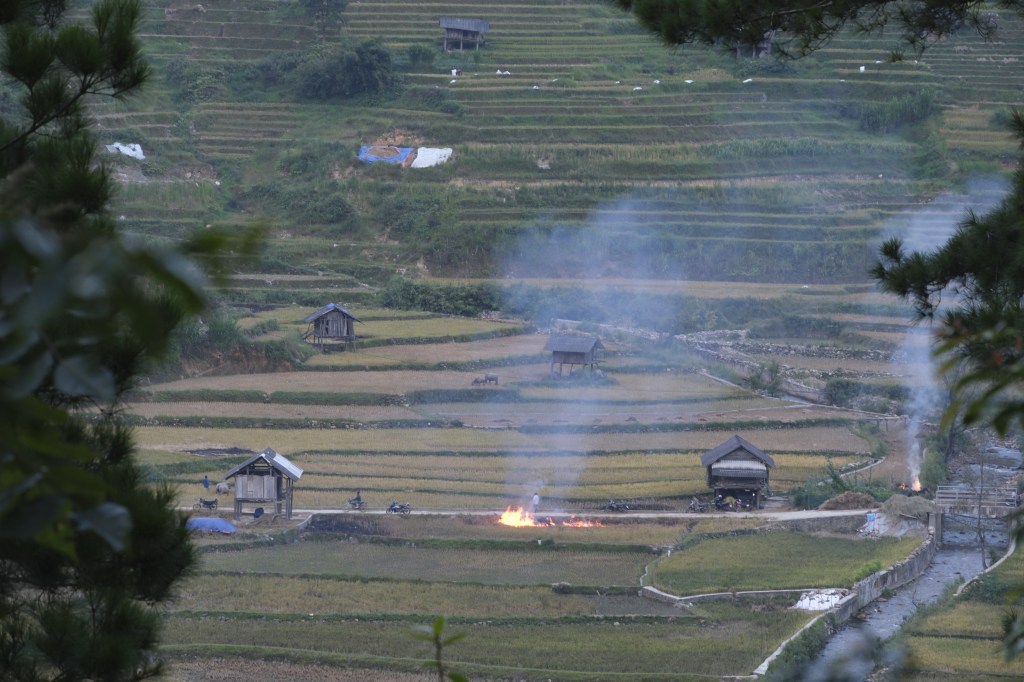
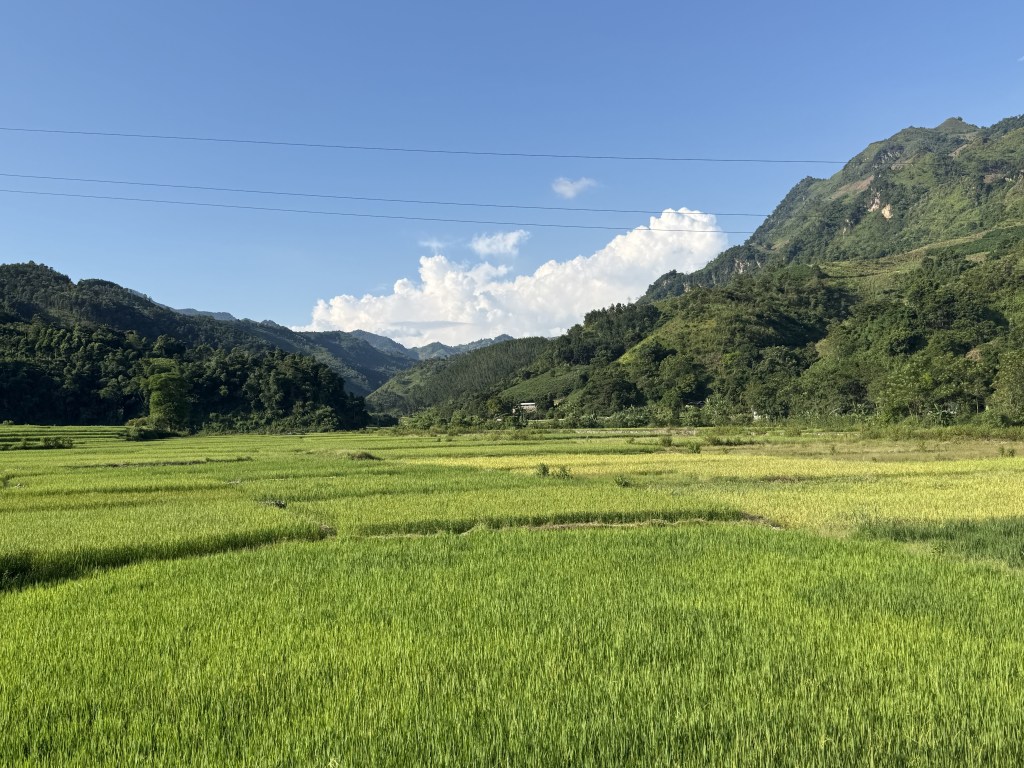
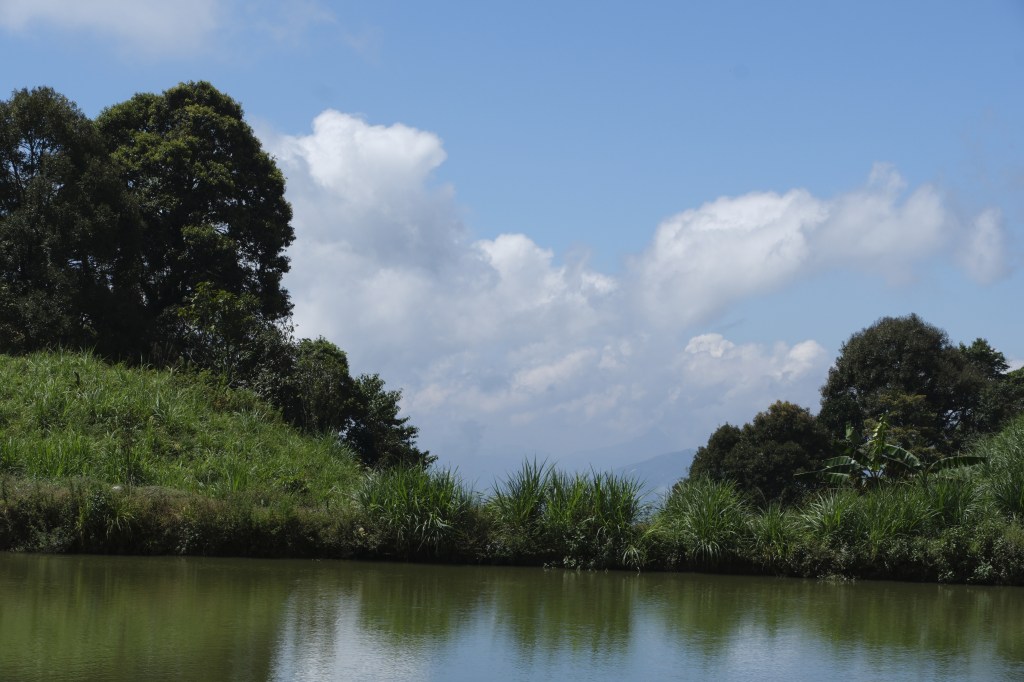
This area has enchanted us with fields of rice growing next to bubbling rivers, daily commerce being conducted, and the backdrop of high mountains with billowing clouds slowly moving across the sky. No other tourists to be seen, just eight of us wandering throughout the markets and fields and engaging with whomever we can. There are few places one can travel that still maintains the daily comings and goings, untouched by tourism.
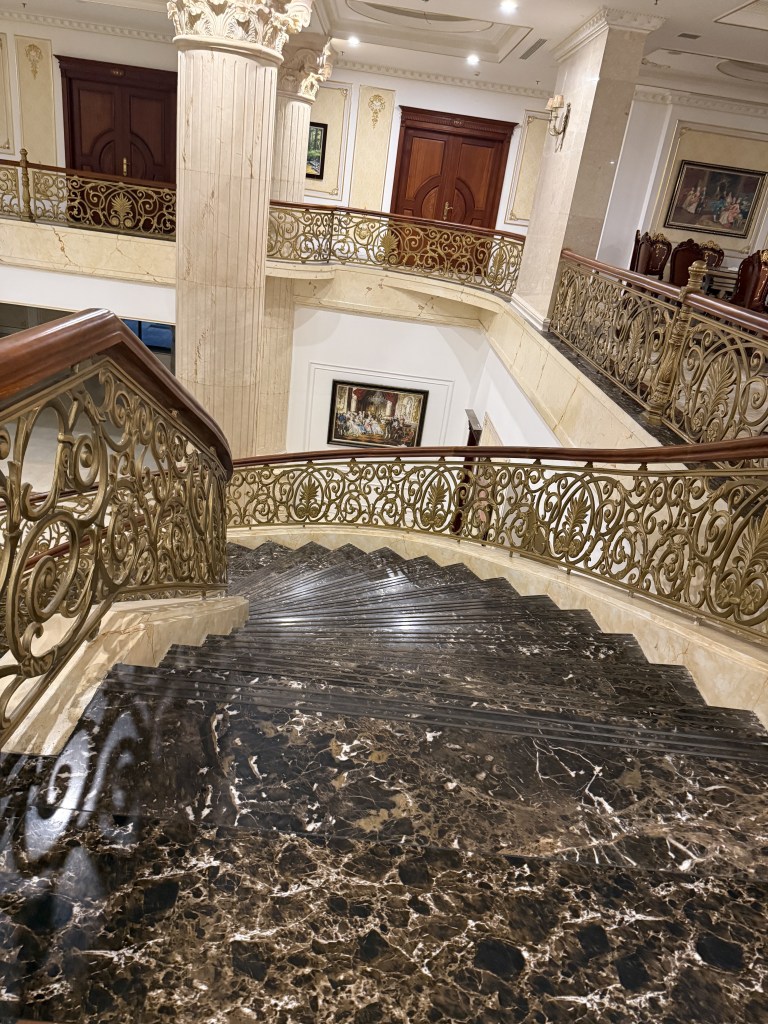
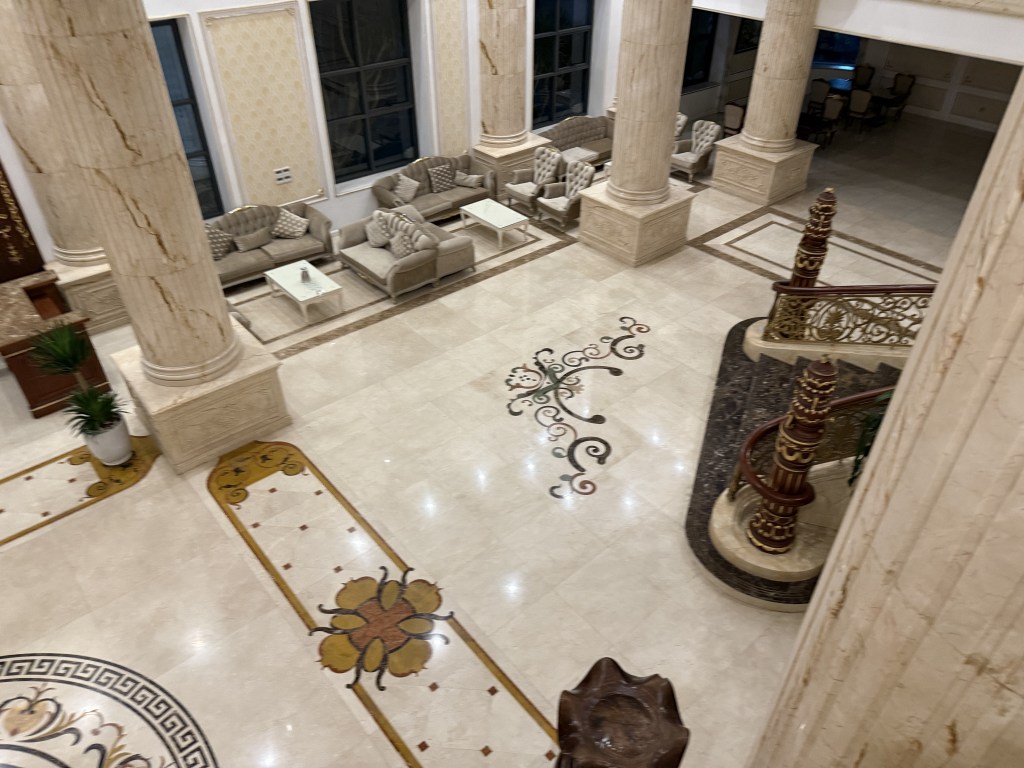
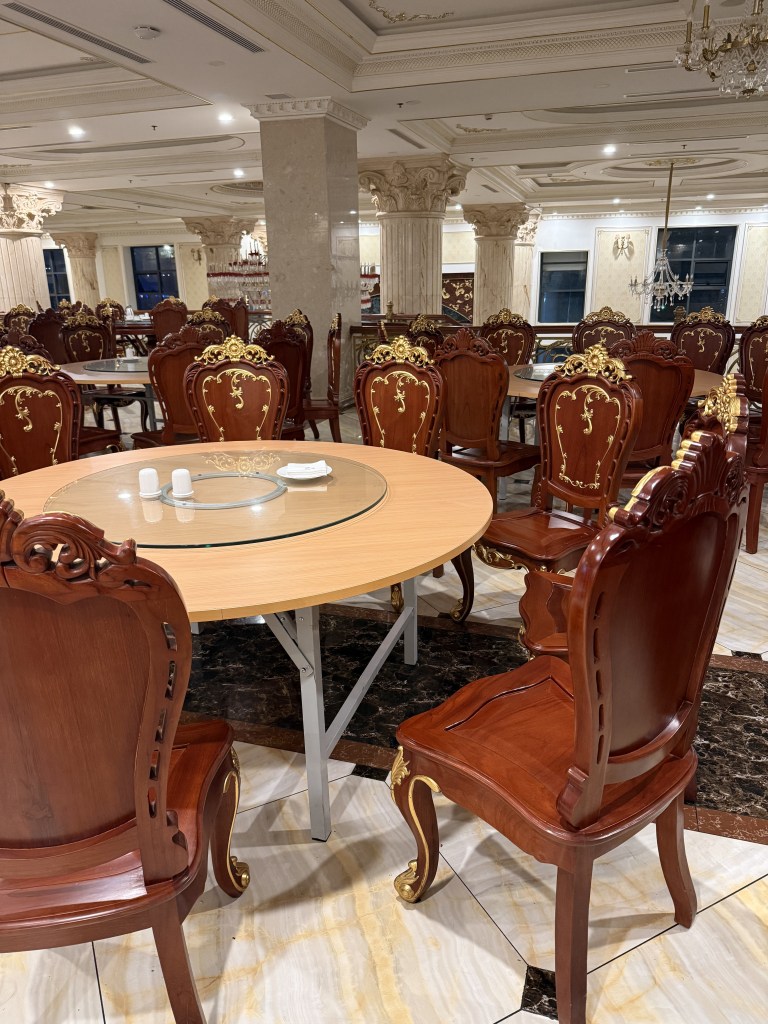
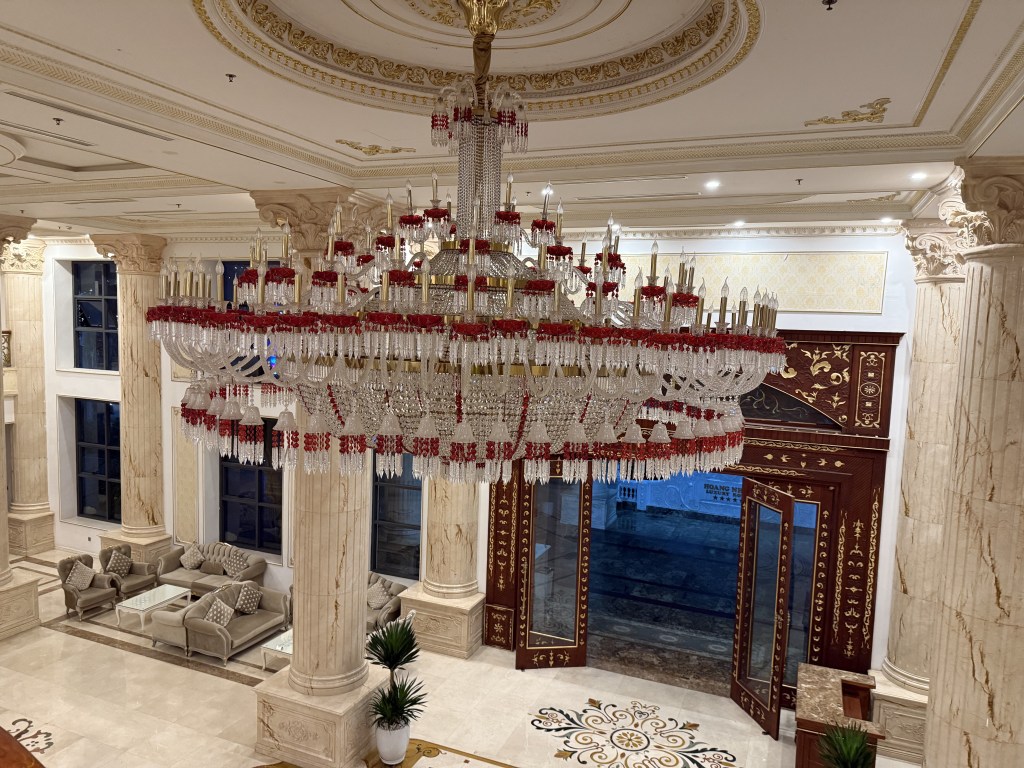
After three nights in this ridiculous hotel we are happy to move on tomorrow. Our hotel has gold everywhere, Trump would love to stay here. It has 108 rooms and we were the only 12 staying here. It is owned by a woman in her forties and from what we understand it is not even close to making a profit. She owns several hydro plants so I think she does not worry about filling her hotel,
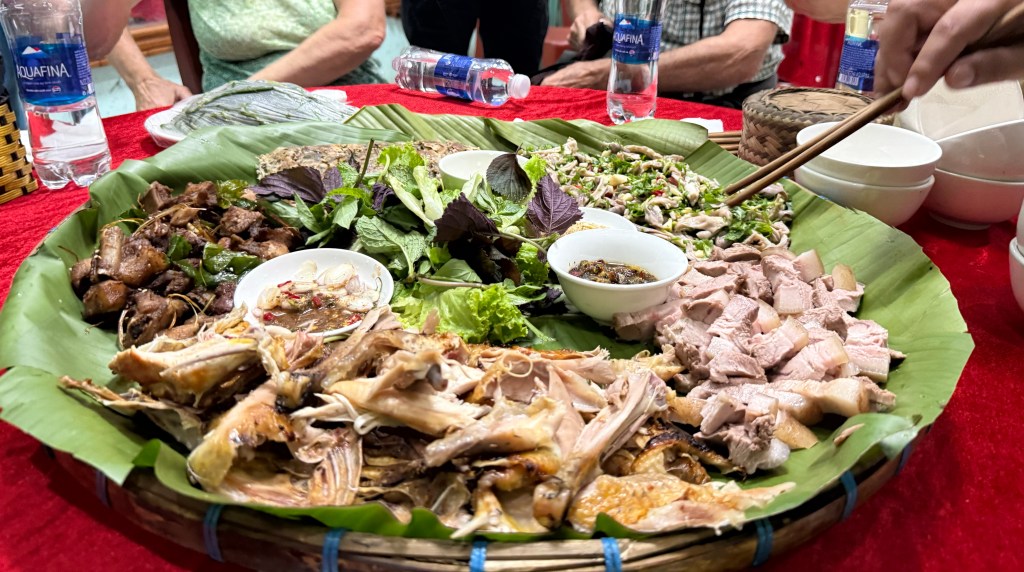
Food alert! I am good with rice noodles, and chicken broth, and fairly benign chicken parts for my breakfast. But I am not OK with a huge round basket full of animal parts. Presentation was one quarter of a large basket platter offering pig intestines, next quarter included clobbered chicken parts with skin, tendons, fat, and the bones. The third quarter consisted of pork fat with a tiny bit of meat, and the fourth quarter was a rectangle of God knows what translated as “meatloaf.” However, he sticky rice was delicious with a bit of fish sauce and ground peanuts topped with strange stringy looking greens. I am dreaming of hamburgers, yogurt, raspberries, peanut butter, bread, cheese, and cold water.
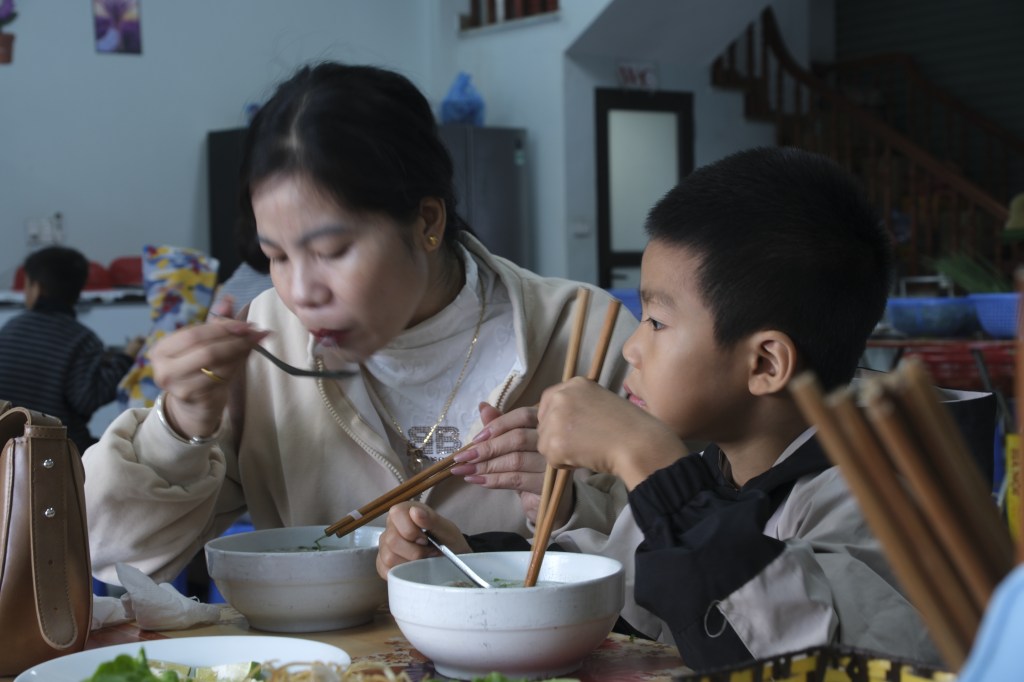
Up at 5 AM and on the road by 5:30. Our destination was an hour and a half away to a Saturday market. Upon arrival we ate our rice noodle soup with about 70 people in what felt like an auditorium. Sitting next to me was a mother and her son, who shyly gave us a smile, he then went back to slurping his soup. After breakfast we headed into the market which was more diverse than the local food market we experienced the evening before. This market not only Hmong people selling goods, but red and black Dao selling.The way to identify the red and black Dao is by the woman’s head dress. Some older women had black teeth, that having been a sign of beauty. They stained their teeth with beetle nuts. I bought several different pieces of cloth to add to my collection as the various cloths were embroidered with beautiful designs.
After the fabulous lunch I described above, we got back on the bus and headed for a national park where a winding path took us a mountain to a most stupendous view. On the way up, we came upon young girls resting by motorbikes. As we photographed them, an older woman and a young girl came climbing up a steep hill beside us, bringing enormous bags of potatoes on their backs. The girls were 15 and had to quit school to work in the fields because the families needed them to make money. It is sad to see these girls cannot follow a dreams.
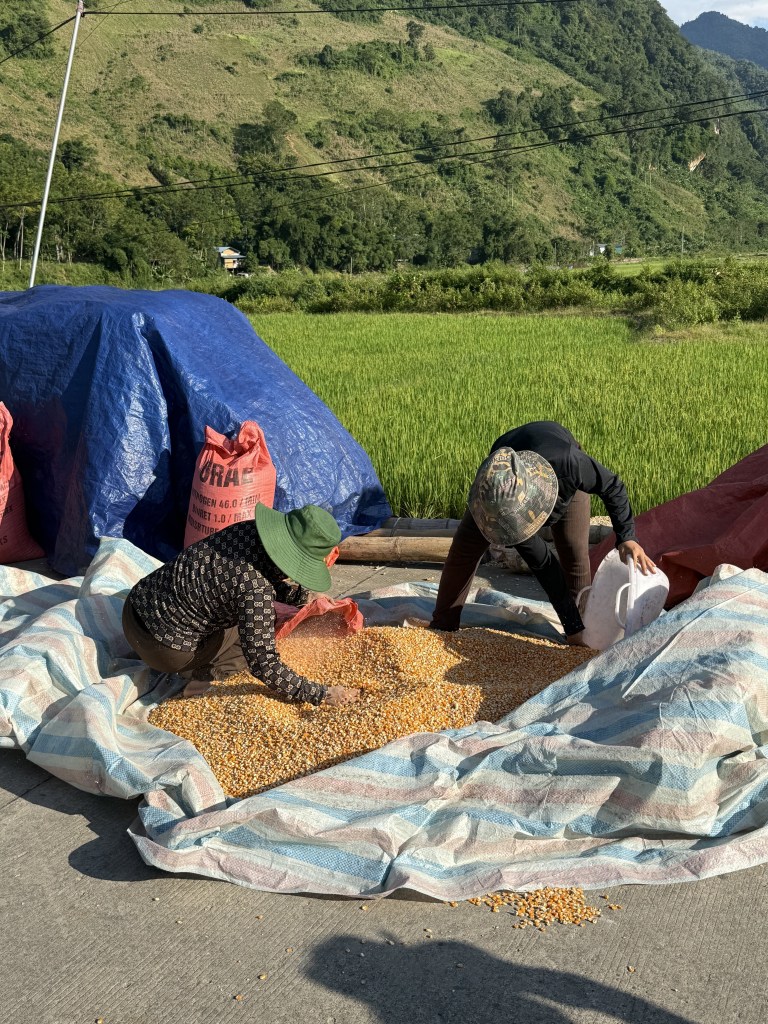
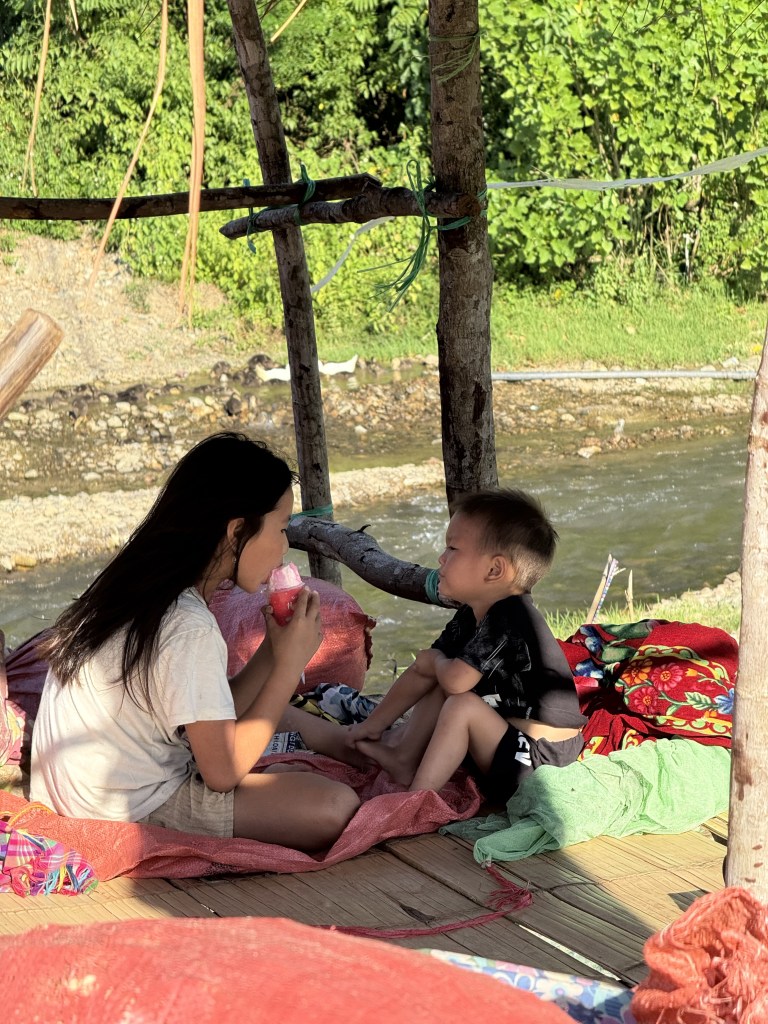
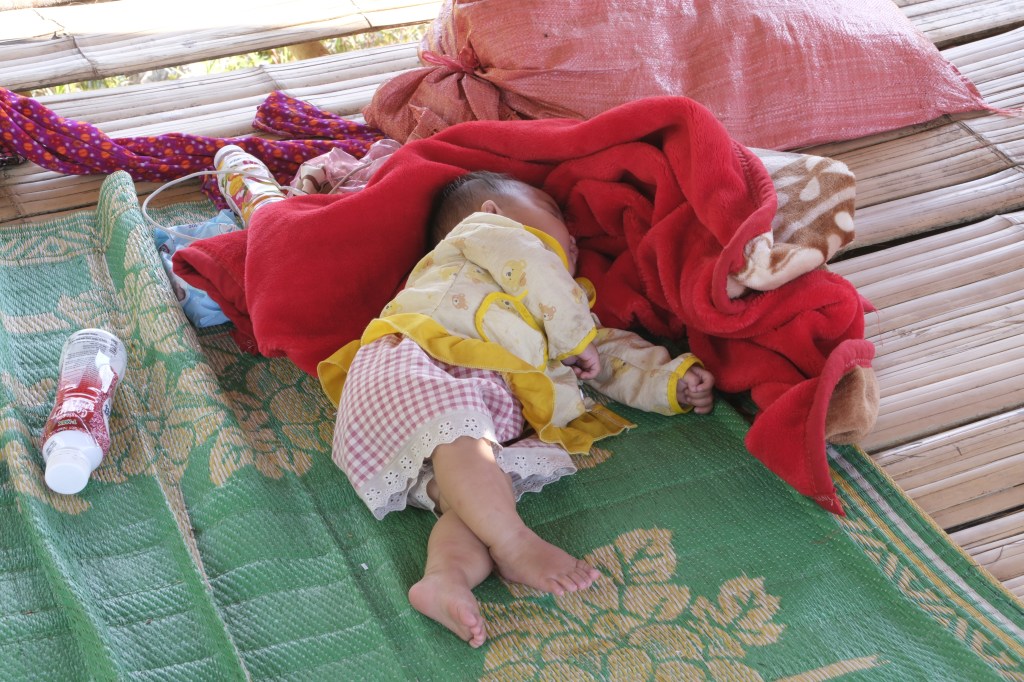
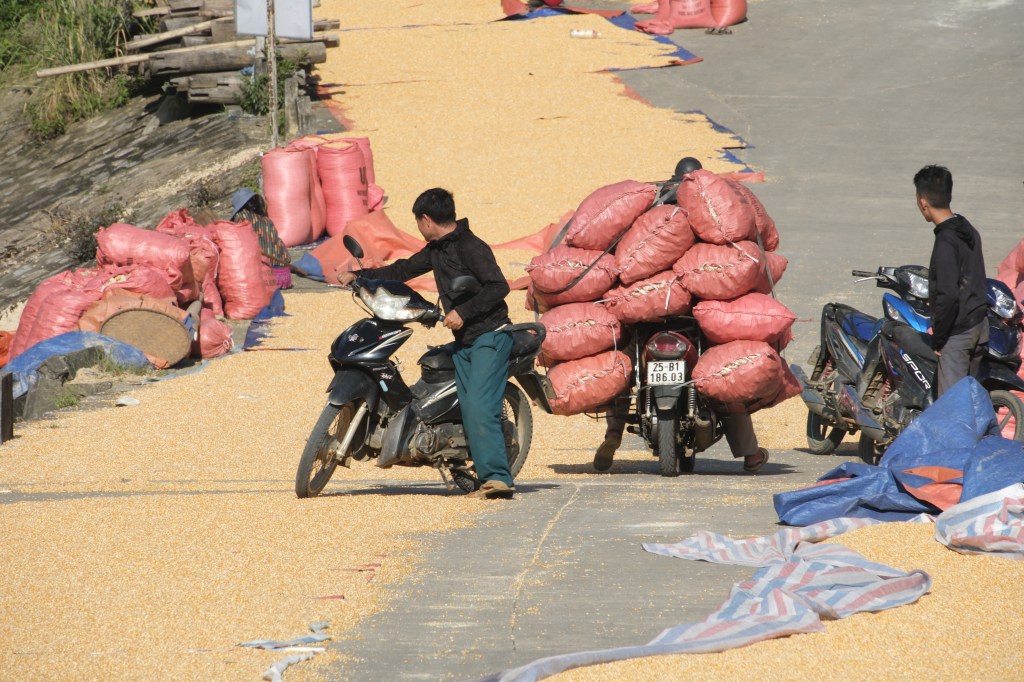
After leaving this park, we went to a bridge where the local people were drying corn. The corn lay on tarps on the cement payment in the boiling hot son. Small pathways made way for motorbikes carrying huge bags, up to 8 at a time, to a central area. Meanwhile small children napped in the shade of small straw covered huts, and children played in the river, catching frogs or floating with the current. The valley floor of rice fields gave way to towering mountains in the distance. A twelve hour day, but worth every minute of it
Beginning on September 11th we started our journey, leaving Stowe to Burlington a forty five minute trio, then one hour to JFK, five hours waiting, seventeen hours from JFK to Singapore, 5 AM arrival, waiting until 9:30 AM for our plane to Hanoi, two and a half hours to Hanoi, one hour to our hotel, thirty-one hours in total, we arrive exhausted on September 13 at 1:00 PM. Lunch at 2:00 pm, and then our driver said he had plans to take us shopping. I looked at him like he was a creature from another planet. Seriously? Apparently, the purpose of this excursion was to acquaint me with the clothing shops that featured Vietnamese style clothing. Imagine my enthusiasm, as I could barely put one foot in front of the other. Why could this not be put off until the next day when I was rested. Answer: I was the tour guide for the rest of the group who would arrive on Monday the 14th. So off we go, me and three men who had not the slightest interest in this endeavor. Imagine a shop that is 12 feet wide and 100 feet long filled with beautiful silk and linen fabric all hand embroidered. Now imagine the clothes all hanging on various racks with the aisles being maybe 1.5 feet wide, add in three men standing waiting for you to decide what you may like. After about three stores I called it quits, stating that I could not stand up for one minute longer. Nor could I take 3 men standing and yawning.
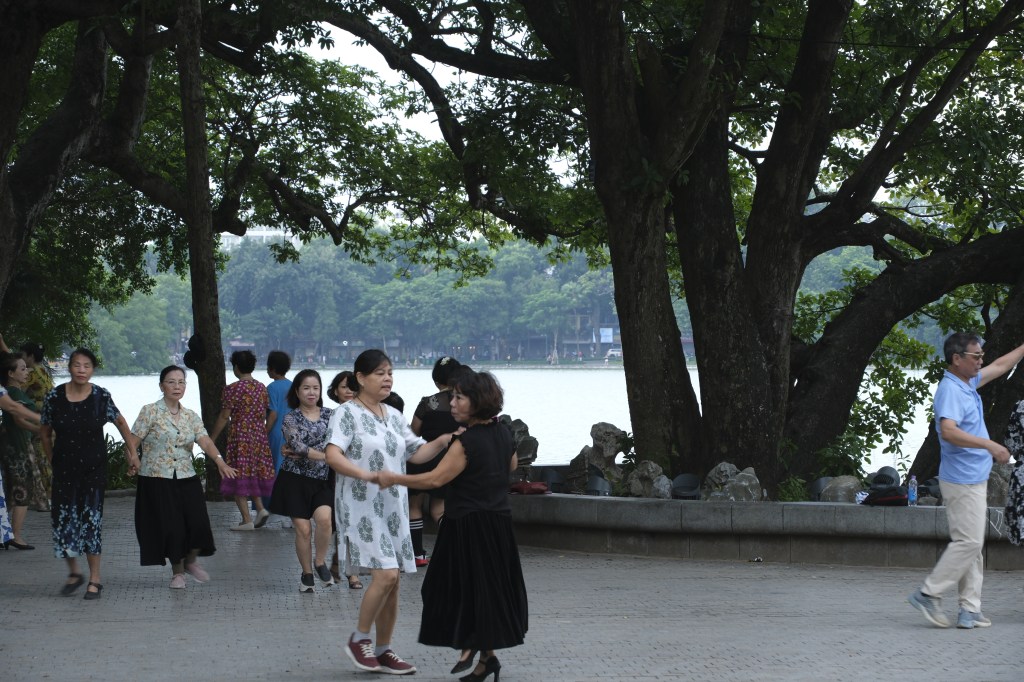
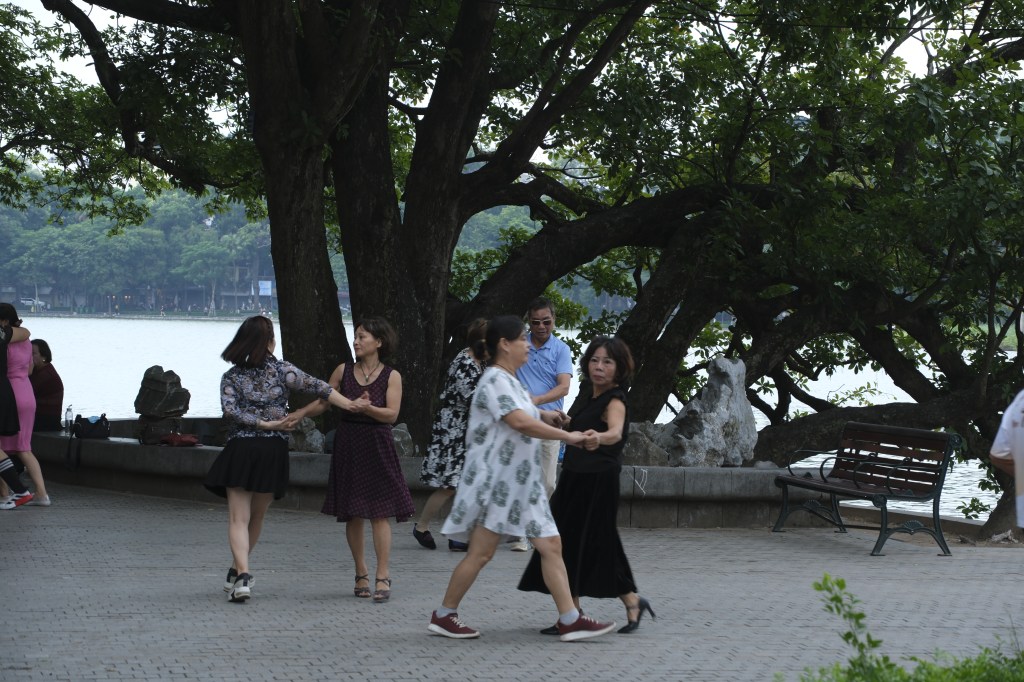
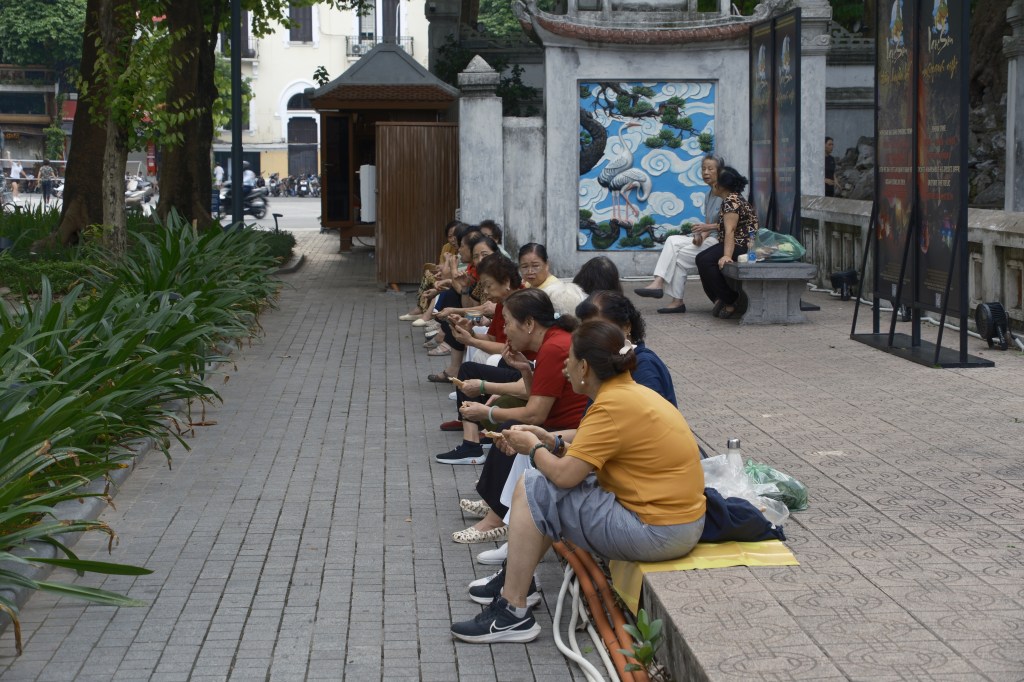
It was an early night, as we wanted to get up at 6 AM to go to the lake to see all the morning activity. Taking our lives in our hands, we crossed the busy streets with scooters and cars aiming for us. The word was. “Do not run across the street” as the cars and motor scooters steer around you and if you run they cannot judge how you plan to go. Once you get the hang of it, it is not difficult. The park around the lake wakes up to many activities. I joined a ti chi class of older people figuring I could move as much they were. What fun. The instructor smiled, gave me the thumbs up and was quite enthusiastic to have me as a pupil. After a bit, I bowed my good-by to him and continued on my way. A bit farther around the lake, I found a group of men and woman dancing. Again I joined in and had such a good time laughing and dancing with 5 women. All of them dressed to the nines and me with my “tourist” clothes.
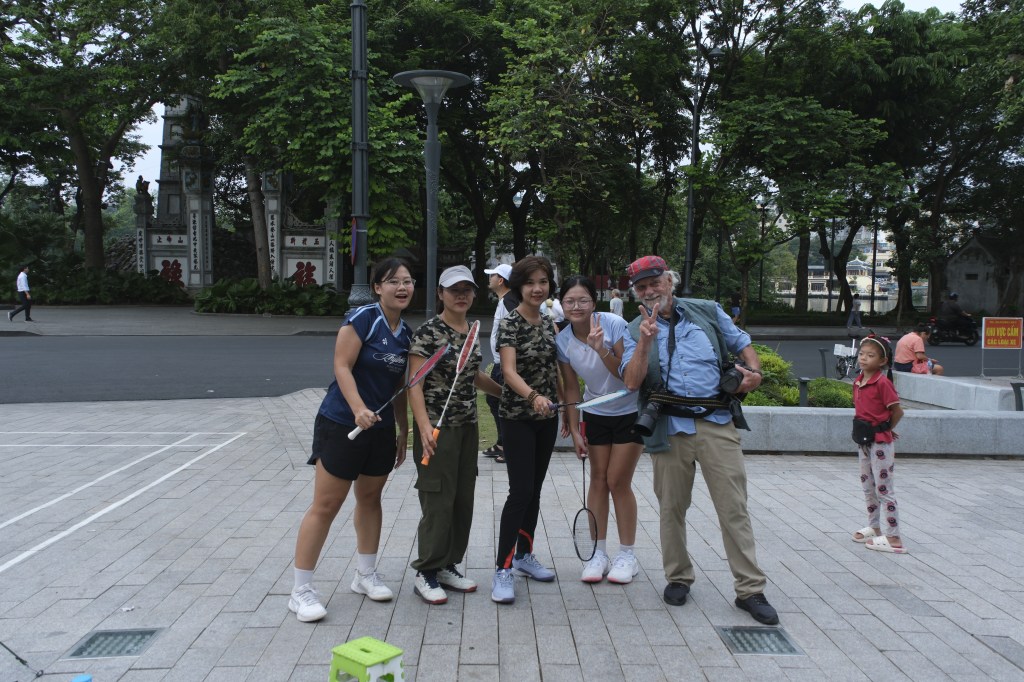
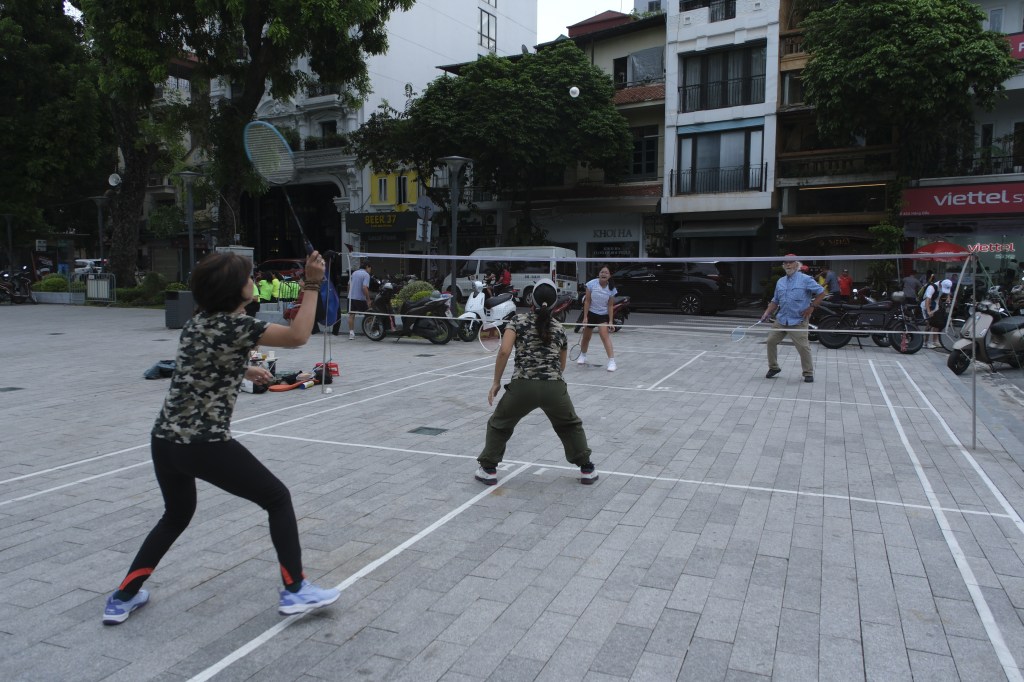
Shap meanwhile was missing, so I traced my steps back and found him playing badminton with three young girls. He definitely kept up his end of the game. And he was so happy to have found them. Hours later we headed back to the hotel.
The rest of the day was spent taking some of the woman shopping, a much different experience than the day before. Woman are so much more fun to be with when picking out clothes. Back to the hotel to meet the rest of the group, off to a fabulous lunch, then for a slide presentation by David Julian our instructor. This gave us a taste of where we were going and many ideas to mull over for photographing. Lastly we all trooped in the pouring rain for a half hour walk to “Train Street.: This is a street that is so narrow the train takes up the entire street. People line the sides crowding into a cafe, waiting for the train. When it is about to arrive, a whistle is blown and everyone is shoo’d off the tracks and told to tuck all feet under a chair. The whole event is quite spectacular and despite the fact it has become a tourist attraction it should not be missed.
Up at 5 AM, another day of pouring rains, we all have these enormous raincoats that envelope us so we look like blobs with feet,
This will probably be my last post from Japan as we leave very early Tuesday morning to head back to Montreal and Stowe. Let’s talk about the train system in Japan. The trains arrive to the second, they are incredibly clean, and the signage where you need to stand to get into your particular car is excellent. The speed of the Shinkenhansen, the main train line between major cities, gets you to places so quickly you can understand why it is the way people travel throughout Japan. The tracks are smooth, the cars are immaculate and the seats are comfortable. I cannot understand why the U.S. does not make an investment in the rail system as it would solve so many issues with our crowded highways, and an alternative to flying. Even the local trains are fast, efficient, and clean.
Of course, one should know when someone says, “You won’t have any trouble finding your train”, you might as well figure the opposite will be true. You arrive at the train station, people are bombarding you from left, right and sideways, rushing toward some train, somewhere. Meanwhile you are standing, probably right in the way of people, gaping at the time table as it flashes at you in Japanese. Now you know it is surely going to change to English, as it does in every station, but until it does you might as well stop gaping and move aside so people can get around you. But you don’t. No, you stand there with your mouth open, schedule in hand, suitcase so embarrassed by you it is attempting to roll away and you pray the schedule will show up in English. When it does, your train or the name of your destination is not on the board. Seconds later it is back to Japanese and you are screwed until it rolls around again.
Eventually you see a time that looks like the time you are to board. If you are lucky you might recognize the name of your destination or else it doesn’t show at all and you have to figure out the final destination of the train, while determining if your stop is on the way. And throughout this process it has flipped to Japanese many times. As if this is not enough, you must buy your ticket. You have to find out where to buy the ticket, hoping you can find a ticket booth instead of approaching one of the many machines that spits out tickets. Those machines just act like sentinels of guards so foreboding you instinctively know you can’t conquer them.
You make it to the ticket booth, mind you, there is about 10 minutes between train transfers, and you desperately have to go to the bathroom, but you don’t even consider trying to find a bathroom because you might not make your train. The ticket taker points to the machine and there you are, back facing “The machine.” You approach and wow, you can select English as your language, you go through the menu, pick your destination, put your money in and out spits the ticket. All in about 5 minutes or less.
Then it is a dash to the right gate, get in line only to find you are not in the reserved ticket line, dash to the section of the train that has reserved seats, and throw yourself through the door as it is closing. Grab your seat, sit down and then you realize, you never went to the bathroom and you have an hour to your destination.
We met a thirty year old on our train to Uno who had just as much trouble figuring out the trains. So we know it is not our age. Did I mention that sometimes you have to carry your suitcase up and down many fights of stairs. Warning to all of you heavy, large bag travelers.
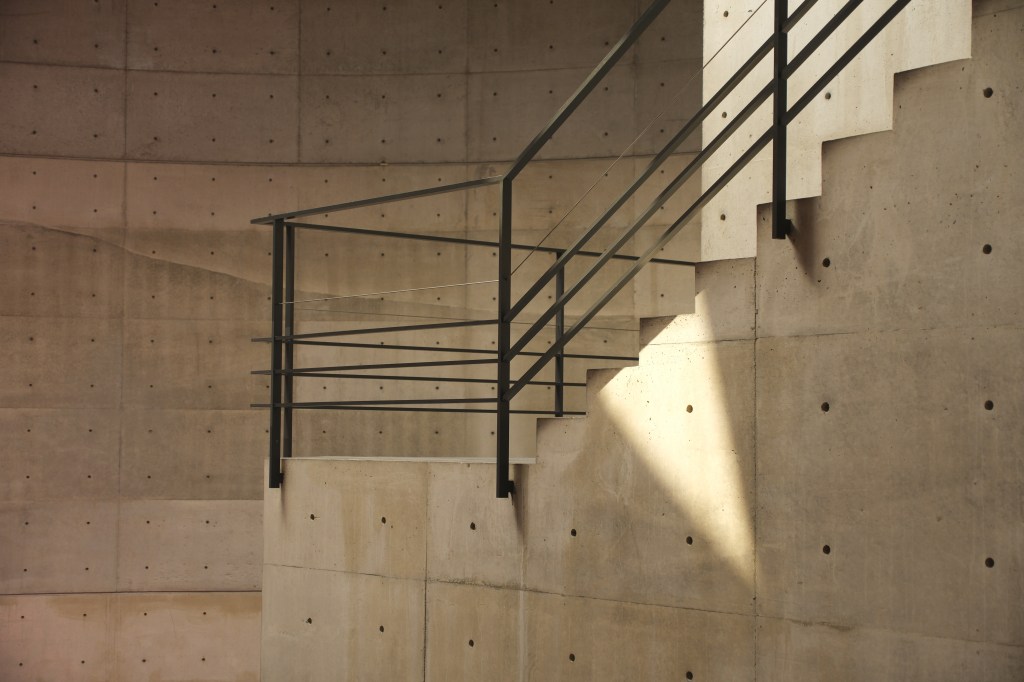
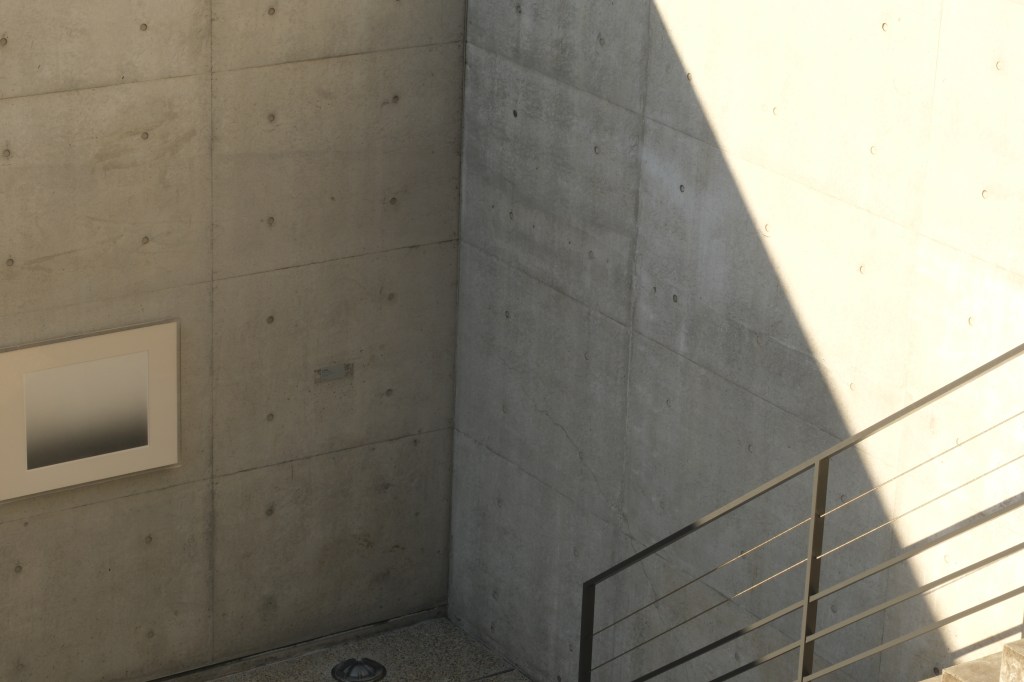
We were headed for Uno where we were catching the ferry to Naoshima Island for an afternoon of touring the island to see all of the famous outdoor sculptures and to go to the Benesse Museum. We really should have had several days, as the island is filled with museums, outdoor sculptures and magnificent views. The famous pumpkin sculpture by Yaoi Kusama is nearby the museum while the”cat” by Niki de saint Phalle stands along the roadside. Other beautiful sculptures dot the hillside looking toward the ocean. Inside the museum are some of my favorite artists, Frank Stella, Louise Nevelson, Giacometti, Lichtenstein, George Segal, and many more. What is truly amazing is the architecture of this museum designed by Tadao Ando. This museum was designed with large openings to allow the natural beauty of the island to be seen through large windows, or balconies therefore creating a space for nature to shine with the works of art.
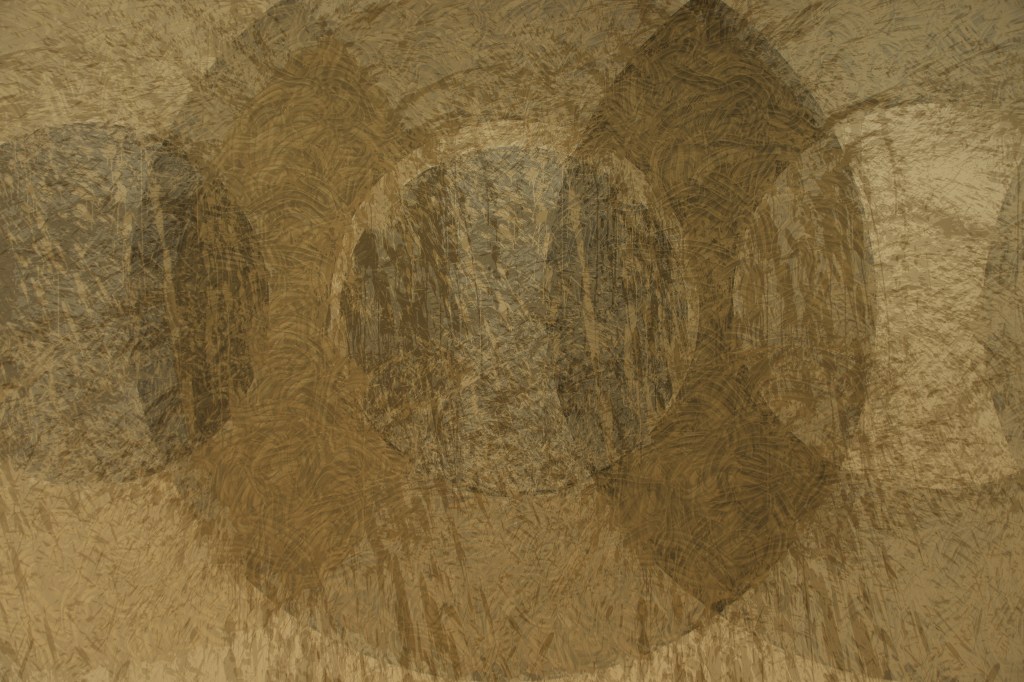
I have included some of my multiple images as this building and the surrounds spoke to me to try to express this art differently. Of course, the pumpkin is so famous I did not have time to create a multiple image as there was a line of people waiting to have their picture taken in front of the pumpkin. I had seconds to try to get a picture without people .
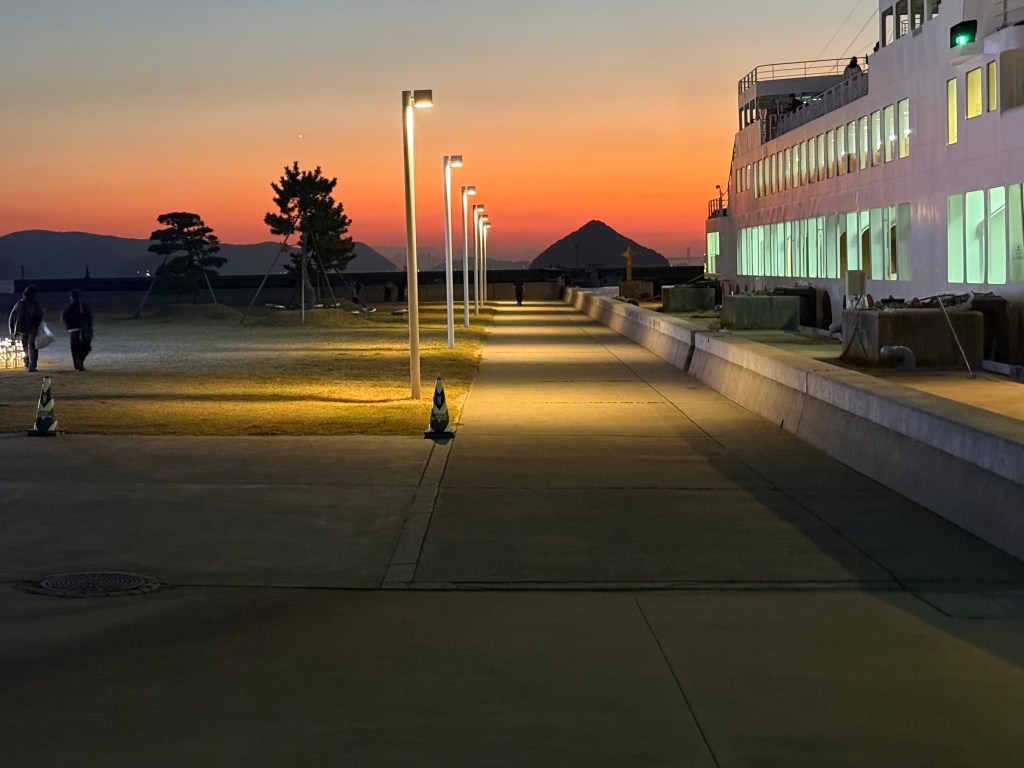
A ferry ride back to Uno in the dark, showed us the island in the last light as it pulled away from the terminal. Good-bye for now, perhaps you may get one more blog from me.
Yesterday was a travel day from Kizo-Fukushima to Nagoya, another major city which is known for its famous Nagoya Castle and the Atsuta Shrine. So there was not much to report except our excellent ability to navigate the train system.
The real reason we were in this city is because of the Arimatsu District, which was a town that was established in 1608 and was located along the Old Tokaido highway, a highway that connected Toyko and Kyoto. Unlike the Nakasendo Highway, this was used by the people of the area. The Nakasendo Highway was used by royalty such as the Samurai and the royal families. The old Tokaido was a pedestrian highway, few horses would pass by, and trade was done along the way by contracting people to take the wares to Kyoto or Toyko.
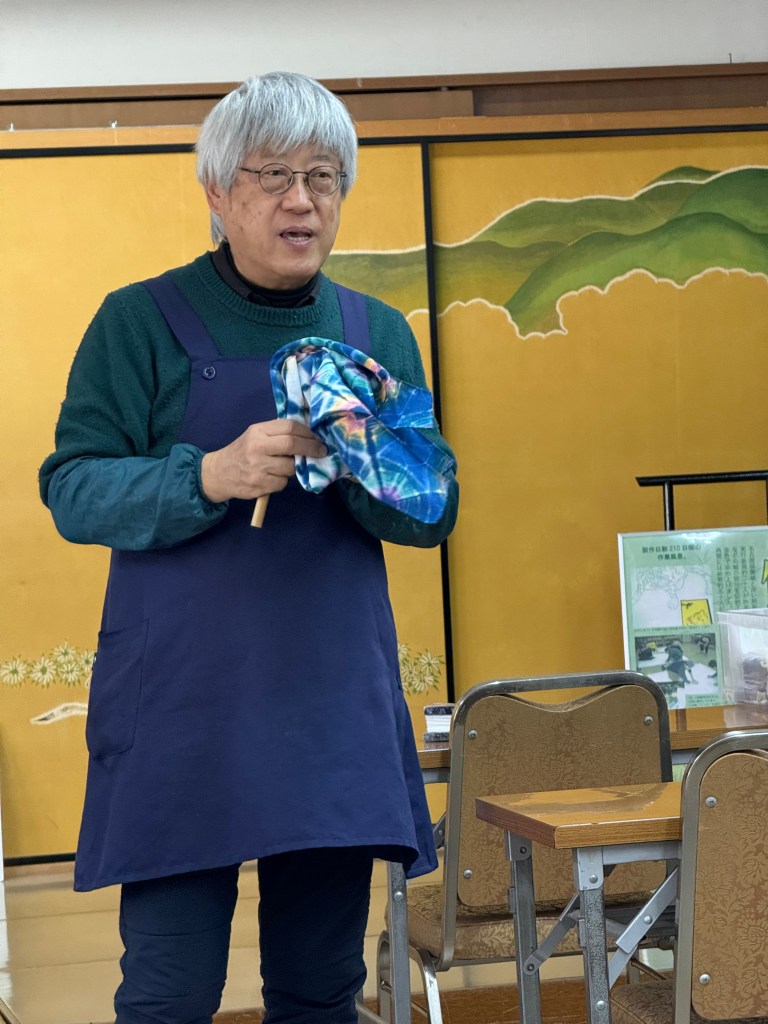
The town of this Arimatsu District was famous for the their unique form of tie-dyeing known as Shiborizome, or as we know it, shibori. This was one of the highlights of the trip for me. There is tie-dying we are familiar with on T-shirts, where we grab some material and tie rubber bands or string at various places and then dip the shirt in dye. Well, this method is like kindergarten to shibori. It was so much more complicated and the results were beyond beautiful.
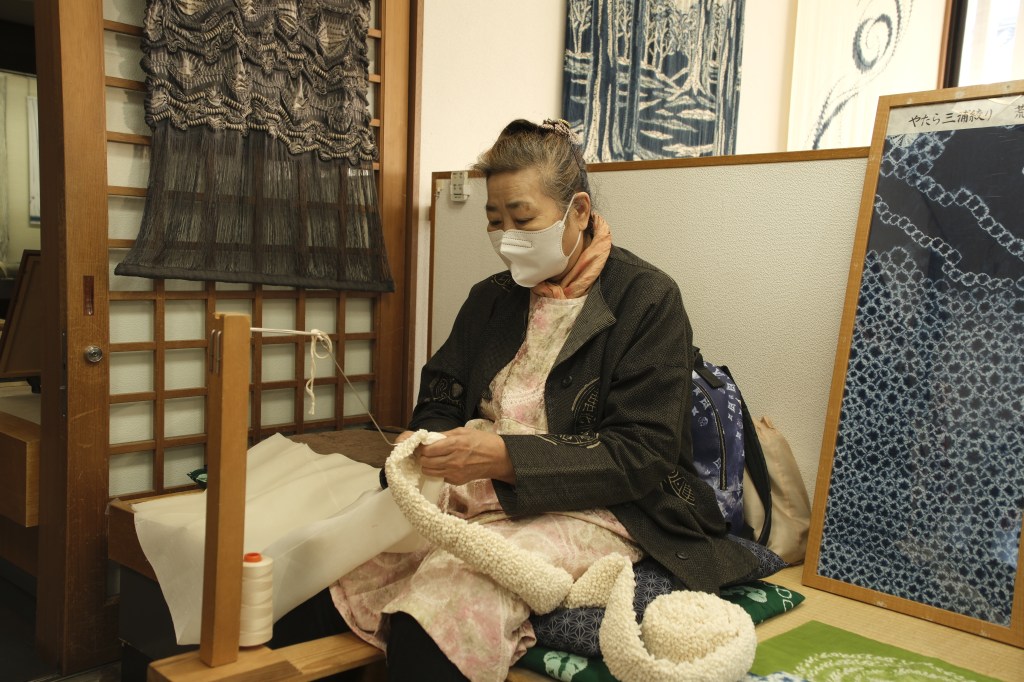
We went to a museum where there was a video of the shibori method, then examples through the history since before the 1600’s. There were two women demonstrating their methods. Each family has their own way of creating a pattern, none are written down but passed from generation to generation. If I developed a new pattern I could call it “Peggy Smith pattern.” I sat and watched while these women stitched the tiniest pieces of material together, pulling the stitch together in a circle and then wrapping the small piece of cloth that points out of the circle. It is hard to explain how it is done. They have just created this cone shape by bunching a small pinch of material together with a finger, wrapping it around a tiny wire and then winding thread around just the tip of the cone shape. Then they pull out the wire and go onto the next. Meanwhile every one of the “bumps” are in a straight line.
The other woman pleated the length of fabric, (precisely, I might add), wrapped it around a 1/2 inch round rope with a thin thread, then repeating, only this time she wrapped the material very tight with thread very close together. Then once it is tied to the rope, it is sent off to be dyed. I can’t even begin to explain it clearly but the tiny stitches and the painstaking preciseness amazed me.
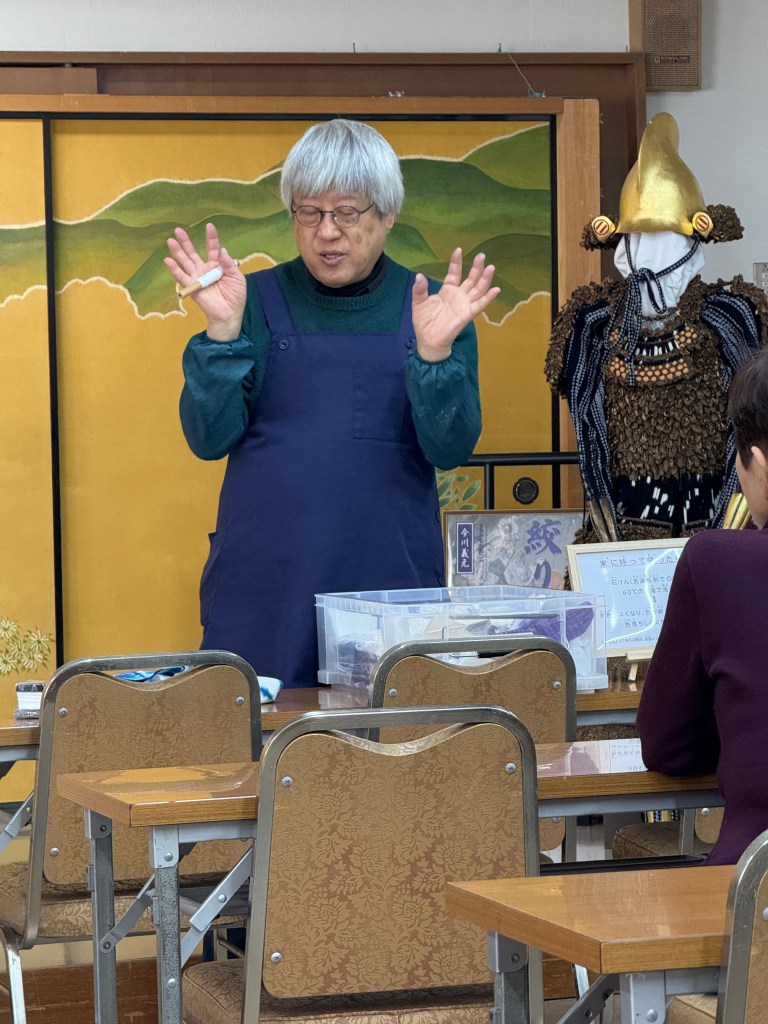
While this was going on, a classroom filled up with people. Our guide asked if I could join and I was excited to find out that I could. I was the only foreigner in the group. Our guide translated much of what he said, so I was able to learn about different methods and designs. We folded our fabric into fourths lengthwise, then folded it like a triangular, much like they fold the American flag. Next it goes between two plastic triangles, then to the basement where the dyes were waiting. Depending on how you dipped your triangle in the dye (and he had various colors) it would come out different ways. I wanted all blue. After you dipped it in the dye for a minute you take it out of the triangle and it is yellow in color. You wash the cloth and it turns blue due to the oxygenation from the air.
This was a dream come true, that I could join in this class. Along with this wonderful class, there were shops selling the most beautiful tie-dyed things, one more beautiful than than the next.
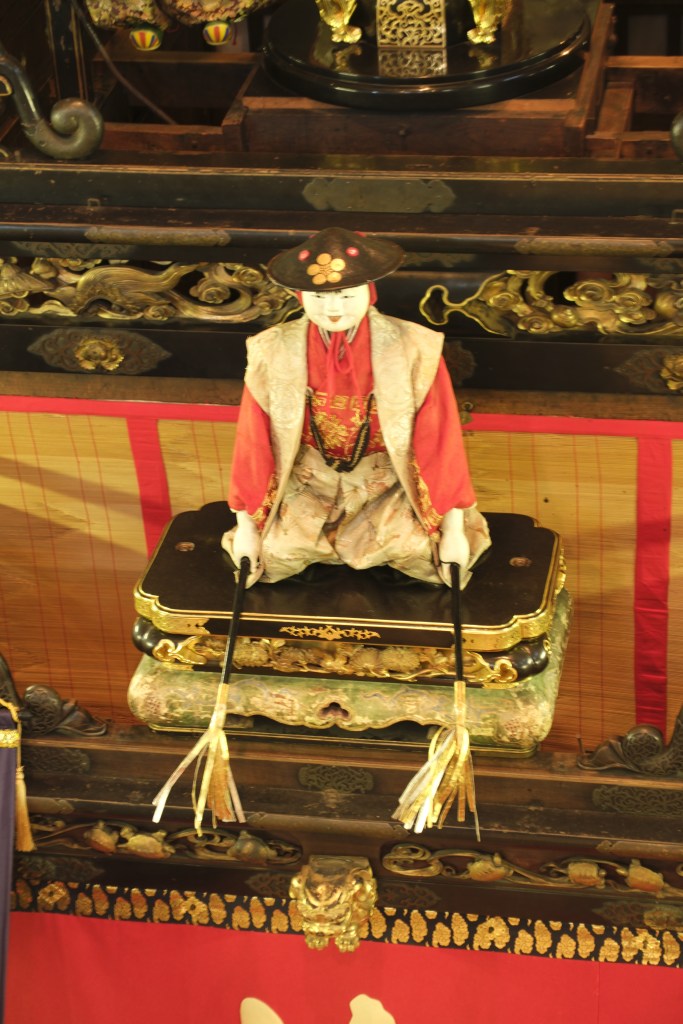
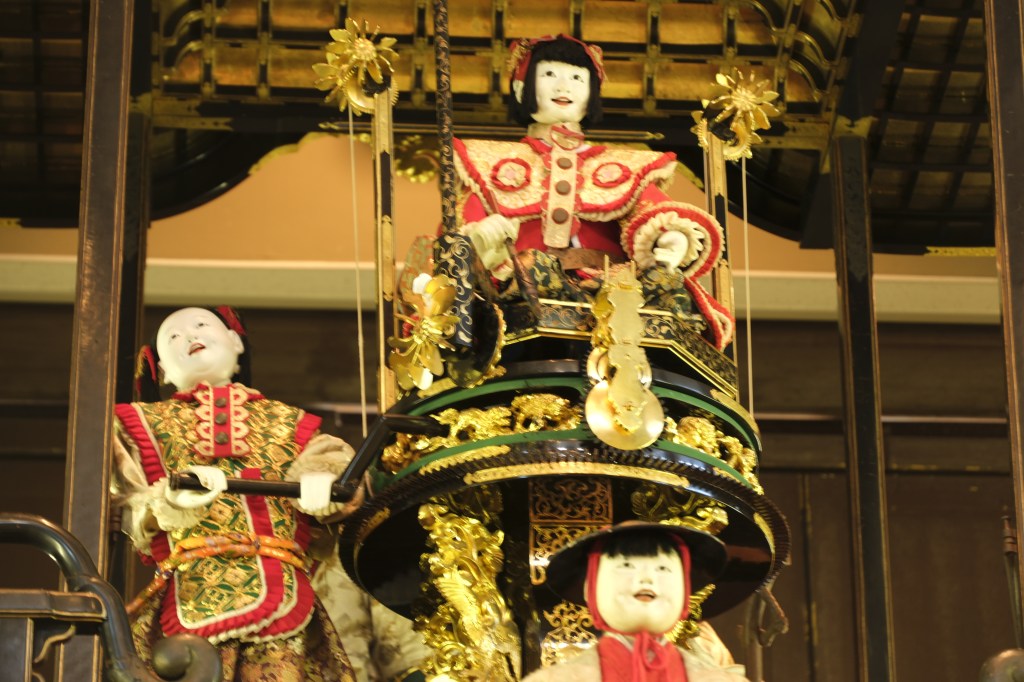
During the festivals in this area, there is a parade with a “float” that was built in the 1800’s that weighs many tons. It is carried by 20 men through the streets. In this district there are three floats, each different. The structure is made of wood beams lashed together with two long beams running lengthwise. The men put the float on their shoulders to carry it. I doubt one could even begin to call this a float. The floats have about three tiers, each getting smaller than the next. The float was covered with red and gold cloth with wooden puppets sticking out, depicting gods and Japanese people on each level. Inside there are 12 puppeteers to work the puppets who must walk at the same time they are moving the bodies and arms. The puppets move back and forth, they move their arms and hands and are quite life like.
Later in the day, we went to a famous shrine that is suppose to hold the sword of a god who had to fight off demons and monsters with three weapons. One of them was a sword and supposing this sword rests in the Atsuta Jingu shrine. This shrine was founded around 2,000 years ago and enshrines this sword, known at the Kusanagi no Tsurugi sword, one of three sacred treasures of Japan. You cannot see the sword, it is in a box with electric wires around it. People come to the shrine to pray. I think the sword is like Jesus, no one knows what it /he looks like, but they believe in the powers anyway.
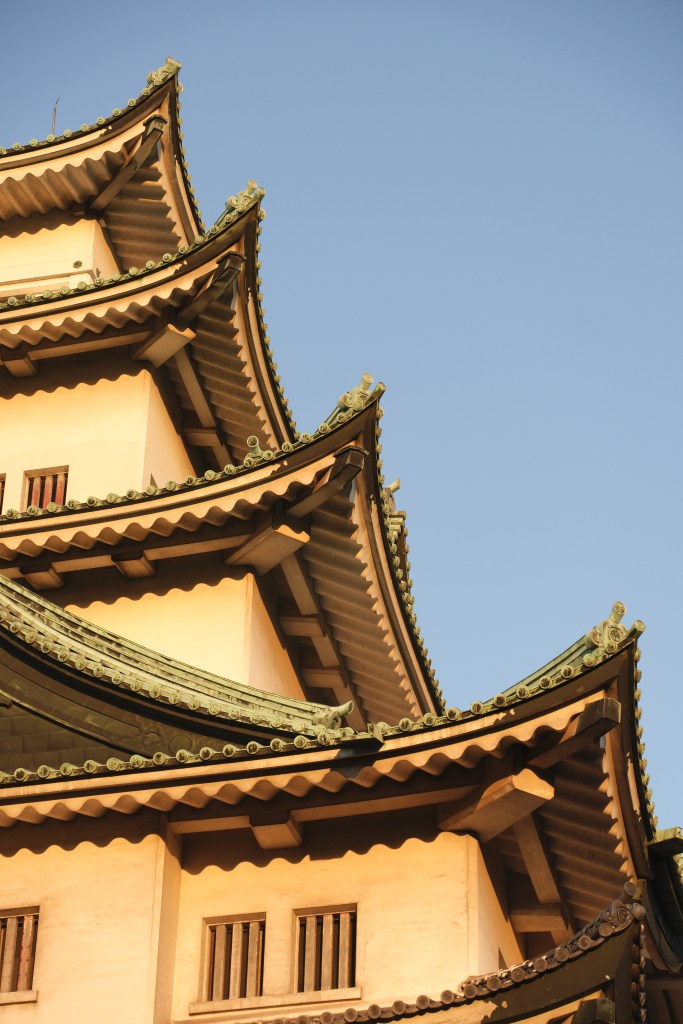
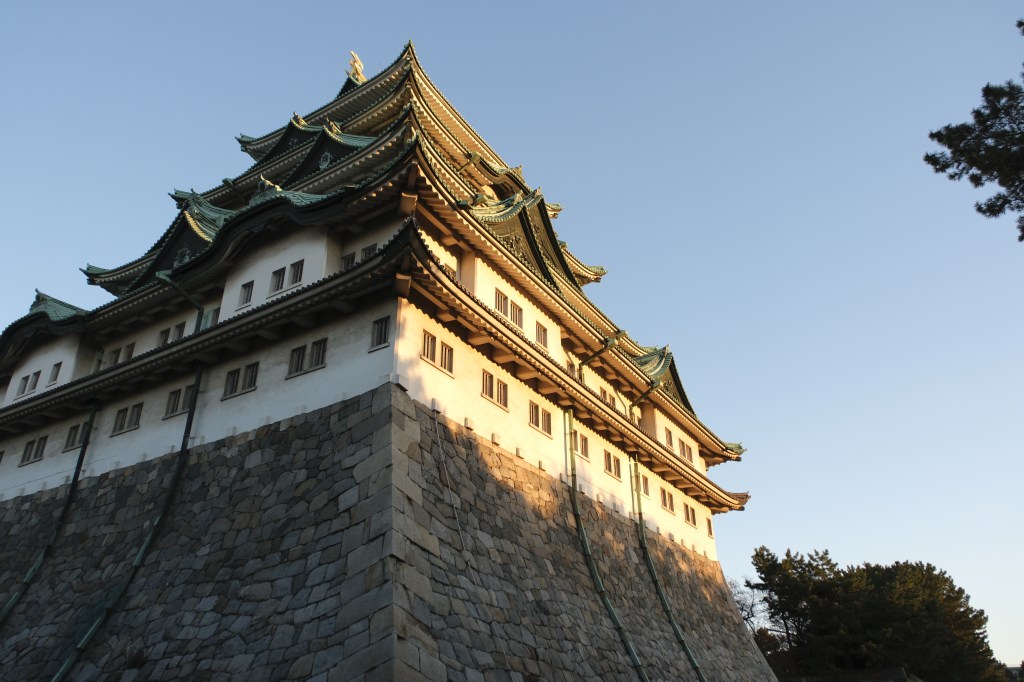
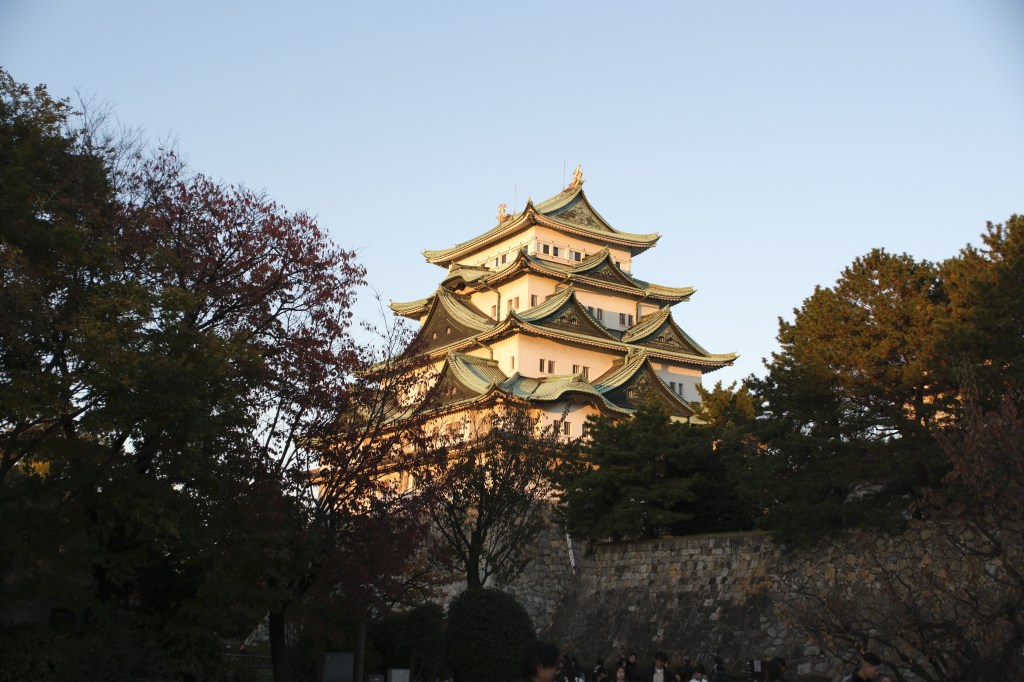
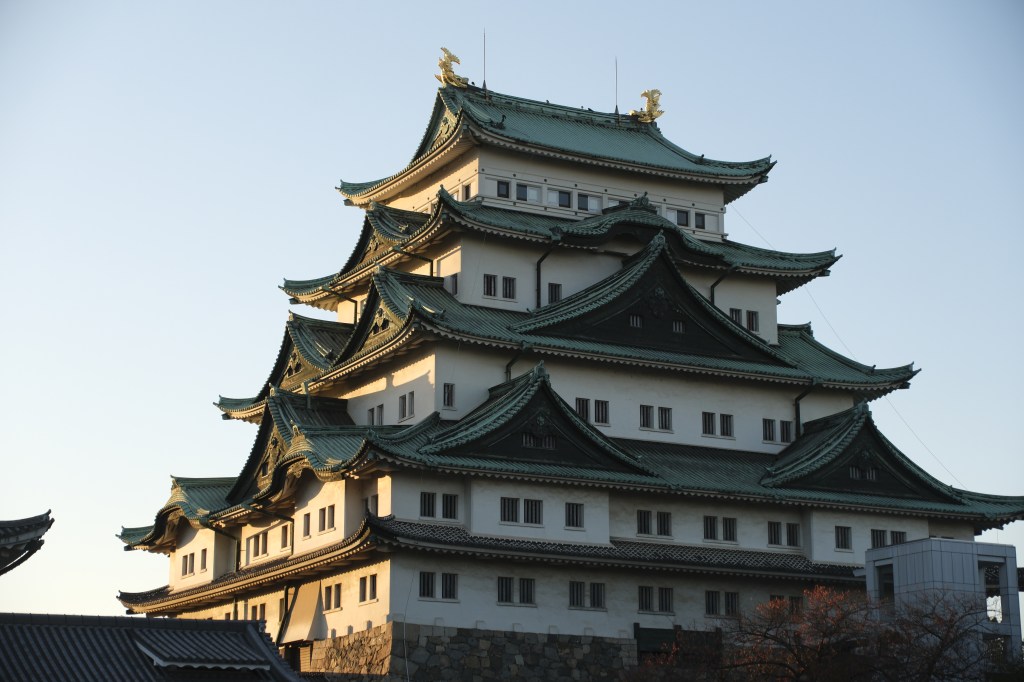
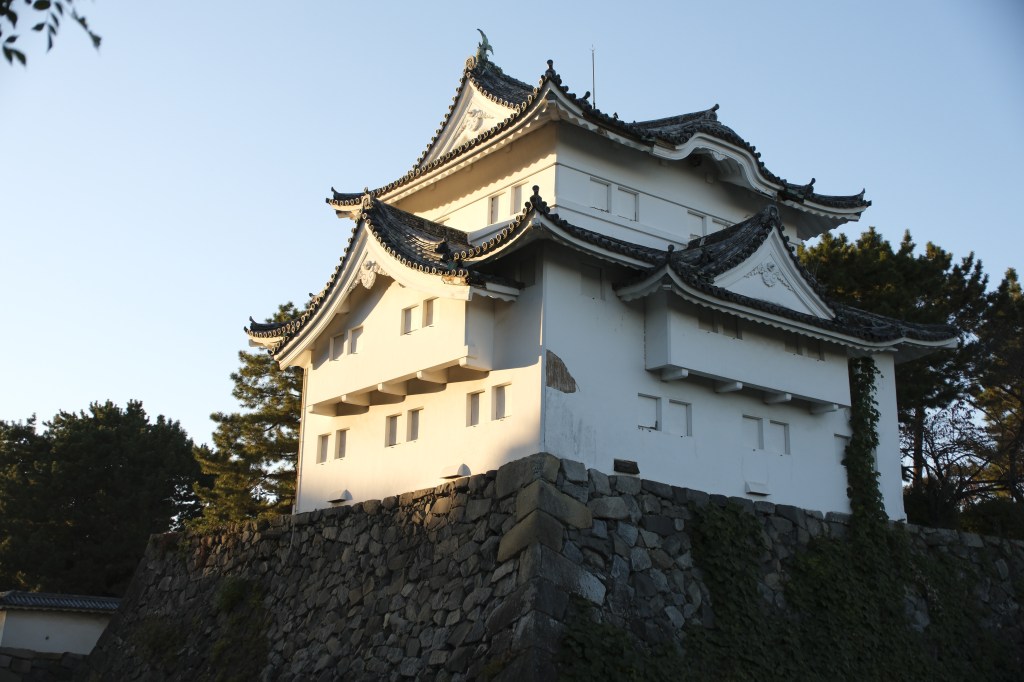
From there we went off to the castle of the Shogun, who 250 years or more, conquered all of Japan after defeating other shoguns. He and his ancestors reigned for 250 year afterwards and united Japan. In the pictures you will see the castle. The tower held the armor, and the weapons, so if there was an attack the soldiers would run up to the top floors to get their weapons. The small windows are for fighting the enemy who were trying to climb up the outside walls. If all else failed, there were small openings at the bottom of the towers where they could throw shit down the walls, making it slippery and of course disgusting. What a way to go, slipping down a wall of shit.
That is about it for the day. Our guide Saki Kelley is married to a man from Illinois, so her english was excellent. We were able to learn a lot and she was great.
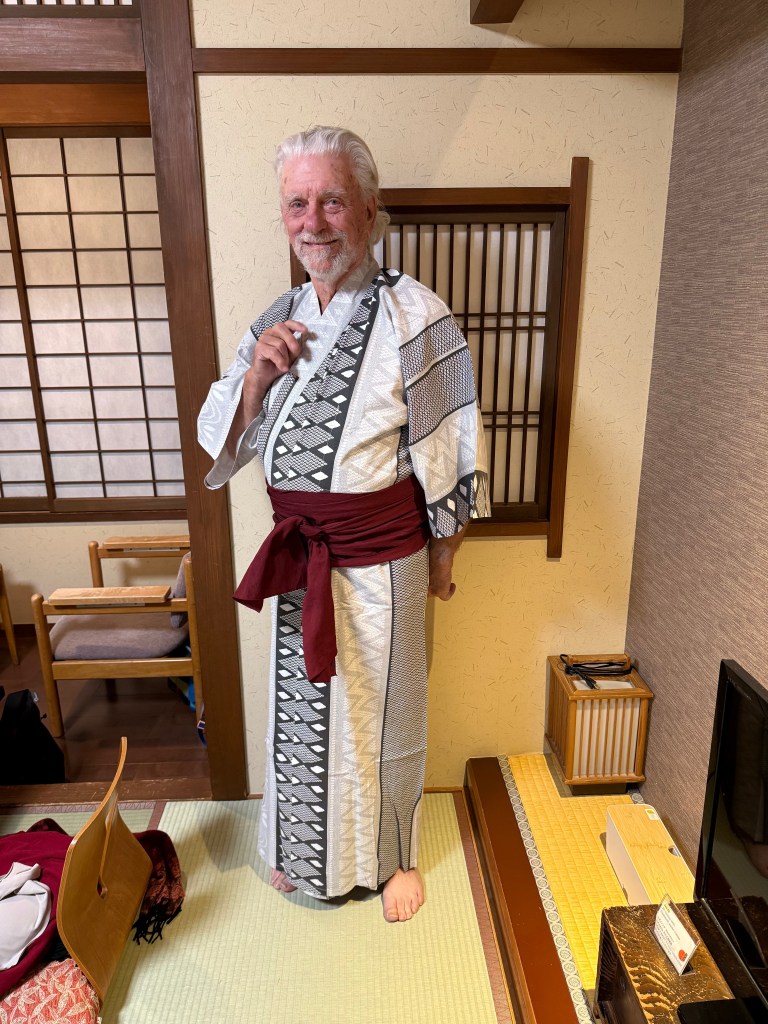
It finally happened, the dreaded Japanese meal. Yep, dinner was included in our stay at this charming typical Japanese inn in Kiso Fukushima. Beautifully appointed and arranged this 6 course meal sat waiting for us. For me this is not my first dinner choice but for Shap it is “never” dinner choice. HIs favorites, raw fish, tofu, raw and steamed vegetables, lots of mushrooms, strange things floating in broth which he was convinced were rubber bands, and finally pickled whatever. I am sure I will be hearing him mummer in his sleep, “Cheeseburger, Cheeseburger.” Despite the three glasses of sparkling water to wash down the slippery fish, he did well. Doesn’t he look happy?
We arrived by train from Kanazawa to Kiso Fukushima which is one of the stops along the Nakasendo Highway. I had read about this highway and decided it should be included in our trip as the hiking seemed reasonable and we were able to stay in a Japanese Inn and experience the bath house after our hike.
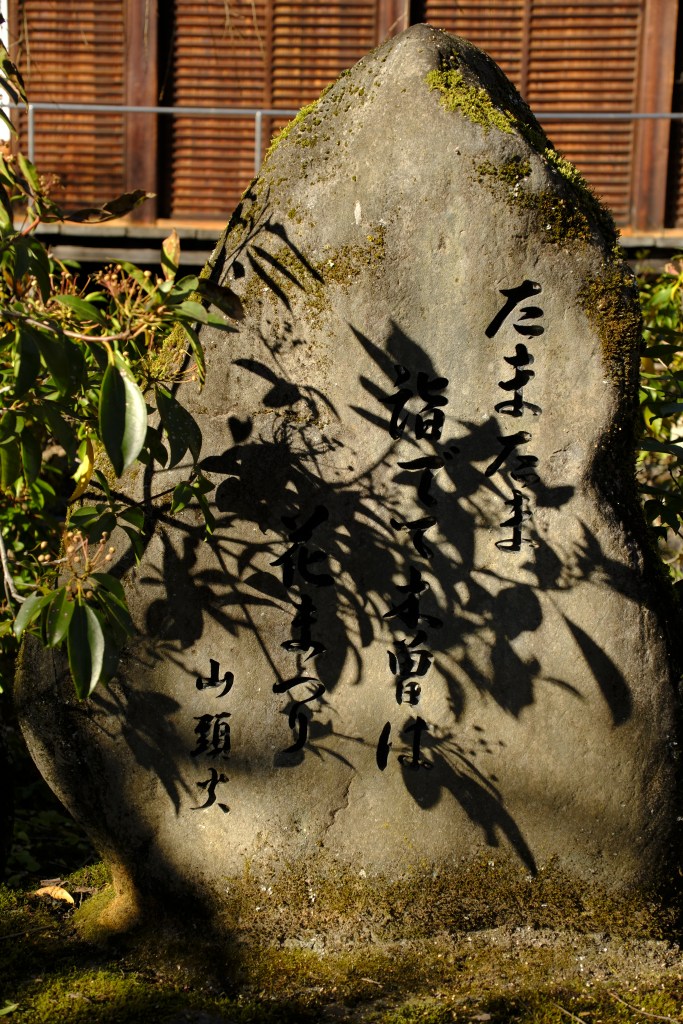
The Nakasendo HIghway was an old feudal highway that ran between Kyoto and Toyko.It was built in the 8th century and it helped to unite the state around the old capital Nara. There are 69 stops along the way and 11 of them are in the Kiso region. Our walk up the paths, past shrines,and graveyards into a forest of cedars that conjured up pictures of people “forest bathing.” The only bathing I accomplished was sweating going up hill, way above the village.
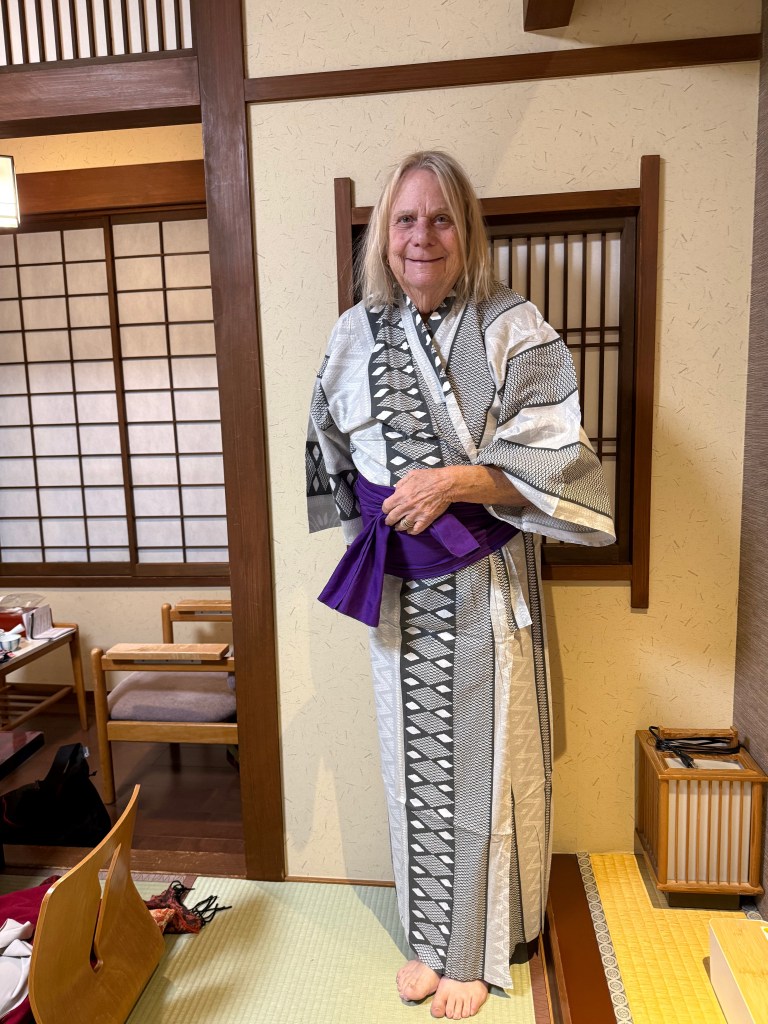
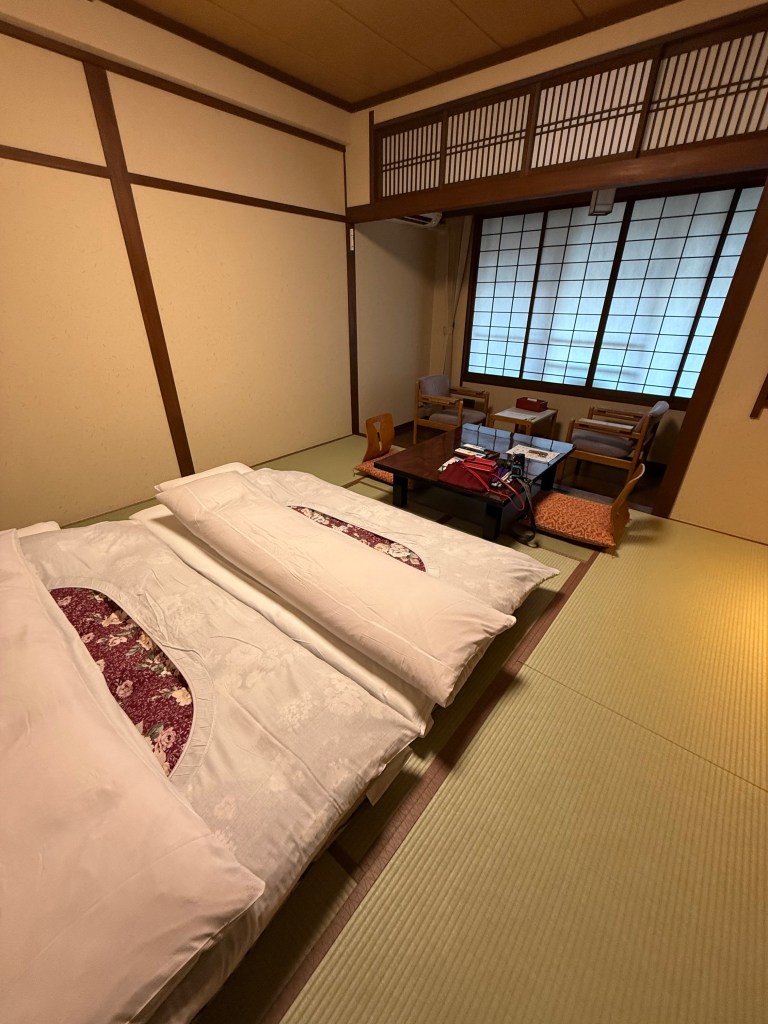
Check in time at our inn was 3:00, but 3:00 found us overlooking the village with a steep decent. Arrival at the inn was easy and quick. We soon found ourselves in our quaint room with the beds on the floor and kimonos waiting for us to wear to the bath house and even dinner. The bath house was delightful with two baths one indoors and one outdoors, separated into men and women sides. Small stools lined the walls with faucets and hand held showers, a bucket if you wanted it to wash your face, and various soaps and shampoos. After scrubbing down, I spent time in both baths and talked to some women who were walking the trail for several days. Relaxed and VERY clean I was happy we opted for this side track adventure. Back to the real world tomorrow.