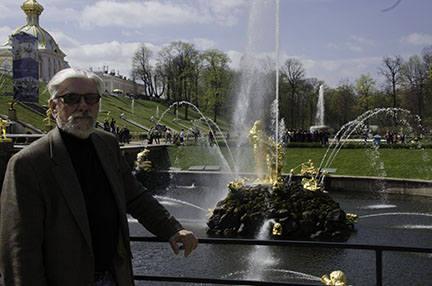
I have been thinking that the blog is getting boring and so I am looking at a different way of approaching it. Although we have studied Russian history and wars, our memory is probably not the best. I have enough problems remembering our own history. Still there are just so many times I can tell you about wars and the Romanov’s. So today you do not get a history lesson.
Walking, driving and boating along this city’s streets, canals and walkways your senses are bombarded with the pure wealth of the eighteenth to the early nineteenth century in St. Petersburg. You imagine what it would be like if you were not part of this aristocracy or an accomplished general having worked your way through the ranks.
Take St. Isaac’s Church, which has 112 marble columns holding up the church and the dome. You were probably a peasant or serf brought in from the country to work on it. And if you were one of the peasants that applied the mercury filled gold paint to the top of the dome, you got to die of mercury poisoning. Workers were expendable and died by the hundreds building these buildings. No wonder there was a revolt.


What strikes me in this city more than any other is GOLD. Every building and room seems to be covered in gold accents, and I am not talking about tiny accents. Elaborate carved moldings and frames around mirrors and wall paintings everywhere. Gold chairs with brocade cloths, gold clocks, gold statues, gold candelabras’, gold, gold, gold inside and out.
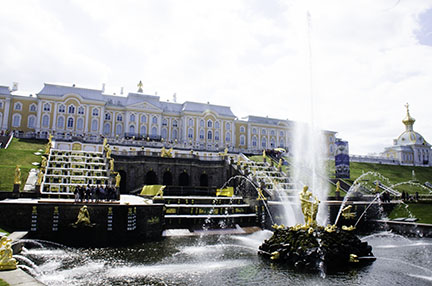
Peterhof, a summer “suburban” residence about a half hour away from the city by hydrofoil is the ultimate statement of GOLD. So today, I am dedicating this blog to pictures instead of words so you can fully appreciate the meaning of GOLD.


And now for a few pictures of the inside of Catherine the Great’s summer palace! This palace was completely burned out and destroyed by the Nazi’s who lived in it and took everything including the famous Amber Room. However, before the siege the Russians were able to bury a lot of the sculptures and move most of the pictures to the Ural’s. In 1954 they began restoring the palace from pictures and by piecing together fragments scattered around the grounds. All the gold today is gold paint with ground gold in it, but originally it was all gold leaf. Think about how accomplished all those peasant craftsmen were and never got recognized. The outside of the palace on the right was all in gold in the time of Elizabeth the ruler before Catherine the Great.


 Go wild with the Smith's