May 26,2017: From Border Arrest to the Insane Asylum

After experiencing the Border arrest in Russia, Shap and I ended up in an insane asylum in Berlin. Before you ask, how can they get into this much trouble, let me explain. I set up a photo shoot with a photographer before I left the U.S. His specialty is abandon buildings. About forty minutes outside Berlin, is an abandon insane asylum that was built in the late nineteen- twentieth century by the Germans. When the Russians took over East Germany, they used them for offices, and a small section for the insane. Now they sit completely abandoned with no fence around them, areas of access with deer and wild hogs roaming around.

Nathan Wright, a Brit who came to Berlin for a 5-day visit and is still here after 8 years, specializes in photographing abandon buildings. He has been exploring these buildings all over the world. He definitely has an eye for creating the scene. Besides this, he is great at helping you with your camera settings.

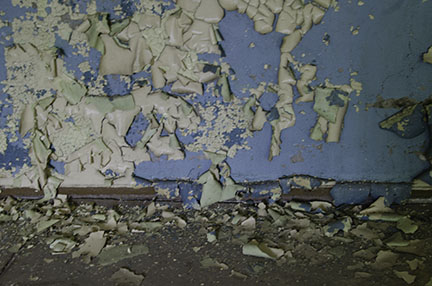
We parked on the side of a road, headed off into a field, and then onto an overgrown pathway surrounded by a jungle of trees that must have been beautiful lawns at one time. The first place was easy to get into, as we went through a door and up a set of staircases. Most of the rooms have peeling sick-colored yellow paint that I figured was full of lead and was definitely painted during the Russian period.

Under the yuck-yellow paint, was a blue color left over from the Germans. I seriously think that there must have been some morbid person that sat in a factory and looked at paint chips that would drive people even more insane. Every wall and window sash was peeling double layers of paint. At one point I took a picture of a wall that looked like a waterfall of peeling paint.

falling paint 2

The eerie atmosphere of the rooms, the dirt on the floors, the old bathtubs, and toilets, the rusted out washers and old belt dryers, abandoned pipes, broken chairs and old operating tables added to the ghostly empty feeling. Hallways extending the length of the building with old shoes, newspaper, and receipt books scattered here and there created incredible pictures. Five different buildings with low light was a challenge, but the light created some amazing pictures.

Typical of me, I arrive on the scene and my battery ran out. I was in Cuba with a wide-angle lens when I should have had a portrait lens; I am now at the beginning of the day without a battery. I was able to get a couple of great pictures before it completely died and then some with the iPhone; of course I had to borrow Shap’s because I left mine in the hotel. You can see how this day went. I did borrow Shap’s fixed 100-lens camera, which gave me some pause for a bit, but then the lens and I came to an understanding, and I enjoyed the rest of the day.

We troop around the various buildings going through some pretty iffy rooms,but the next shocker was from Nathan who says: “ Do you want to go down in this hole to the basement or climb in this first story window?” I look at the window and it looks like an accident waiting to happen for me. I can just envision my head on one side of the window and my ass hanging out the other. Since my knees don’t work that well anymore I figure there was no way I could rely on them to help. So off to the hole in the basement, where Shap hops down to the first level right into a cloud of bugs. At this point I decide that the best thing that I could do is stay outside. But Shap would not hear of it and so I dove into basement through the bugs and onto the floor. Then we had to duck down through basement pipes that were wrapped with asbestos and continued up a set of stairs that were shaky at best. Nathan kept saying not go anywhere unless he told us, as half the building was burned out and the floor was falling through. However, we did get some of the best photos at this location.

At some point our age came up with Nathan and his statement was “You are the oldest couple I have taken down through that hole in the basement.” Great, does that make us stupid or cool?


Just so you don’t think we were done with border guards and police on trains, I want you to know that on our way home on the S bahn, we got kicked off the train. The ticket Nazi came by and asked in German why we did not have out ticket punched. I understood what he said, but just kept saying in English, we don’t understand. Best line of defense is to act dumb and pretend you have no idea what is going on. Finally, he says “Get Off, get ticket punched. “ In all my great wisdom I advise Shap to ignore him and stay on the train, as it was slowing down. The ticket Nazi starts yelling at us from halfway down the car to get off. So we finally got off the train and he yelled for us to get out ticket punched. I kept saying where, where? He motioned to a small red box where we punched our ticket. How ridiculous was this? We had obviously bought the tickets, we had not scammed the system, so why we had to get off to punch our ticket, I have no idea, just another autocrat pulling his weight around. Shap and I survived another incident on the train, once again.


Last day in Berlin, on to Norway.


May 23, 2017: Berlin


We have been in Berlin since Sunday, what an amazing city. I have not been here since 1965 and there is no question that this city has had a transformation. When I was here most of the buildings were bombed out facades and the streets were a wreck, all broken up. It was worth your life to walk around and not sprain an ankle there were so many holes in the sidewalk.

Checkpoint Charlie is now preserved exactly where it stood. It brought back memories of going over to the East Side and being warned to stay in our group and not to say anything, just go to the museum, and do not take pictures. This is where I saw Queen Nephrite’s statue and was completely in awe of it. It is still here today.

What I saw then on the East side was a lot of Soviet style grey apartments and buildings ,also bombed out, but everything was in worse shape. Today it is hard to tell the difference or where the wall was. There are remnants and cobblestone placed along the street to remind us of this. We visited Bernauer Street where the apartments were right on the wall. People were jumping from the windows until the East German police bricked up all the windows and put barbwire on the roof. They evacuated the apartment houses and eventually put up a wall behind the apartments. Then they demolished the apartments and between the new wall and on the site of the apartments they built a higher wall, creating a no man’s land between. Having lived through this era, seeing the pictures on TV, and reading the descriptions and pictures at the wall with the guard tower, it all brought back many memories.

Looking through the wall to the East Side today

According to someone we talked to, you can still see the influence and feel the difference in the East side of Berlin from the West even today. He also said that each sector (the American, French and British) that was developed after the war has a distinct flavor.To me, Berlin looks completely modern with small reminders and government buildings that remain the same.

Apparently, Berlin has the least amount of cars as any city and I would say this is true. They have the most amazing bike lanes, which protect you from the traffic. It seems that everyone is on a bike. There are bikes with carriers in the front for small babies and groceries. There people going to work, riding in the Tiergarten but the hardest thing was staying out of the bike lane, as a pedestrian you share the sidewalk with the bikers.

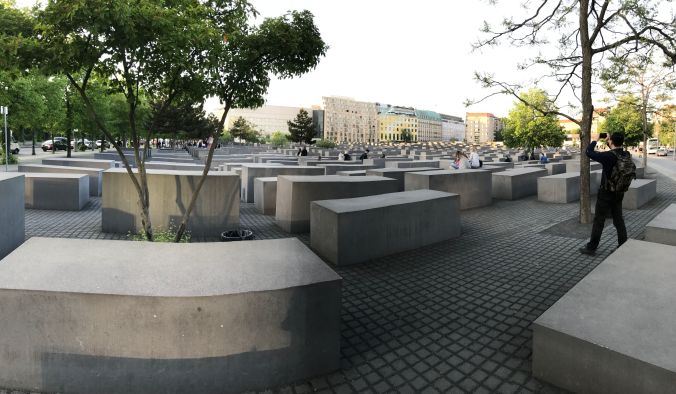
We had the most moving experience at the Jewish Museum. There is one tribute near the Brandenburg Gate that you will see below. These rectangular stones form a maze that you walk in and out of, no names just a silent walk through them. Below them is a museum dedicated to the Holocaust where some of the displays hang in corresponding shape to the stones above as if they came through the roof. There are stories of families with some surviving relatives who gave photographs. Everyone walked in silence and reverence.

jewish tribute

Thinking that there could not be a more moving experience, we still went to the actual Jewish Museum and we were both completely in awe of this entire experience. I want to quote the architect because I cannot describe in anyway what he puts into words:

For Libeskind, “The new design, which was created a year before the Berlin Wall came down, was based on three conceptions that formed the museum’s foundation: first, the impossibility of understanding the history of Berlin without understanding the enormous intellectual, economic and cultural contribution made by the Jewish citizens of Berlin, second, the necessity to integrate physically and spiritually the meaning of the Holocaust into the consciousness and memory of the city of Berlin. Third, that only through the acknowledgement and incorporation of this erasure and void of Jewish life in Berlin, can the history of Berlin and Europe have a human future.”[13] A line of “Voids,” empty spaces about 66 feet (20 m) tall, slices linearly through the entire building. Such voids represent “That which can never be exhibited when it comes to Jewish Berlin history: Humanity reduced to ashes.

Most of the exhibit is underground and brings you from an existing building to a steel and concrete modern building with a few windows. Most of the time you are underground until you climb stairs leading to an exhibit of the Jewish history through time.

garden of exile

Garden of Exile

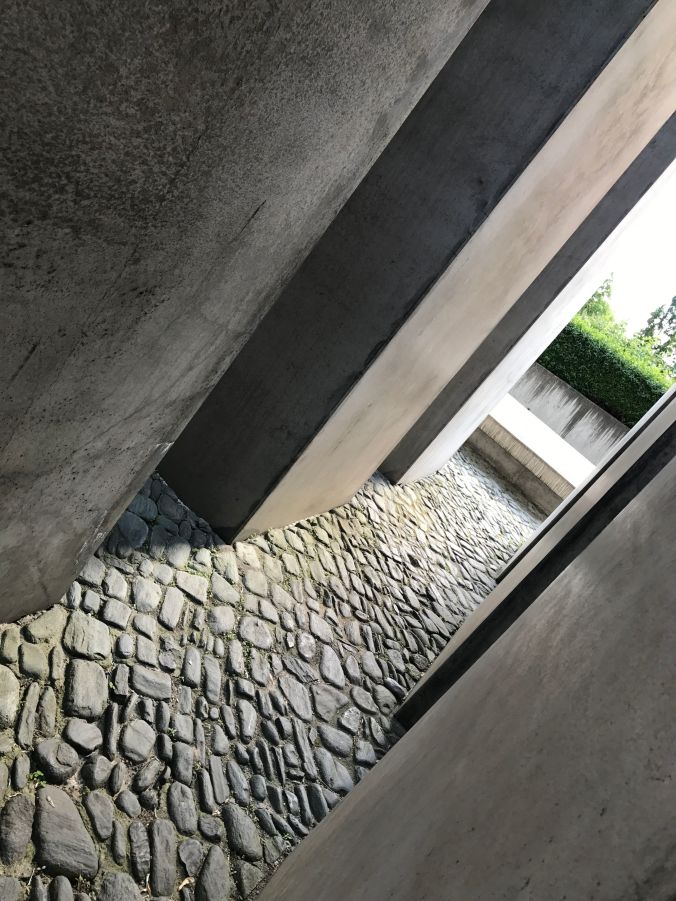
The floors are slanted giving you a sense of imbalance while you stand in the “Void,” the intersecting empty spaces. But even more disconcerting is the “Garden of Exile.”I took this picture this way so that you would have the feeling of what it is like to walk in this Garden.

To demonstrate the feeling the Jews felt when arriving in new countries, having gotten out of Germany in the 1930’s, the garden is built with an upward slant from where you enter and a tilt to the right. Again there are large concrete pillars with trees planted on top for you to walk through. Only this time you are never on sure footing, you always feel like you will topple over. So you not only experience this exile emotionally, but physically.

Garden of Exile

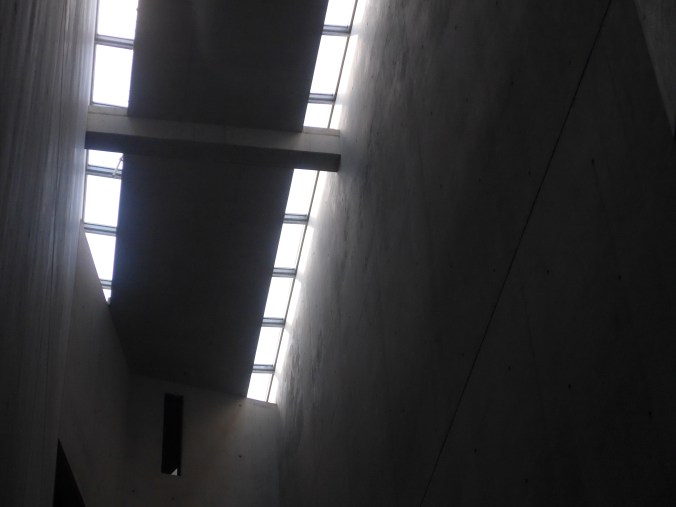
The “ Holocaust Tower” was even more poignant. I thought I was going into a tower to climb up, but instead entered a completely dark triangular room with a sky light built into the ceiling creating a slice of light directed downward to illuminate only a bit of the room. You could hear the traffic and sounds from outside, but you were standing in a black void with a bit of grey from the light. To me, it created a feeling of what the gas chambers must have felt like. To Shap, it was very spiritual. The walls leading to the light at the top was enlightening for him, that there was hope. So you see, how we interrupt our experiences different. Some people peeked in and left, I think feeling nothing. Shap and I stayed there for a long time. I am glad he saw hope, I saw the void of nothingness, of despair.

iight in Tower of terror

Holocaust Tower

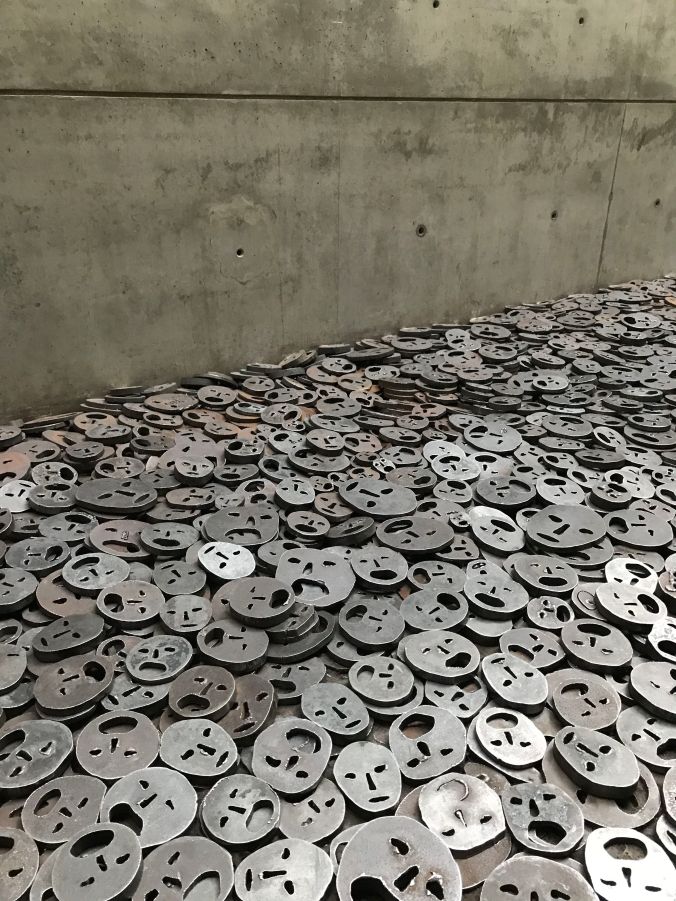
There were three exhibits that left Shap and I with indelible memories, the two I just mentioned and the third was called “Fallen Leaves” but I think it should be called “10,000 Faces.” Here is the description:

Installation Shalekhet – Fallen leaves[

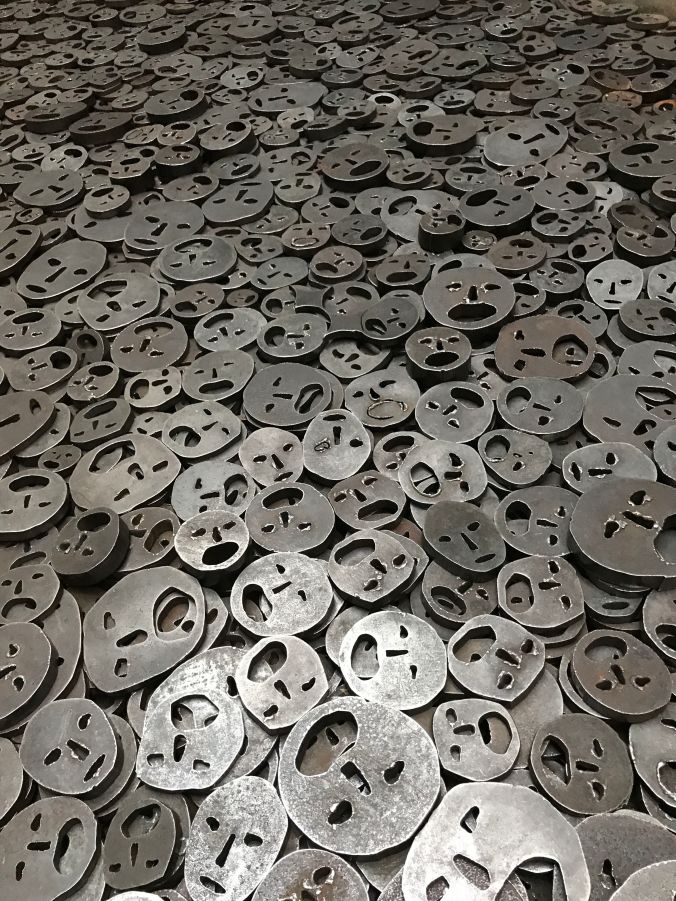
10 000 faces punched out of steel are distributed on the ground of the Memory Void, the only “voided” space of the Libeskind Building that can be entered. Israeli artist Menashe Kadishman dedicated his artwork not only to Jews killed during the Shoah, but to all victims of violence and war. Visitors are invited to walk on the faces and listen to the sounds created by the metal sheets, as they clang and rattle against one another.

You have no concept of what this does to you emotionally. You can see the picture below and then perhaps it will hit you as it did us. These metal faces are in a triangular room, again with a shaft of light, and they are all piled up on each other. It reminds you of all the pictures that you have seen of the murdered Jews laying on top of each other. One face on top of another, on top of another, scattered throughout the room, 10,000 of them. And as you walk on them the noise of the metal sounds like screams, you think to yourself, I am walking on the dead, I am hearing them screaming for us to remember them. Shap thought that the sound was of breaking glass, that it was spiritual and the contrast of walking from the light into the dark corner affected him. But this installation did not just remind one of the Holocaust, but of the thousands of people being killed by terrorists, by dictators, by ISIS. It is horrifying how genocide continues through the ages.

faces scream

faces 1

This says it all, I think.

We left the museum after three hours completely in awe of the architect and the artist that could create such an emotional experience by steel, concrete, and metal. The other exhibits are amazing but Libeskind created a masterpiece. If you never go to another museum, this one should never be missed.

May 19th: GOLD

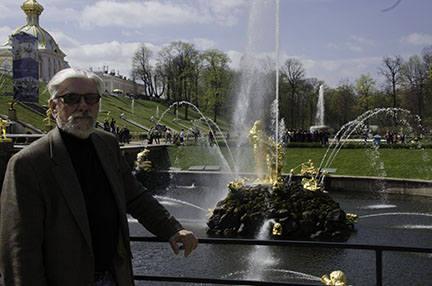
peterhof shap and fountain blog

I have been thinking that the blog is getting boring and so I am looking at a different way of approaching it. Although we have studied Russian history and wars, our memory is probably not the best. I have enough problems remembering our own history. Still there are just so many times I can tell you about wars and the Romanov’s. So today you do not get a history lesson.

Walking, driving and boating along this city’s streets, canals and walkways your senses are bombarded with the pure wealth of the eighteenth to the early nineteenth century in St. Petersburg. You imagine what it would be like if you were not part of this aristocracy or an accomplished general having worked your way through the ranks.

Take St. Isaac’s Church, which has 112 marble columns holding up the church and the dome. You were probably a peasant or serf brought in from the country to work on it. And if you were one of the peasants that applied the mercury filled gold paint to the top of the dome, you got to die of mercury poisoning. Workers were expendable and died by the hundreds building these buildings. No wonder there was a revolt.


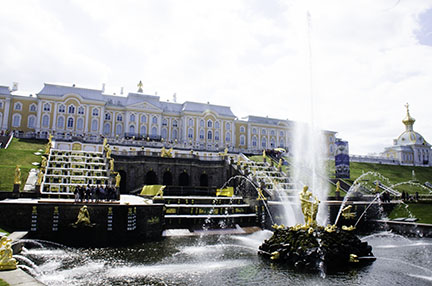
What strikes me in this city more than any other is GOLD. Every building and room seems to be covered in gold accents, and I am not talking about tiny accents. Elaborate carved moldings and frames around mirrors and wall paintings everywhere. Gold chairs with brocade cloths, gold clocks, gold statues, gold candelabras’, gold, gold, gold inside and out.

peterhof and fountainblog

Peterhof, a summer “suburban” residence about a half hour away from the city by hydrofoil is the ultimate statement of GOLD. So today, I am dedicating this blog to pictures instead of words so you can fully appreciate the meaning of GOLD.

And now for a few pictures of the inside of Catherine the Great’s summer palace! This palace was completely burned out and destroyed by the Nazi’s who lived in it and took everything including the famous Amber Room. However, before the siege the Russians were able to bury  a lot of the sculptures and move most of the pictures to the Ural’s. In 1954 they began restoring the palace from pictures and by piecing together fragments scattered around the grounds. All the gold today is gold paint with ground gold in it, but originally it was all gold leaf. Think about how accomplished all those peasant craftsmen were and never got recognized. The outside of the palace on the right was all in gold in the time of Elizabeth the ruler before Catherine the Great.

May 18th: Canal Trip and Nightlife

I have to correct an item I got wrong. Can you believe I was actually wrong? The picture in Moscow of one of the buildings was an example of the Stalin era and not Lenin. Now that I can stop feeling guilty about giving you erroneous information, we can go on to last evenings activity.

It is the beginning of the White Nights, so life goes on as if the day has never finished meaning all the shops and the bars stay open until late at night, the streets are crowded and the boat trips are very active.

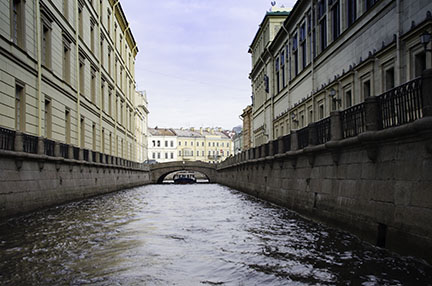
                  Traffic on the canal and a local celebrity

We decided to take the canal trip at around 7 pm, which was a good time to go as the sun was setting. There is a ton of activity on the canal and you wonder how all the boats fit and what the schedule is. Before we left a couple of guys went roaring by on their jet skis and another in a motorboat. They wove in and out of the tourist boats with the impatience of a local having to put up with tourist traffic.

canal long view blog

View of the canal and the bridges

Speaking of which, I would highly recommend anyone thinking of going to Moscow or St. Petersburg consider only going in May or September/October. Just over the past week we have seen the crowds getting larger. I cannot imagine what it is like in the height of the tourist season, as there are busloads of people and tour guides leading large groups on and off buses. It is nice having your own guide and driver as you do not have the feeling you are in a cattle car being herded here and there. The cruise ships have not even started coming. We are told they come 4 to 5 at a time. Can you even imagine? These ships carry 3000 people.

Scenes along the way. The right one is the Hermitage

The canal trip was well worth the time as we really got a feel of the city from the water and how it was laid out. Peter the Great wanted people to travel by boat and not by horse and buggy, so the canals are laid out to be like streets and grand boulevards. Many people had their own docks outside their palaces with grand highly decorated boathouses. We have not seen very many as there have been floods and of course the “Siege of Leningrad” was a time when many buildings were destroyed or damaged from the bombing by the Nazi’s.

Open water and other scenes of the canals

I love the roofs and then the dome.                   Out hotel

The “Siege of Leningrad” lasted 900 days and many of the beautiful gardens were plowed up to plant cabbage. Bread was given out that was made with sawdust. Around a million people starved to death but they eventually defeated the Nazi’s. It is a time that is still remembered by people.

After leaving our boat we headed to the main street, a wide boulevard called Nevsky Prospect (they do not call them streets). Prospect is for prospective, meaning a view to something. This is teeming with residents, tourists, street musicians, stores, cars, pick pockets, Starbucks coffee, restaurants and just about anything you would want to see or look for.


Street performers

Because the day is long (17 hours) everyone is outside enjoying themselves. We walked and gaped at all that was going on. It was a great evening and of course we had to visit Starbucks so we could send pictures back to Coulter, our Starbucks representative. We were told the coffee is better at Starbucks, than at the local bookstore cafe. We will have to check it out tonight.

          The master of the house and  his car. 

May 18: St. Petersburg… Day One at the Hermitage

hotel window 2blog

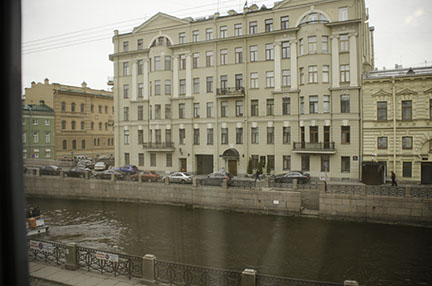
This is the view from our window in the Pushka Inn. I can see why they call St. Petersburg the Venice of Russia. The canals run throughout the city. Since it was built on a marshland, this was the way of channeling the water. Hmm, do I dare say that St. Petersburg was built on a “piglet meadow?”

                      Hermitage and the building where the army was staffed across the plaza

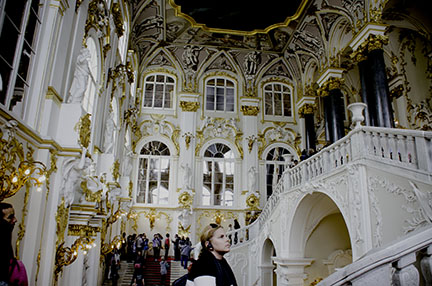
Off to the Hermitage at 10:30 this morning, with just a few thousands of people waiting to get in. I don’t think that I have ever experienced so many people heading in the same direction except possibly a Grateful Dead concert. I would imagine there was every nationality there. Cameras galore, mostly cellphones, selfie sticks, a woman tearing along the corridor snapping random pictures with no regard to what they were, and others videoing, videos. (Does that make sense?)grandstaircase 2 blog

I have cut out most of the people,there are a couple hundred coming up the stairs and on the top of the stairs

I am thinking of upgrading our house and thought you might enjoy some photos of ideas I have collected today. I am sure that I can re-create these ceilings in our house.

ceiling painted 4 blog


Actually today’s blog will be mostly pictures of the Hermitage as this is where we spent the day. Headed out later tonight for a canal cruise, and tomorrow an overall view of the city. Then headed for Peterhof to see the amazing fountains. It is quite exhausting covering these cities.

After being in the Hermitage I can see why all of the serfs revolted. I find it hard to believe that there was so much opulent wealth. Not only the Emperors and Empresses, but the merchant class also had oodles of money. Catherine the Great’s collection is remarkable. Seems she had a few “important men” in her life (think lovers) that gave her rather extravagant presents. One is a peacock clock out of gold where every animal moves and the peacock’s feathers expand on the hour. There was a video of it as they do not wind it often, it looked like not only the peacock’s feathers moved but its head sounded out the hour. Also an owl moved its head, a squirrel moved, a bug moved, I think indicating the seconds and there were other animals moving. It was quite the present.

                    Throne room(the smaller one for intimate meetings!) and a hallway that Catherine the Great wanted to have it painted like the Sistine Chapel 

We are lucky that these collections have survived wars and people are interested in preserving them. I shutter when I think of all of the works that were destroyed in Iraq and the Middle East. The Russians sent most of their work to the Urals during the World Wars. And there is every indication that this museum has been well taken care of.

mummy bolg

It houses the most ancient mummy in the world I believe our guide told us. Yuck!

                     Mary Madeline (don’t know the sculptor)       Boy done by Michaelanglo

Also paintings by DiVinci , a sculpture by Michelangelo, and many other famous Italian painters of the 14th-18th century are to be found here. French paintings, Asia art, and primitive Russian archeological items were displayed in the basement area where only a few people were admiring them. I found this to be the most fascinating. The museum is so large that you could not possibly see all of it in many days.

Gathered around the DaVinci painting we were warned about pickpockets in the museum, there are crowds close together so it is a perfect place .

mother and child2blog

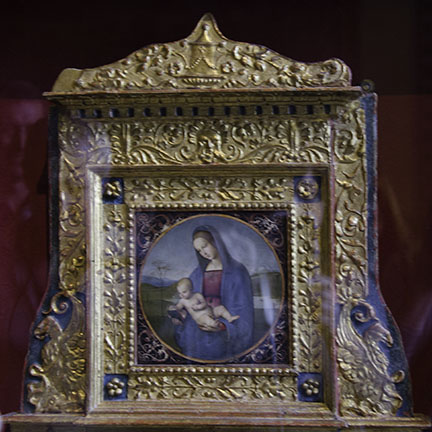
Painting of Mother and Child done by DaVinci 

This is the third warning that we have gotten since we arrived. I guess we have to take it seriously. I can see by the amount of people crowding into various rooms how easily this would happen.

mosaic floorblog

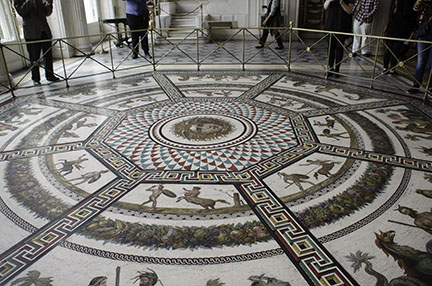
Mosaic on the floor and a matching piece as a table. Incredibly small pieces 


We are excited to be here and experiencing all of this. I am glad that we have the guides, even if I have complained about some, because it really educates us and helps us to understand the Russian history. We did have to buy a children’s book on the Romanov family since it is hard to keep them in the right period of history. There are so many Alexander’s, Ivan’s, Nicholas’s and Catherine’s, I get them all mixed up in the different periods. The war of 1812 is really a time that is glorified in Russian history as Russia was able to turn back Napoleon, that was a great feat.


We had our last train ride of the trip on the high-speed train… four hours from Moscow to St. Petersburg and very smooth. This would be a great way to travel throughout the U.S. if we could ever get our act together to improve our infrastructure.


May 12th: First Class on the #01 Train

us on the train

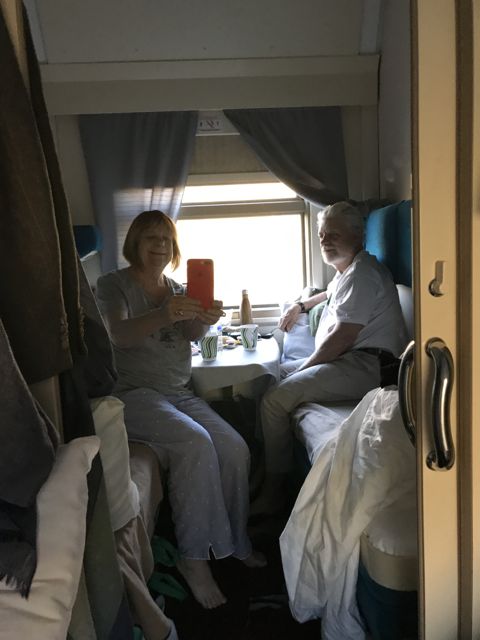
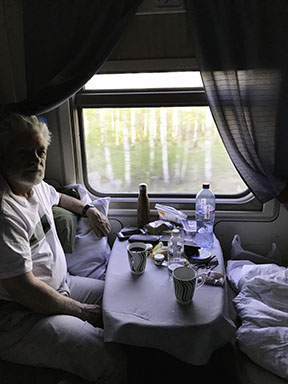
Don’t we look wide-awake in our “luxury” cabin, enjoying our morning coffee? Oh by the way Coulter, that is Starbucks Veranda instant coffee made with the boiling water from the Samovar at the end of our car. I might suggest it over Nescafe, which is available in every supermarket. Starbucks is missing a great opportunity of supplying Russia with some good instant coffee. Meanwhile, the coffee in Russia is fabulous. Each cup is made fresh, no sitting around in coffee pots.

We are on the number ONE train, the luxury train with “deluxe” first class cabins. If you had been on the Mongolia train, which had no first class and frankly a dubious second class, you would agree that this is deluxe. And if you have been on the trains in the U.S. you would also agree that it is deluxe. However, I imagine if you were on one of those Orient Express trips through Russia this would look like second-class or third. But I would not trade any of our cabins for that kind of tour. Even if you meet other people, you are not meeting the local people and having to figure out timetables, how long each stop is, when you get off and how to communicate with people.

Getting on the train, we were stopped by a severe, heavily made up train attendant in a uniform that seemed more fitting serving a Gulag than a train. Lots of back and forth with our ticket and passports, I am thinking that they have our record of “sneaking” into Russia and breaking the “Russian law.” Great, we will be stuck in Irkutsk sweeping the streets in front of Lenin’s sculpture. However, after several heated discussions, we were allowed on the train. They did not even look at Shap’s passport. I wonder why? Once in our cabin we agreed that we were not about to step out of line, not that we could in our few square feet. Ms. Gulag came in and with a slice of her hand pointed to the outlet, the sheets, the towels and with a nod that resembled a salute, she left. Only to be seen each day with the vacuum cleaner violently sweeping the carpet running over our toes if we did not get them out of the way. No recognition, no smile.

This trip was different from the rest. Everyone stayed in his or her cabins, no one conversed and dinner and lunch were brought to us. People did come by selling food, even ice cream but we had loaded up on salami and cheese, water and cookies so we were all set.

shap in the train blog

Two long days, two nights, this time with more of a cushioned seat and duvets to snuggle in. However, it did nothing to ease my aching hips by morning. Thank God I brought “My Pillow” with us. If you do not know the man with the gold chain around his neck and looking like someone left over from the sixties (think Neil Diamond in the 60’s) who sells “My Pillow” on TV and elsewhere, you have to find one. I bought ours at the craft fair and with it came a travel pillow. This has been our savior for a good nights sleep both at home and traveling. Everything they say about it is true. Shap decided to sleep without his one night on the train and the first thing he said in the morning is “Where is ‘My Pillow?” Ok, enough about the free advertising.

The countryside goes by at a rapid speed with plowed fields, lovely new green grass and acres of white birches. There is no undergrowth. We stop at some small towns and large cities. One town seemed to be underwater as we approached. There was a ditch around the area and when we came to a stop at the train station that portion was dry. After leaving the town area we again ran into the houses under water. I have no idea what that was all about? It is fun to look out the train window and imagine the lives of people. One of my favorite scenes was a little old lady coming out of a small wooden house pushing a cart. She looked just like a fairy tale character.

train station in E

We are pulling into Ekaterinberg which is where the Romanov family were murdered. I am looking out the window at the stairs, again we have to carry these suitcases up and down. But who is this, the man I keep passing in the aisle every morning, offering to take my suitcase off the train? Wow, the only words we had was for him to show me the timetable and where we were getting off. You never know where small acts of kindness come from, but I was happy.

May 13th: Ekaterinburg

Getting off the train, we encounter our guide who is putting women on the train who I recognize from our previous train to Irkutsk. He quickly grabs our bags and off we go flying through the station and into his car. He speaks in broken English, and is definitely a bit hard to understand. Actually he shouts in broken English and gestures with both hands while driving and weaving through traffic. And I notice already, he has a tendency to repeat himself.

We stop by our Hilton Holiday Inn, which proves to be a wonderful sojourn with an actual elevator to take us to our room, instead of struggling up stairs with my suitcase. And even better, reliable hot water, hair dryers and BIG fluffy towels. It is nice to have a bit of American hotel treatment. Again the first thing on my mind after two days on the train is a shower and washing my hair. Oh the little comforts in life that we take for granted. It is also getting time to do a major laundry. I have worn everything. You may think with my complaints of how heavy my suitcase is means I have a lot of clothes, but the truth is I don’t. I think it is all the electronics, the camera, the tripod and shoes that are weighing me down.

The reason for the stop at Ekaterinburg is to see the site of the murder of Nicholas II and his family. I think everyone has a fascination with this story and the tragic end to the family. As a teenager I think I read every Russian novel, I actually enjoyed my required summer reading. Once I finished “War and Peace” I was hooked. But my fascination with the Romanov’s had to do with the possibility that Anastasia was alive. I think that ship has sailed after our visit here! Ok, so I knew that they found her bones but one can always hope.

Oleick, our guide, gave us 15 minutes to shower and get in the car because he was afraid that the museum would close and we had to go 27 kilometers away from Ekaterinburg to the site. We endure a half an hour of the story of the Bolisvicks and their revolt and numerous unpronounceable Russian names that were involved in the decision to arrest the Romanov’s, all being shouted from the front seat while he weaves in and out of traffic. We arrive at Ganina Yama(translated as Ganya’s pit hole), a Russian Orthodox monastery. The official name is Saint Royal Martyrs of Ganina Yama. Obviously the Royal Martyrs are the Romanov family, having been made saints in 1991.

Once the Soviet Union broke up, religion has become acceptable again. Churches are being rebuilt in sites where they were taken down. The Russian Orthodox Church seems to have a commodity on the religious front here in Russia. Where they are getting all the money to rebuild their churches I have no idea, but those onion domes are dominating the landscape of the cities. By the way, I finally found out that the dome does not represent an onion, but instead a candle flame. Makes sense what religion worships the onions?
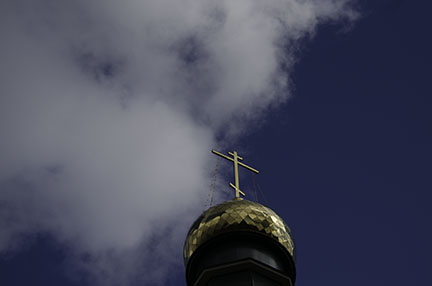
single onion dome 3 blog

This monastery is really beautiful, enclosed by a wooden rail fence where you enter through a gate and are handed a wrap around skirt and a scarf, if you do not have one. Women have to have their heads covered and must wear a skirt. It was a great fashion statement, red skirt with jeans sticking out below and a ski hat.
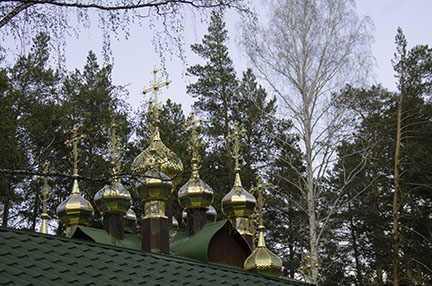
many onion domes blog

There are 7 Churches to represent the 7 family members, all made from large heavy logs stained dark brown with golden onion domes at the top. One of the churches is built in memory of the family and the others represent saints that had particular meaning for Nicholas. Both he and Alexandria were very religious.

                     Icon of the holy family and the church dedicated to them

The museum featured many pictures of the family, taken by Nicholas II who was interested in photography. Some of these we had seen at an exhibit in the U.S. It is striking to see them in their daily life and think how brutally they were killed. Nicholas II was a progressive monarch according to the information in the museum. Yes, reading in Russian is my expertise. I am very good at translating pictures. Pictures of the room they were murdered in and the house where they were imprisoned were displayed. Oleick very emphatically saying with almost every sentence “And I tell you….” He does tell us about how the murders came to be. In short, the Bolshivicks in Moscow knew the White Russian army (being support of the czar) were advancing on Ekaterinburg and ordered the Romanov’s to be moved to Moscow with the underlying implication that they should meet their demise before they got there.

So why are we at this monastery? I am a bit confused why they chose to build this complex of buildings here but trying to ask the question was not happening with Olerick’s commentary going non-stop. He really is a wealth of knowledge, but he has repeated himself quite a bit. Shap can see I am getting a bit impatient.

“Now I tell you,” as he would say. After they shot the Romanovs in the cellar of the house they were staying in…”Yes, they had to go down 23 steps to the cellar, 23 steps I tell you.”… the Bolisvicks did not know what to do with the bodies. One of the soldiers suggested a mine that he knew about not far away, so they took their trucks and loaded the bodies up and headed out to the mine. (in a Ford truck apparently). They threw in the bodies of the family and four of the other people living with them in the mine, along with the family dog.

The next day they decided that the mine was not deep enough so they came back and here is where the story divides between the scientist and the Church. The Church says they were taken out and burned on the spot where they have now built a Church. But years later all that they found in the mine was the dog, glasses and some false teeth. No traces of bone fragment that would be left over if they burned the bodies. However, the Church is insistent that this is the place. I would be too if I had built 7 Churches in that location.

The site of the mine and statues of the children of the Romanov’s

The inside of these log Churches are exquisite, built by intertwining stacking logs to form a hexagon upward to a bell tower. Inside are icons, gold leaf and candles; just a feast for your eyes in beautiful colors of reds, gold, blue, yellow with carved oak doors and carved icon frames. You do not have to be religious to be awed at the beauty and serenity of these churches. If you look at them purely as an art form and an architectural feat, it is enough to appreciate their existence.

Olerick is telling us something about a report made by the Bolisvicks to Moscow regarding taking the bodies in a truck away from the mine. By this time I am so confused about who is who and all these Russian names and his rushed way of talking that I am tuning out. All I can figure out is we are going on some old road and “he will show us.” Whatever… he has the car and he is insisting, fine with us.

We leave the monastery, and careen down the one lane highway as he swerves into the mud and then plays chicken with the on coming car. Who has the right of way on this one lane road? I think I figured out it was the car heading out of the area or at least that is what our car seems to be indicating. Meanwhile Olerick is shouting about old roads, railroad ties and notebooks while turning down a dirt pathway, waving at a “piglet meadow” which looked like a swamp to me. New real estate term for a swamp!!

Finally we pull up to a wooden archway and I can see down a path to a cross. It finally becomes clear to me as we walk down the path… here is where the Romanovs’ were found. The scientist won out. From the notebooks in Moscow that have been under lock and key with the KGB it describes an old road, a bridge, and trucks getting stuck in the mud near a bridge. The account indicates they buried the bodies right there and covered the area with wooden ties. They also burned two of the bodies and poured acid on the bodies they buried. Somehow the word got out to a select few and those in the know searched for year but in secrecy. Finally in 1978 a man and his student who spent all of their holidays tramping this area found the site. The notes indicated that they only buried them in a shallow grave. So when the student picked up a board he found a skull. This was kept a secret until the Soviet Union was dissolved and in 1991 they excavated the site to find 9 bodies, but not two of the children, Mary and Alexis. Apparently there was fear of reprisal from the KGB if the site of the bodies were revealed.

Finally in around 2005, figuring that the bodies were in the first car and judging the location of where the bodies were buried, it was assumed they burned them near the first truck and so they were able to find the site. There were fragments of bones. Although the other Romanov’s were buried in a family plot in St. Petersburg, the bones of the other two are still being held for analysis. And there is your story.


We rush back to Ekaterinburg to the site of the house where they were shot, which there stands, yes you are right, a church to commemorate the family. Going inside we were treated to a choir singing, and outside to a statue of the family including the “23 steps” they had to go down to the cellar. Boris Yeltson was responsible for bulldozing the house. Turns out ole Boris was from this region and was known as a “simple man who drank a lot.”
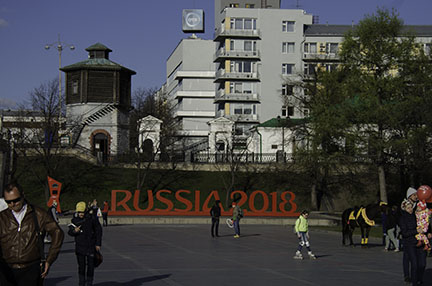
world soccer sign blog

World Cup Soccer sign

Olerick then gave us a tour of the city, including a wonderful park with a huge sign that says “Russia 2018.” The World Cup soccer is going to be held here next year. Standing in the park with a river running through it, we are freezing to death and Olerick is expounding on all the factory buildings that used to be here. I want back in the car I am so cold. He repeats the story of this factory area, having just told us previously. Please let me get back in that car.
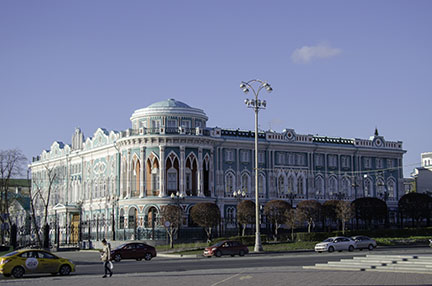
house built by gold 2 blog

Is this about the ugliest house you have ever seen? Built by a wealthy gold mine owner who could not decide what style architecture he wanted other than he stated “I want them all.” He got them!

Next we find ourselves in front of the military museum with an example of the tanks and the missile that shot Gary Powers down. Ekaterinburg is known for all of its minerals as it is in the Urals, and is the center of where all of the bullets, missiles, tanks etc. are made because they feel they will not be attacked here. These factories started producing during WW I. I am feeling a bit on edge looking at these tanks and being told they have just developed another larger one.

We are now in the middle of a political discussion about how great Putin is and how he does not want war but wants to be on equal footing with the other world powers. “After all, we have everything here, minerals, oil, gas, everything that everyone in the world needs. So why shouldn’t we be recognized as an equal partner?” And I guess my retort to that is why shouldn’t they? Having grown up with air raid practices in grade school and lived through the Russian/U.S. missile crisis in Cuba, I still have lingering reservations and find it hard to think of them as “good guys.” I can remember in 1965 going across through Checkpoint Charlie into East Russia and wondering if I would be taken. Who would have thought that I would willingly want to go to Russia in 2017.

As he points out, they are no longer communists, they have a different way of governing but not that different and they are a strong country. This discussion goes on (one sided) for the rest of our tour and into the hotel. My head is about to explode from the intensity of our guide’s deliverances. All I can say is, he is so Russian.

Even Shap had had enough of his constant diatribe. He was so emphatic and dogmatic; however, after getting some distance from him, I appreciate the knowledge he tried to give us of his city and the Romanov’s history and realize how hard it must be to impart this knowledge in such a short period of time. And if he is “so Russian” that is what we came to experience. And as he said in the end, “Let’s talk about peace.”


May 17th: Moscow

This time arriving at the train station, we were able to roll our suitcases along with no problem. Helen met us and off we went into Moscow traffic. Construction everywhere. There are 9 train stations in Moscow and 296 metro stations. We are promised a tour of the Metro stations.

street scene from hotel

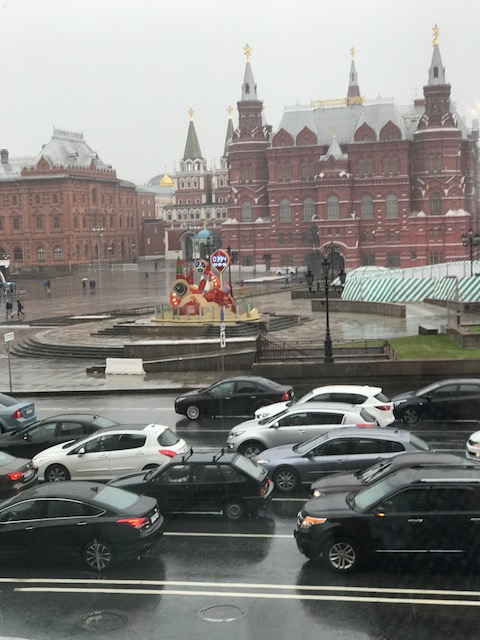
View from the dining room at the National Hotel

Our hotel, the National, is perfectly situated across a large park from the Kremlin. It is an old historic hotel, decorated inside, in what I consider “Russian” style, lots of red velvet with gold brocade chairs and sofas. There are huge dramatic paintings of peasants and scenery that are about one grade above velvet paintings, also heavy draperies everywhere. The bar is a pleasant room with lots of light where Shap has discovered the same women sitting there every night. He has determined that she is a “women of the night”, but he seems hesitant to approach her. Wonder why?

We take an evening stroll; it is amazing how clean these cities are. There is not a bit of trash to be seen anywhere, including the subways. It is disgusting when you compare our cities, especially New York to the Russian cities that we have seen. We have trash everywhere, people pissing in the subway; there is really no excuse for it. I don’t know what they are doing here but we could take a page out of the Russian’s book. I remember my “Austrian sister” (the family I lived with when on the Experiment of International Living) coming to the states and being appalled at all of the trash on the streets.

entrance near kremlin blog

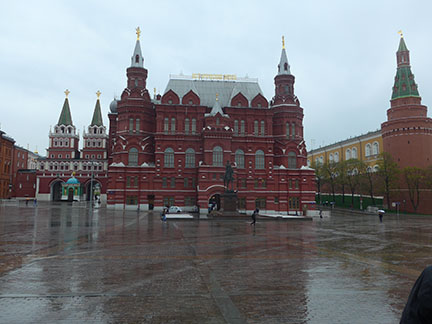
View across from our hotel

Although we were told that there was not much to see in Moscow and to spend more time in St. Petersburg, we were pleasantly surprised at how interesting it is. Besides the Kremlin, the architecture is from many different eras. The most interesting was during the Stalin period. He was very interested in style and his buildings have a hint of art deco. Most of the buildings have very straight columns with bas-reliefs of people or periods in Soviet history.

state buidling blog

State building in Lenin style and National Hotel behind it

There are seven skyscrapers though out the city, which we could see from the St. Catherine’s Church. These were built during the Stalin period and are referred to as the “seven sisters.” The style resembles the Empire State Building in some respects.

guide and shap

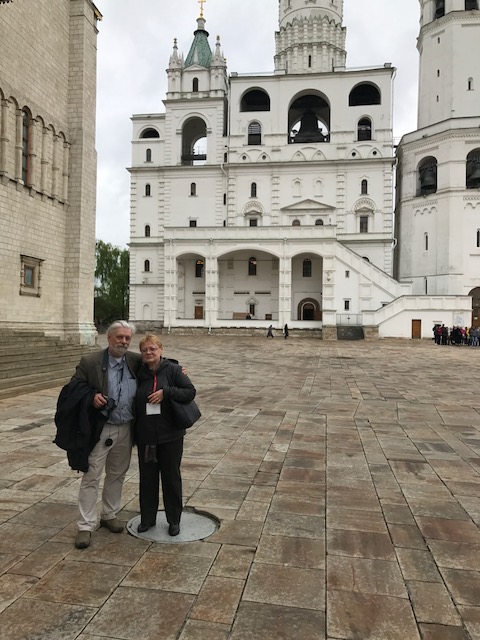
Shap and Helen inside the Kremlin

Our guide, Helen, grew up in Moscow during the time of the Soviet Union. She was telling us her grandparents were Russian Orthodox and she was baptized in secret. Everyone was afraid to mention religion. Many of the churches were destroyed, but the ones in the Kremlin were closed up. St. Basil’s, the one with colorful onion domes, was also closed. However, St. Catherine’s (where we could observe the city from the top) was destroyed. All of the icons were destroyed except a priest hid one. There was a video of the destruction; you just wondered how such beautiful churches could be destroyed. But look at what ISIS is doing. So history repeats itself.

                            Kremlin walls with buildings inside the walls

We were offered a look- see at Lenin’s body, for me, this was a must miss. Shap thought it would be great to look at a 90 year old dead body. That is how many years since he died!

                    Inside the Kremlin

The Kremlin wall and the inside of the Kremlin are quite impressive. Beautiful gardens, churches, buildings with a lot of open courtyards and guard towers. I had no expectations of how it would look, except that I thought Red Square was in the middle of the Kremlin walls. We were a bit disappointed that Putin did not come out to welcome us, but then neither did Trump when we were at the White House in April. Guess we just don’t have enough prestige. We did get to see the changing of the guards at the tomb of the Unknown Soldier. That makes it twice for us, one at Arlington cemetery and once at the Kremlin.

changing of guards

Changing of the guards

If you have not read “A Gentleman in Moscow,” I highly recommend it. It is a story of a man who is imprisoned in the Metropol Hotel in Moscow. Shap and I were curious to see it, so we walked down to the hotel, passing the Bolshoi Theater which is quite grand. I tried to get tickets to a ballet but there were none while we were here.

Bolshoi theater

The Metropol is a historic hotel, definitely unimpressive from the outside but quite impressive inside. It was fun to try to identify areas in the book.

Metropol Hotel and inside

We have seen a difference with our guides since we left Iskutuk. As we have gotten closer to Moscow, our guides have more of what I consider the Russian personality. I remember from our visiting teachers back in the 90’s when we did our Russian exchange program that there was a definite lack of interest in our culture, a lack of a sense of humor and a strict adherent to the schedule. I know that Helen had a bit of trouble understanding our questions and she definitely did not get Shap’s sense of humor, but we had to march to her timetable. She was not happy when I wanted to stop by our hotel to get some warmer clothes.

                      Inside the subway and view of my favorite station

After the Kremlin, and the view from St. Catherine’s Church, we did a tour of the subway. The subway stations are beautiful. Each one is different and designed by different architects. They also represent different periods, and different themes. Khrushchev came from Ukraine and one of the stations had mosaics depicting Ukrainian way of life. My favorite was a UNESCO landmark with an art deco look about it. Still I was amazed at the cleanliness of the stations, not a spec of dirt, litter or homeless people. Of course they probably send the homeless to a place far away from downtown Moscow.

                     Outside and inside of the GUM department store. Now it is a huge high end shopping mall, just like those in the States.

We are off on the high-speed train to St. Petersburg today. The train is crowded but comfortable and FAST. Wish we had trains like this in the U.S.

May 11 th: Irkutsk

belss and city blog

Irkutsk is basically in the center of Russia. It was an outpost in Siberia where mostly nomad people lived and took weeks to get to from Moscow by horse and carriage over horrible roads. At the end of the nineteenth century the merchants waited patiently hoping that the Trans-Siberian railroad would come through Irkutsk. By this time, the village had grown to a much larger town and it was becoming a center of trade. The decision of where the railroad would be built would determine the fate of Irkutsk. Alexander the II decided on Irkutsk despite the difficulties building through the mountains and close to the lake. Irkutsk became a booming city.

But this was later and we need to go back into the time of the Czar, Alexander I. A group of Russian aristocrats were in France fighting in the Napoleonic Wars with an army of Russian peasants. Russia was still in a state of serfdom and the aristocrats observed that the peasants from other countries, who were fighting, were free. These peasants would be going home to their own land, while the Russian peasants were expected to go back to their homes, with or without limbs, and work the soil for their lord.

Once they were back home these aristocrats formed a secret society. One was in Moscow and the other Kiev. They wrote a manifesto to present to the czar giving freedom to the peasants, freedom of speech etc. but circumstances prevented them from presenting this manifesto and they decided to stage a revolution. The czar got wind of this and defeated them.

This is a simple version of the history to explain how the Decembrists came to be. Some of the men were hanged or shot and others were sent to Siberia for twenty years of hard labor. Most of them were young and not married, but those that were had to leave their children and wives behind. They were not allowed to speak French (the language of the Russian aristocrats) and they were scattered in different areas in Siberia.

Some of the wives followed, some had to leave their children behind. If the wives followed they were not allowed to take very much money, no longer allowed to return, and their only contact to the outside world was through letters or the occasional visitor. These women were brought up to entertain, paint, etc, found themselves relying on the local peasants to help them establish a small hut and learn how to grow food in order to survive. They were allowed to visit their husbands twice a week.

Meanwhile, the Decembrists, using their education and individual strengths would gather at night in dark, after working in the mines and teach each other English, astrology or other sciences. There were doctors, geologist, artists, and linguist among them so they kept their minds sharp in this way. Children were born, some survived but none would ever be able to take the title that had been their birth right. They would be peasant children.

The Decembrist and their wives started schools in the villages and when they were finally allowed to leave, having served only 8 to 10 years, the village people were upset because they had never imagined that their children would have been able to be educated as they had been and this would no longer be available to them. Slowly the Decembrist were allowed to move into Irkutsk because of pressure from relatives in Moscow and sympathetic people. Their homes became gathering places for intellects. Irkutsk became a stopping point for many travellers such as Chekhov. He remarked that Irkutsk was the “Paris of Siberia.”

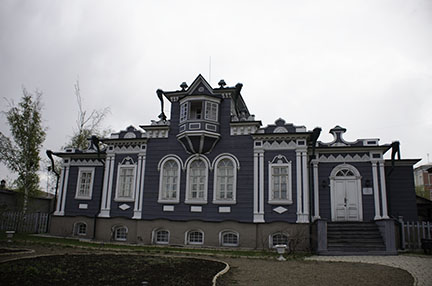
decemberist house blog

Irkutsk is a city of diverse architecture, from the Russian orthodox churches to the wooden homes painted in bright colors and elaborate shutters and window trim.

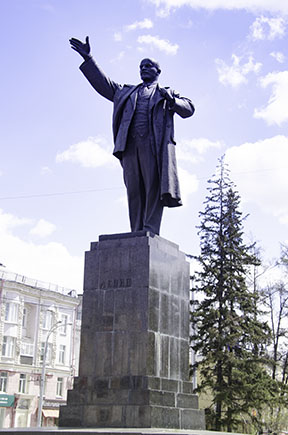
From large Russian style sculptures of Lenin, Alexander the Second, and the fierce tiger with an ermine in its mouth, the symbol of Irkutsk.

lenin blog

A river divides the city flowing north out of Lake Baikal eventually to the Atlantic Ocean. Our guesthouse was in the center of the city, built of logs inside and out. Charming and convenient, we were able to walk to many restaurants. This is not our guest house!!

Back to the train station with the realization that I would have to lug my suitcase down the same set of stairs that I had come up four days before and once again back to the platform. I figured there had to be a porter somewhere in the train station and our guide was able to locate one. Never have I been so happy to see this strapping young man carry both of our suitcases up and down the stairs like they were featherweights. Seriously, next long trip is going to be two pairs of pants and two shirts. Well maybe three so I can wash one. I would be fine if I did not have to have 6 different layers to stay warm. Yesterday I started with long underwear, warm ski pants, fleece, wool vest. Parka, raincoat, wool hat, mittens and a neck warmer and still could have used another layer.

shap monkey see blog

I think spring is coming, there are budding trees everywhere.

May 9th: On the Way to Irkutsk

pano on landscape blog small

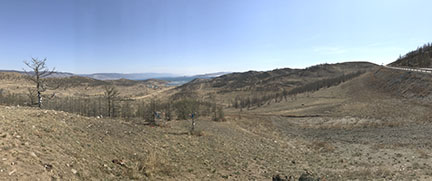
Leaving early this morning from Olkhon Island we feel like veterans of the area. We pass the lone birch tree where lovers from different economic status fell in love, forbidden to marry and did so anyway. This was the legend told to us; the parents of the son went to the Shaman and asked him why he married them and he said if I was right a birch tree will grow here and if I am wrong it won’t. A tree grew and at least these lovers did not get turned to stone, like every other fable we have heard.

prayer flags top of hill blog

Colored ribbons are tied to the tree for prayers, and in fact, they are tied to many posts and trees in sacred areas. Blue for the endless sky, white for purity, red for earth, and yellow for wealth and happiness. I thought these were prayer flags but was corrected as they are just ribbons. It seems all the same to me, everyone sending prayers in some form. I know it sounds like I am being cynical, but I truly believe that these cultures are more attuned to our world than other religions. It is a belief in the universe, the sky, the fields, the lake… these are their gods and they have a deep respect for the earth.

Although we knew the archeologists believe that people from Siberian and Mongolia migrated across the Bering Straits, we can see so many similarities in these cultures, there does not seem to be any question. Early houses are similar to the teepee and the nomadic way of life and physical features all add up to this conclusion. After all, Alaska did belong to Russia.

peggy and K blog on our way

It is “Victory Day” with grand parades in Moscow and the big cities. Everyone is off work. As we pass villages, we see small parades of school children with balloons and dressed in army clothes. The dress of the day has a military look with brown shirts, kaki pants, belt and a cap with a Soviet pin. Unlike our Veteran’s Day in November, this is the time that Moscow pulls out the military tanks etc. Our guide talks about what a terrible time it was for the Russians and how little food there was. She talks about how America, British, and French troops fought side by side in WW II with the Russians; how the Mongolians helped fight the Japanese at the Chinese border. It is so different to listen to the stories understanding now how surrounded Russia was by the enemies and how distant the U.S. was from the fear and the action.

Our guide says today there are people who are trying to defend going to war with the United States and how stupid these people are. We agree that war is not going to get any of us anything but heartaches. It is interesting to listen to attitudes that exist and not to comment or judge. We do however, stress how most Americans are like the Russians, they do not want war.

Enough about “Victory Day.” We roll into a town where we are told there it is a Buryak museum. We have a Buryat guide who speaks in Russian and Kristina translates. I cannot take my eyes off this women and want so badly to take a picture of her. Being a sculptor, I am trying to figure out her nose, which seems to come straight out of her face with no bridge connecting the upper forehead. Her cheeks are even with her nose and she has pert lips that also seems even with her nose. There seems to be no mussel, her face is so unusual. There was this space that was flat between the eyes. Oh, how I wish I had taken a picture of her, I think she would be so interesting to sculpt.

We got to see Wooly Mammoth bones, and teeth the size of a buffet dinner plate. The leg bone alone would be big enough to carve out a child’s cradle. Did you know that the Wooly Mammoth could grow back his teeth 4 times in his life? Apparently chomping on things, he wears them down. Let me tell you, these are awfully big teeth to be worn down. Now they have the DNA for him, having found some intact near this region. Will we clone Wooly Mammoths in the future? I hope not.

3 of us with shaman blog small

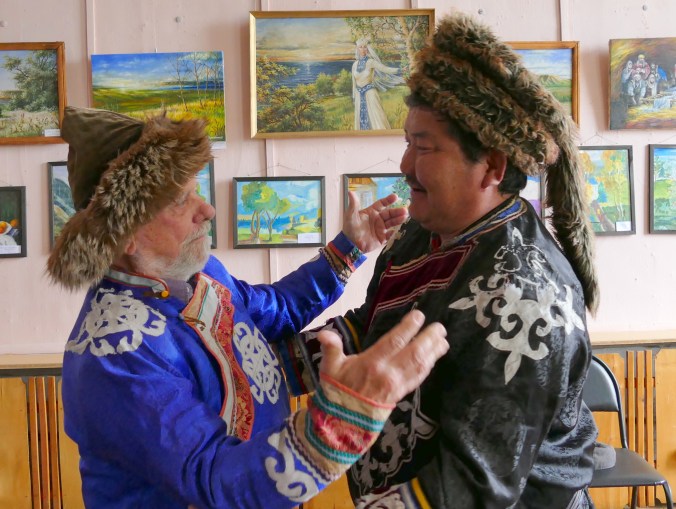
The highlight of the trip back to Irkutsk, was our visit with a Shaman after our tour. A large burly man with a long tunic and fur hat welcomed us and offered us a seat. He asked where we were from and we talked a bit of politics, and philosophy. Then he gave us instruction on how we should conduct ourselves to make sure that we eat the right things, sit correctly and stand so that the energy is not blocked. Guess I am going to have to practice not crossing my legs or arms. Prayers were said, some paper and herbs were burned, then we were dressed in traditional clothes, what is this obsession everyone has with dressing us up? Suddenly Shap finds himself in a huge bear hug by this Shaman who was twice his size. I am thinking, this guy better not be hugging me. Luckily, women do not get bear hugs. Walking clockwise around posts we chose a ribbon to tie on to them and give a wish. He asked for us to have a safe trip and for our family to be healthy. We left, the three of us, feeling a sense of peace and happiness.

shap and shaman blog

Shamans go back generations in families. It is difficult to become one and there are different levels of achievement. We asked if one of his children would be following him, and he said his middle son was the one that was interested and went to all the ceremonies with him. Apparently, women can also be Shaman. Amazing, someone thought we were smart back in the ages. Olkhon Island and the area around it, follow the traditional beliefs. I find it interesting that for the longest time religion was frowned on and now is accepted, with the Russian Orthodox Church gaining in popularity. Apparently, the church is railing against abortion with ardent supporters just like the U.S. It seems church and state cannot separate themselves.

shap love blog small

We arrived back in Irkutsk, staying at a charming inn in the middle of the city with a tour tomorrow of the Decembrist houses and more.